Seven years have passed since New Delhi tore up the constitutional arrangement that governed its relationship with Jammu and Kashmir, yet the wound has not closed. It has festered.
Every fifth of August, Kashmiris mark Youm-e-Istehsal, to mark the moment when the Indian parliament, acting through a presidential order rather than the consent of the Kashmiri people, abrogated Article 370 and stripped the region of the autonomy it had been promised since 1947.
The anniversary is a standing indictment of a decision that violated India’s own constitutional processes, defied binding United Nations resolutions, and inaugurated seven years of militarization, dispossession, and silence imposed on eight million people.
Article 370 was never a favour extended to Kashmir. It was the legal hinge on which the region’s accession to India rested, a temporary provision that reserved to the Jammu and Kashmir Constituent Assembly the authority to define the scope of the state’s integration with the Union.
When that assembly dissolved itself in 1957 without recommending the article’s repeal, most credible constitutional scholars in India and abroad concluded that the provision had effectively become permanent. The government of Prime Minister Narendra Modi disagreed, and in August 2019 it engineered a legal fiction: it used a governor’s rule, imposed after the collapse of the state government, to manufacture the very consent the constitution required.
A rubber-stamp administration accountable to Delhi, not to Kashmiris, “concurred” with its own erasure. Legal challenges to this manoeuvre have languished in India’s Supreme Court for years, and when a verdict finally came in December 2023, it upheld the abrogation on procedural grounds that many jurists found unconvincing, avoiding the deeper question of whether a subject people can lawfully be asked to consent to their own subjugation through a body they never elected.
Pakistan’s objection to the events of August 2019 rests on a body of international law that India has spent seven years trying to talk around.
United Nations Security Council Resolution 47 of 1948, along with subsequent resolutions, established that the final disposition of Jammu and Kashmir would be determined through a free and impartial plebiscite conducted under UN auspices.
No such plebiscite has ever taken place. By unilaterally altering the region’s constitutional status, dividing it into union territories, and opening its land to settlement by non-residents, India acted in defiance of resolutions it formally accepted as a state party at the time they were passed. A dispute that international law defines as unresolved cannot be resolved by the domestic legislation of one claimant party alone.
The principle of self-determination, enshrined in the UN Charter and in the International Covenant on Civil and Political Rights, further undercuts India’s position. Kashmiris were not consulted before their special status was dissolved. They were placed under curfew instead.
Article 1 of the ICCPR, to which India is a signatory, holds that all peoples have the right to freely determine their political status. Locking down a population and revoking its autonomy in the same breath is the precise inversion of that right.
There is also the matter of the Fourth Geneva Convention, which prohibits an occupying power from transferring its own population into occupied territory. The revocation of Article 370 removed protections that had barred non-residents from purchasing land and settling permanently in Kashmir.
Domicile certificates have since been issued by the hundreds of thousands to outsiders, a demographic engineering project that rights groups and independent observers have compared to settlement practices condemned elsewhere under international humanitarian law.
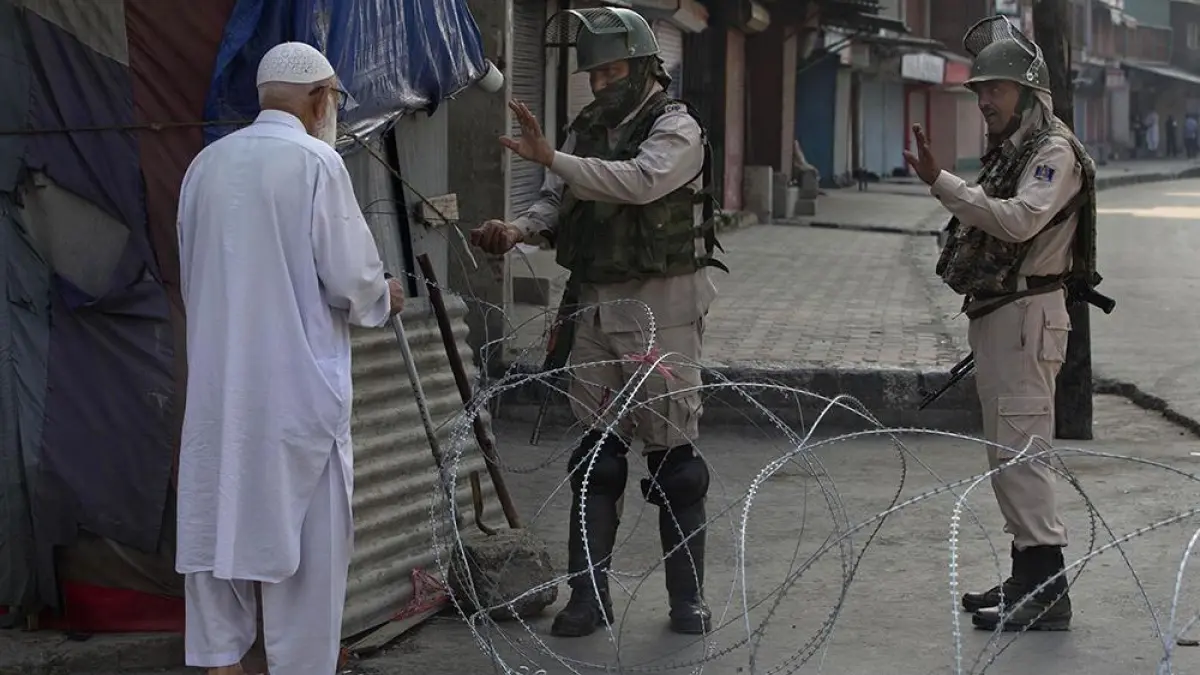
The abrogation was not a single act. It opened a sustained campaign of control that continues today. The initial communications blackout in August 2019, one of the longest internet shutdowns ever imposed by a democracy, cut nearly seven million people off from the outside world for months.
Thousands were detained without charge, including elected politicians who had themselves campaigned within India’s constitutional framework. The Public Safety Act, a law that permits detention without trial, has been used liberally against journalists, students, and civil society figures who question the official narrative.
Since then, the mechanisms of control have grown more sophisticated but no less severe. Land laws have been rewritten to ease acquisition by outside investors and security agencies. Domicile rules have been loosened. Media accreditation has been weaponised against independent reporters.
Delimitation exercises have reshaped electoral constituencies in ways that critics argue dilute Muslim-majority representation. When assembly elections were finally held in 2024, they took place in a territory still stripped of statehood, still governed substantially through a centrally appointed Lieutenant Governor, a hollow exercise in democratic theatre that changed little of substance on the ground.
Human rights organisations, including Amnesty International and Human Rights Watch, have documented enforced disappearances, custodial deaths, and the harassment of Kashmiri families abroad.
The United Nations Special Rapporteurs have repeatedly raised concerns about the human rights situation in the region, concerns that New Delhi has dismissed as interference in its internal affairs, even as it continues to invite selected foreign delegations on choreographed tours designed to project normalcy.
Pakistan marks this day not out of reflexive antagonism but because it remains a party to a dispute that the United Nations itself has never declared closed.
The observance is a refusal to let the world forget that a territory’s status cannot be settled by the fiat of one government, however large its parliamentary majority, when that territory’s future was promised to its own people and to an international process that has yet to run its course.
Seven years on, the facts on the ground have hardened, but the legal and moral questions have not gone away. A plebiscite promised in 1948 remains undelivered. A population’s consent, never sought in 2019, remains unaddressed.
And a region once defined by its constitutional distinctiveness now finds itself administered as a garrisoned territory, its politics suspended, its demography under quiet revision, and its future decided everywhere except in the one place international law says it should be decided: among the Kashmiri people themselves.
Until that reckoning comes, Youm-e-Istehsal will continue to be observed, not as an act of grievance for its own sake, but as an annual insistence that unresolved disputes do not disappear simply because one side stops discussing them.