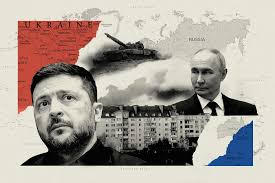
February 2022: Moscow launches full-scale offensive
On February 24, 2022, Russian President Vladimir Putin announced the commencement of what Moscow described as a special military operation in Ukraine, shortly after recognizing the separatist territories of Donetsk and Luhansk. Russian forces advanced along multiple axes, including toward Kyiv. By April 2022, troops had withdrawn from the capital’s outskirts, with the fighting increasingly concentrated in eastern and southern Ukraine.
The announcement triggered sweeping sanctions from Western governments targeting Russia’s financial institutions, energy exports, and strategic sectors. These measures reshaped global trade flows and intensified geopolitical polarization.
March 2022: Zaporizhzhia nuclear facility under Russian control
In early March, Russian forces assumed control of the Zaporizhzhia Nuclear Power Plant, Europe’s largest nuclear facility. Both Moscow and Kyiv have exchanged accusations over shelling near the site, raising global concerns about nuclear safety. The International Atomic Energy Agency continues to maintain a monitoring presence amid repeated power supply disruptions.
Early diplomatic initiatives
Shortly after the outbreak, Russia and Ukraine engaged in direct negotiations in Belarus and later in Türkiye, including meetings in Antalya and Istanbul facilitated by Recep Tayyip Erdogan. Reports indicated a draft framework emerged in March 2022, but talks eventually stalled as battlefield realities shifted and mutual mistrust intensified.
Major offensives and counteroffensives
Over the subsequent months, the war evolved into a series of territorial offensives and counteroffensives, with key battles in eastern Ukraine shaping the course of the conflict. Russia consolidated control over certain regions while Ukraine launched counterattacks to reclaim lost territory, resulting in a protracted stalemate that has drawn international attention.
Global economic and strategic impact
The conflict has had widespread economic repercussions, including disruptions in energy markets, food supply chains, and global trade. Western sanctions on Russia have influenced commodity prices and supply security, while countries worldwide have had to recalibrate defense and foreign policy strategies in response to the crisis.
Impact on South Asia
South Asia has felt significant ripple effects from the war. Energy price volatility strained import-dependent economies including Pakistan and India. Food supply disruptions, particularly in wheat and fertilizer, added pressure on regional food security. Strategically, countries in the region have pursued a delicate balance, maintaining longstanding ties with Moscow while strengthening relations with Western partners. The conflict has also influenced defense procurement and diplomatic alignments across the region.
Four years on: Looking ahead
Four years into the conflict, the Russia–Ukraine war remains a defining geopolitical crisis, reshaping security doctrines, economic partnerships, and strategic calculations far beyond Eastern Europe. Its long-term impact continues to influence global diplomacy, trade, and regional stability.