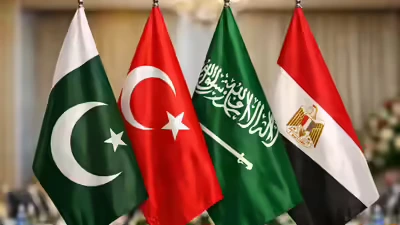
The contemporary global security landscape is undergoing a profound structural realignment defined by the retreat of traditional Western hegemony and the subsequent ascension of assertive regional middle powers. Central to this transformation is the nascent formation of a strategic quartet involving Turkey, Pakistan, Saudi Arabia, and Egypt. This architecture represents a significant departure from post-Cold War paradigms that relied almost exclusively on United States military guarantees. Instead, this emerging order seeks to establish a widening defense umbrella that integrates the nuclear deterrence and battle-tested manpower of Pakistan with the advanced defense industrial base of Turkey, the financial gravity of Saudi Arabia, and the geographic weight of Egypt. This quartet finds its most formal expression through the high-level deliberations of the 2026 Antalya Diplomacy Forum, signaling a transition toward regional ownership of security. The genesis of this architecture resides in the Strategic Mutual Defence Agreement between Pakistan and Saudi Arabia, which serves as a foundational model for the broader quadrilateral alignment. This pact marks the shift from decades of informal symbolic military cooperation toward a binding institutional framework that reconfigures the power dynamics of both the Gulf and South Asia. For Saudi Arabia, the arrangement provides a formalized partnership that reassures domestic audiences of the kingdom’s ability to deter rivals following perceived American unreliability. For Pakistan, the agreement offers a vital strategic lifeline, formalizing its footprint in the Middle East while securing the political backing of the most influential state in the Muslim world.
Institutional Architectures and the Doctrine of Collective Deterrence
The institutionalization of this alliance rests upon a fundamental re-engineering of military and constitutional structures, particularly within Pakistan. Under the leadership of Field Marshal Asim Munir, the state has positioned itself as a key security actor through the passage of the 27th Amendment, which codified military primacy and established the post of Chief of Defence Forces. This centralized command grants direct operational authority over the Army, Navy, and Air Force, facilitating the rapid deployment of forces and the integration of joint operations with regional partners. Parallel to this, the establishment of the Army Rocket Force Command provides a dedicated long-range conventional deep-strike capability intended to deter aggression beyond front lines. This technological integration is supported by a burgeoning defense industry that features advanced combat drones already being supplied to Gulf allies. The strategic intent is multifaceted, addressing acute security anxieties in an era of perceived external abandonment. The Strategic Mutual Defence Agreement introduces a nuclear shadow over the Middle East, as public statements suggest that Pakistan’s strategic assets could be made available to Riyadh if core interests are threatened. This potential extension of a nuclear umbrella effectively ends long-standing monopolies on regional nuclear capabilities and forces adversaries to reconsider the costs of escalation. By integrating strike systems into the defense frameworks of the region, the alliance enhances a collective deterrence posture that offers a conventional alternative to nuclear brinkmanship.
The Antalya Framework and the Geopolitical Security Development Nexus
While bilateral pacts provided the foundation, the Antalya Diplomacy Forum served as the primary venue for the institutionalization of the broader quadrilateral security architecture. Under the theme of managing uncertainties, the forum convened heads of state to solidify a platform for structured cooperation. This mechanism is distinct from immediate diplomatic efforts, focusing instead on building a long-term framework for regional autonomy. The doctrine of regional ownership posits that if the states of the Middle East and South Asia do not learn to solve their problems collectively, external hegemons will continue to impose solutions that serve foreign interests. The institutional design of this quartet is characterized by a division of diplomatic labor and a shared commitment to combining diverse strengths. Turkey brings a robust domestic defense industry and experience as a NATO member, while Egypt serves as a demographic and military pillar guarding the Suez Canal. This coalition of necessity is united by a common realization of the existential cost of protracted regional war, which threatens energy security for Riyadh and economic survival for Islamabad. The significance of this architecture lies in its ability to connect historically distinct but increasingly interdependent theaters. For Pakistan, this alignment provides strategic depth that extends beyond its traditional focus on the Indian subcontinent. By becoming a security guarantor for the primary energy providers of the Gulf, Pakistan secures its own regional standing and gains significant diplomatic leverage. Conversely, for the Gulf states, the inclusion of Pakistan provides a credible deterrent that traditional Western security umbrellas failed to maintain.
Global Power Recalibration and the Paradox of Strategic Autonomy
The emergence of this alliance is fundamentally a reaction to the receding security presence of the United States. The perception among regional allies that Washington is no longer a reliable partner has created a vacuum that local actors now seek to fill. While Turkey, Pakistan, Saudi Arabia, and Egypt maintain institutional relations with global powers, their participation in new initiatives is characterized by a strategic pivot. They engage with Western-led frameworks when it serves their interests while simultaneously building an independent security bloc that operates outside of external control. This dual-track approach allows the quartet to manage regional de-escalation while asserting their own influence over the terms of future settlements. However, the path toward a fully integrated architecture remains fraught with internal contradictions. The most significant hurdle involves divergent threat perceptions, particularly regarding the role of Iran. While some members seek to balance relations through mediation, others view certain regional rivals as existential threats. Furthermore, the ambiguity surrounding nuclear entanglement tests the credibility of global non-proliferation norms. Economic factors also present a challenge, as the role of certain members as the linchpin of the alliance depends heavily on financial lifelines from others. For the quartet to remain sustainable, it must move beyond transactional relationships and establish a genuine coalition based on shared long-term interests. Despite these hurdles, the formation of this architecture signifies a fundamental shift in the regional power balance, challenging long-standing dominances and introducing a new pole of power based on collective capability. The widening defense umbrella now has significant implications for maritime security and the protection of vital trade routes, proving that regional diplomatic leverage can translate into tangible security outcomes in a multipolar world.