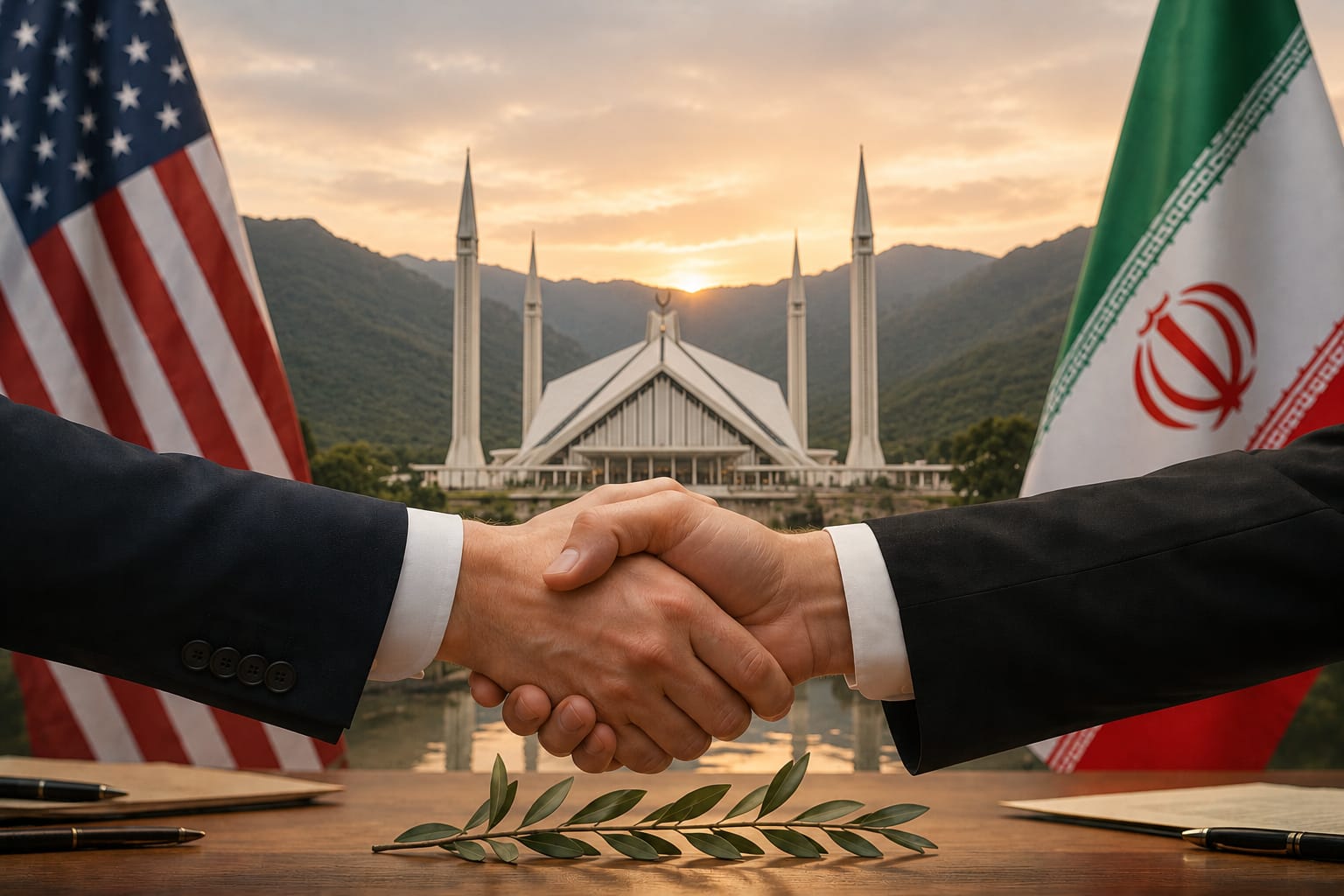
There are dates that nations carry in their collective memory, not because they were marked by celebration alone, but because they marked the moment a country proved something to itself and to the world. May 28, 1998, was one such date for Pakistan, and now the Islamabad Accord, as Senator Mushahid Hussain proudly stated.
After 107 days of war between the United States and Iran, a conflict that pushed oil prices past $100 a barrel, choked nearly a fifth of the world’s oil supply through the Strait of Hormuz, and threatened to drag the wider Middle East into catastrophe, the guns have fallen silent. And the announcement that ended it did not come from Washington. It did not come from Tehran. It came from Islamabad.
Iran’s embassy in Tunisia captured the irony of the moment in a post on X:
History can be ironic; Trump, in pursuit of a deal with the Islamic Republic of Iran, went to the doorstep of another ‘Islamic Republic’ — Islamic Republic of Pakistan.
Sharif’s Announcement Heard Around the World
Prime Minister Shehbaz Sharif announced on social media that following intensive talks, the peace deal between the United States and Iran had been reached, with both sides declaring the immediate and permanent termination of military operations on all fronts, including in Lebanon. He added that mediators would facilitate a series of meetings in the days following, laying the foundation for technical talks and an official signing ceremony.
It was Pakistan that broke the news to the world. Not as a footnote, not as a regional aside, as the central diplomatic fact of the day. Pakistan, the key mediator, said the formal signing would take place in Switzerland.
Within moments, President Donald Trump confirmed the breakthrough on Truth Social, declaring the deal with Iran “now complete” and calling it a “Great Deal” that would bring peace and security to the whole region, adding that, for the first time, the leaders of the region had found a president who could help them achieve real peace. Trump further stated that with the opening of the Strait upon the signing of the deal, oil would flow again for the region and the world.
On the Iranian side, the tone was measured but unmistakably one of relief. Iran’s Supreme National Security Council confirmed that military operations on all fronts, including Lebanon, would end immediately and permanently, and that the naval blockade imposed on Iran would be lifted in full, with negotiations on a broader settlement to begin only after both sides fulfilled their obligations under the memorandum. Tehran’s gratitude was directed specifically at the country that had carried the burden of this diplomacy from the very beginning. Iran’s Supreme National Security Council thanked Pakistan and Qatar for their efforts in facilitating the process.
A Title Earned, Not Given
Names matter in diplomacy. They are not accidents of geography. When the world’s most consequential ceasefire of the year carries Islamabad’s name, whether as the “Islamabad Memorandum,” the “Islamabad declaration,” or the “Islamabad Accord,” it is because the substance of the agreement was shaped, hosted, and carried across the finish line from Pakistani soil.
Pakistan positioned itself as the chief mediator between the US and Iran from the very start of the conflict in February, hosting the first round of talks in April and relaying messages between Washington and Tehran throughout the war. Pakistan maintained continuous diplomatic consultations with US leadership while working actively to create conditions conducive to negotiations, staying in contact not only with Washington and Tehran but also with European partners and key multilateral blocs, including the Organisation of Islamic Cooperation and the Gulf Cooperation Council.
This was not improvised diplomacy. This was sustained, deliberate, months-long engagement, exactly the kind of patient statecraft that rarely makes headlines until the moment it produces a result the entire world is waiting for.
The World Responds — And Names Pakistan
What followed Sharif’s announcement was perhaps the most striking part of this story: a wave of international recognition, specifically and repeatedly naming Pakistan’s role, from institutions and leaders not known for offering such credit lightly.
UN Secretary-General António Guterres congratulated both parties on the agreement, calling it a critical step towards the peaceful settlement of the conflict, and expressed appreciation for the role played by Pakistan, Qatar, and other Middle Eastern countries in supporting the talks.
The response from the wider Gulf was equally warm. Qatari Prime Minister Sheikh Mohammed bin Abdulrahman bin Jassim Al Thani, who mediated alongside Pakistan, praised the breakthrough and thanked Pakistan, urging positive and constructive negotiations ahead.
European capitals followed suit with their own statements of welcome. Leaders from the UK, France, Germany, and Italy welcomed the deal, calling for swift implementation, the urgent reopening of the Strait of Hormuz, and reaffirming support for Lebanon’s sovereignty and stability. European leaders went further still, pledging sanctions relief in exchange for verifiable nuclear commitments from Tehran, while US Vice President JD Vance acknowledged that peace in the Middle East would take time but hailed the agreement as a major step forward.
Even market reactions told their own story of relief. U.S. stock futures jumped on news of the deal, and Japan’s Nikkei surged 5 per cent, as the world’s markets responded to the prospect of the Strait of Hormuz reopening. Australia’s government noted that while full economic recovery would take time, reopening the Strait of Hormuz was essential to easing pressure on global energy markets.
From Washington to Brussels, from Doha to Canberra, the message was strikingly consistent: this would not have happened without Pakistan.
What the Accord Actually Contains
Beyond the symbolism lies substance, and the substance is significant. The agreement includes an end to military operations, the reopening of the Strait of Hormuz, the lifting of certain restrictions on Iran, and a 60-day negotiation process on issues including Iran’s nuclear programme and sanctions relief. The agreement reportedly includes a provision that Iran reaffirm its commitment to abstain from producing nuclear weapons.
The formal signing ceremony is scheduled for June 19 in Switzerland, with pre-implementation discussions this week laying the foundation for the technical talks to follow, discussions in which Sharif tagged President Trump, Vice President JD Vance, Iranian President Masoud Pezeshkian, and Foreign Minister Seyed Abbas Araghchi directly.
This is not a fragile verbal understanding hastily assembled for a press cycle. It is a structured, sequenced framework: ceasefire first, strait reopening second, nuclear and sanctions diplomacy to follow, precisely the architecture that serious, durable peace processes require.
Why This Is Pakistan’s Moment, Not Just a Pakistani Achievement
It would be easy to frame this purely as a diplomatic success story for Pakistan’s foreign office, a feather in the cap of Shehbaz Sharif’s government, a talking point for the next bilateral summit. But to frame it only this way would understate what actually happened.
For months, as missiles flew and the Strait of Hormuz sat effectively closed, the loudest voices in global commentary treated Pakistan as a secondary actor in its own region, a country whose relevance to great-power diplomacy was assumed to be limited to its immediate neighbourhood, if that. The assumption, often unspoken but widely held, was that wars between major powers get resolved by major powers, with smaller states as bystanders at best.
The Islamabad Accord shatters that assumption. A war that threatened to engulf the Middle East, disrupt a fifth of the world’s energy supply, and drag in Israel, Lebanon, and the broader Gulf was brought to its conclusion not in Washington, not in Brussels, not in any of the world’s traditional power centres, but through the sustained, patient, and ultimately decisive diplomacy of Islamabad.
This is what Senator Mushahid Hussain’s framing captures so precisely. May 28, 1998, was the moment Pakistan demonstrated it could not be dictated to on matters of its own security. The Islamabad Accord is the moment Pakistan demonstrated it could shape outcomes far beyond its own borders, that it has become, in the truest sense, indispensable to global peace.
A Word of Caution Amid the Celebration
Pakistan’s enthusiasm for this moment does not come without an acknowledgement of fragility. Earlier in the process, Israel and the US indicated that Pakistan’s agreement did not include Lebanon, with the US State Department mediating a separate track on that front. The deal’s nuclear and sanctions dimensions remain subject to 60 days of further negotiation — a window in which much could go right, or much could unravel.
The path to this point was not smooth; even as the deal neared completion, Israeli strikes in Lebanon threatened to derail the agreement, with Trump pressing Israeli Prime Minister Benjamin Netanyahu to stand down while a deal was near.
Peace processes of this magnitude are rarely linear, and the work of the next 60 days, the technical talks, the verification mechanisms, and the implementation of nuclear commitments will matter as much as the announcement itself. Pakistan’s role does not end with the signing in Switzerland. If anything, sustained mediation through implementation will be the truer test of whether the Islamabad Accord becomes a lasting peace or a ceasefire that requires renewal.
Two Dates, One Lesson
May 28, 1998, taught the world that Pakistan would not be coerced. June 2026 has taught the world that Pakistan can construct peace where others could not, patiently, persistently, and without the fanfare that usually accompanies great-power diplomacy.
Pakistan did not seek this war. It had no stake in the conflict between Washington and Tehran beyond the stake every nation has in a stable, functioning global economy and a region free from catastrophic escalation. And yet, when the moment came, Pakistan did not stand aside. It stood up, overtly, persistently, and ultimately successfully, as the only party willing to do the unglamorous, exhausting work that ending a 107-day war required.
The Strait of Hormuz will reopen. Oil will flow. Markets have already begun to breathe again. And when the history of this moment is written, it will carry a name that Pakistanis will recognise with pride for generations: the Islamabad Accord.
Two finest hours. One nation. Youth salutes Pakistan’s diplomacy and the quiet, determined statecraft that made the impossible look, in the end, almost inevitable.