Before a single missile is fired, before a single soldier crosses a border, wars are fought in the minds of the people who will eventually judge them. Who was the aggressor? Who are the victims? Whose cause is legitimate? In the Afghanistan-Pakistan confrontation of 2025-2026, one side has understood this reality with sophisticated clarity. The other has been largely reactive.
That side is the Taliban.
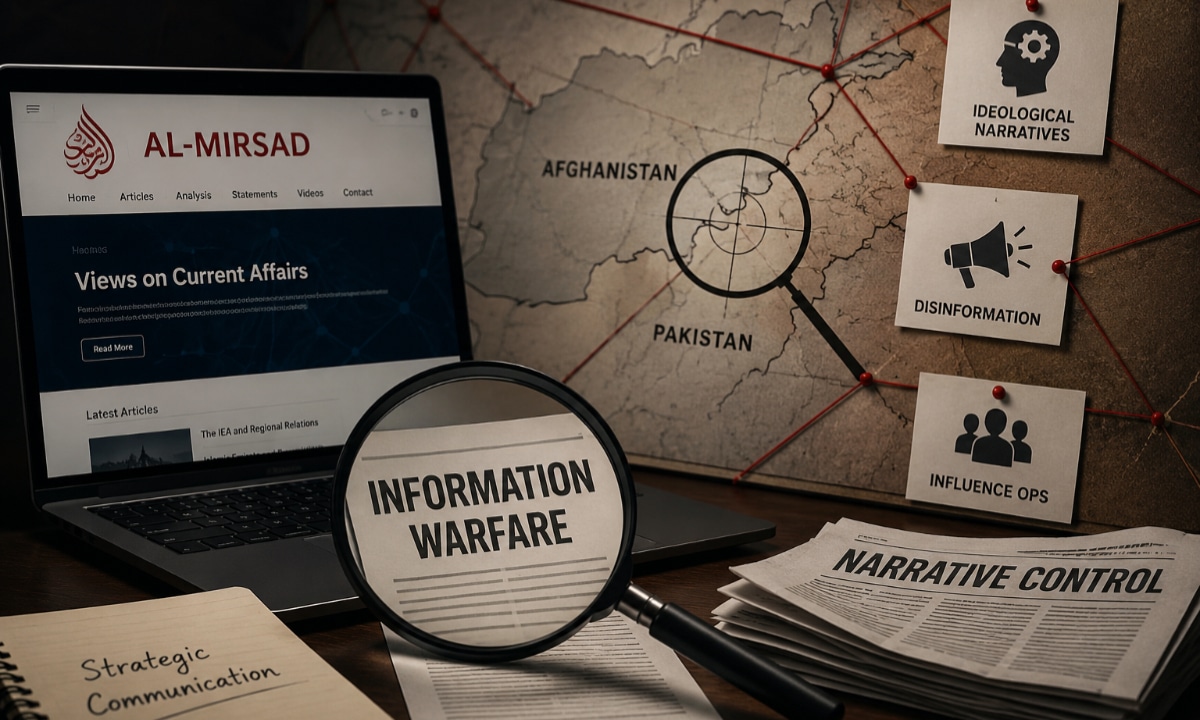
A newly published analysis of Al-Mirsad, the Islamic Emirate of Afghanistan’s English-language media outlet, by Joey Moran for the Durand Dispatch reveals something that every Pakistani policymaker, diplomat, and informed citizen needs to understand urgently: what looks like a news organisation is, in reality, a precision instrument of statecraft. And it has been operating, largely uncontested, in the international information space for over a year.
What Al-Mirsad Actually Is
The analysis, based on 137 English-language Al-Mirsad articles published between January 2025 and March 2026, identifies three interlocking strategic objectives that the outlet pursues with remarkable consistency.
First: delegitimise ISKP, not as a security threat, but as a theological heresy and foreign intelligence creation. Second: reposition Pakistan as Afghanistan’s principal external adversary, replacing the United States in that role. Third: project the Islamic Emirate of Afghanistan as a sovereign, diplomatically engaged, internationally legitimate Islamic state within an emerging multipolar world order.
These are not editorial positions. They are campaign objectives, executed through what the report calls institutionalised Strategic Communications, a level of sophistication that goes far beyond what the 1990s Taliban, with its near-total information blackout, was capable of or interested in. The current Taliban administration combines domestic media restriction inside Afghanistan with a carefully constructed, English-language international outreach apparatus aimed specifically at governments, analysts, and international audiences.
This is a Taliban that has learned, even if its ideology has not fundamentally changed, how to present itself selectively to the world that will ultimately decide whether it deserves recognition.
The Pakistan Narrative Being Built Without Pakistan’s Response
The most operationally significant finding in the report, from Pakistan’s perspective, is how Al-Mirsad has constructed the Afghanistan-Pakistan confrontation in international discourse.
Pakistan is portrayed simultaneously in three overlapping roles: as a sponsor of ISKP, as a failing state blaming Afghanistan to mask its own domestic dysfunction, and as a declining power whose coercive leverage over Afghanistan is exhausted. Pakistan’s Inter-Services Intelligence is framed as a proxy of Western intelligence, accused of training ISKP in Baluchistan. Pakistan’s strikes are framed as unlawful aggression against civilians. Pakistan’s economic difficulties, its IMF dependence, and its political instability are presented not as governance challenges but as evidence of a collapsing state whose external behaviour reflects internal desperation.
Critically, these narratives were already in place before Pakistan’s 2026 strikes. This was not a reactive information operation. The ideological terrain was prepared in advance, meaning that when Pakistan acted militarily, it stepped into a pre-constructed narrative framework that had already assigned it the role of aggressor and assigned the Taliban the role of sovereign defender.
That is not an accident. That is a strategy.
The handling of Fitna al-Khawarij, the TTP, reveals the same deliberate architecture. Despite being the central issue in Afghanistan-Pakistan tensions, the TTP appears in only four of 135 analysed articles. When avoidance becomes untenable, Al-Mirsad employs a three-move selective framing: recast TTP as Pakistan’s domestic problem, praise it as a legitimate political-military actor, and reclassify dead Afghan-based terrorists as “Waziristani refugee settlers.” The effect is to remove the TTP from the international conversation about cross-border terrorism almost entirely, a silence that serves Taliban interests more effectively than any direct defence of the group could.
The Legitimacy Campaign and Its Contradictions
Al-Mirsad simultaneously pursues a legitimacy campaign for the Islamic Emirate, amplifying every instance of de-facto international recognition, Russia’s diplomatic engagement, China’s economic relationship, India’s reopening of channels (leveraged explicitly against Pakistan), while systematically omitting the constraints that block formal acceptance: gender apartheid, ICC arrest warrants, links with Al-Qaeda, the absence of inclusive governance, and the continued restriction of half the Afghan population from education and public life.
The report identifies a core contradiction that Al-Mirsad manages with sophistication rather than resolves: the Islamic Emirate ideologically rejects democracy while simultaneously seeking legitimacy from the democratic international system. It claims sovereign self-defence against Pakistan while invoking pan-Islamic solidarity elsewhere. It labels ISKP as foreign-intelligence-created Khawarij while pursuing recognition from the same Western governments it accuses of creating ISKP.
The sophistication, the report notes, lies precisely in managing these tensions rather than resolving them, deploying different arguments to different audiences through selective publication architecture and audience segmentation. This is not ideological consistency. It is strategic communication at a level that most state actors struggle to match, let alone a non-state administration governing a country under international sanctions.
Why Pakistan Is Losing This Battle
PAYF does not say this lightly, because the implications are serious: Pakistan is currently losing the information dimension of the Afghanistan confrontation, not because its position is weaker, but because its strategic communications are fragmented, reactive, and institutionally uncoordinated.
When Al-Mirsad framed Pakistan’s October 2025 and February 2026 strikes as unlawful aggression targeting civilians, language that was subsequently echoed in international media coverage of strikes on what Pakistan maintains were militant hideouts, Pakistan’s counter-narrative arrived late, spoke in bureaucratic language, and failed to reach the international audiences that Al-Mirsad’s English-language operation specifically targets.
When Al-Mirsad spent months pre-positioning the narrative that Pakistan sponsors ISKP through ISI-Baluchistan networks, Pakistan’s response was neither consistent nor internationally amplified. The accusation reached governments and analysts in the language they read. The rebuttal reached domestic audiences in languages they already agreed with.
This asymmetry matters. The report’s most urgent finding is that future crises will increasingly be shaped by which actor succeeds in defining legitimacy, victimhood, sovereignty, and counterterrorism narratives before international audiences, before the crisis happens, not after. In that race, Pakistan is currently running behind.
The Narrative War Has Already Begun
The Taliban has built a sophisticated, institutionalised, English-language strategic communications apparatus. It has pre-positioned narratives that frame Pakistan as an aggressor, a sponsor of terrorism, and a failing state. It has done so deliberately, consistently, and largely without serious contestation in the international information space.
Pakistan has a stronger factual case on TTP sanctuaries, on cross-border attacks, on the documented human cost of terrorism launched from Afghan soil. But facts, unpackaged and undelivered, do not win information wars. Stories do. Consistency does. Institutional coordination does.
The war before the war is already underway. Pakistan needs to show up for it, not reactively, not fragmentarily, but with the sustained strategic seriousness that the Taliban’s own STRATCOM operation has already demonstrated is possible.
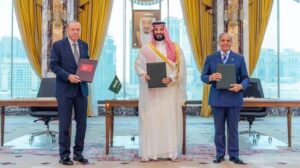
The Islamabad Accord showed the world that Pakistan can exercise statecraft at the highest level. Countering Al-Mirsad requires the same quality of sustained, strategic intent, applied not to a negotiating table, but to the information environment where Pakistan’s reputation, its narrative, and ultimately its security are being contested every day.