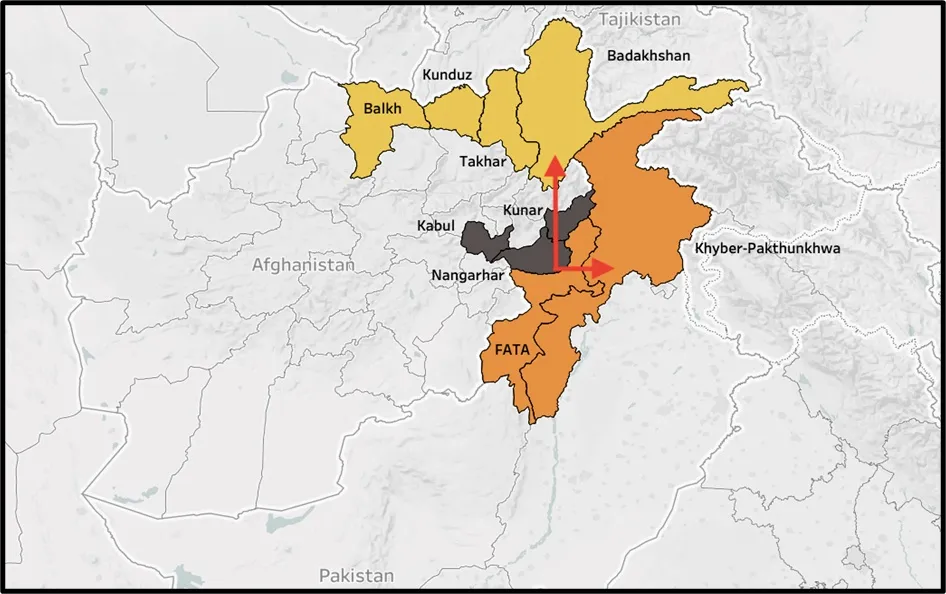
The Taliban’s Ministry of Defence has claimed that its air force carried out overnight strikes against multiple positions in Pakistan’s Balochistan and Khyber Pakhtunkhwa provinces, claiming the targeted locations were being used, allegedly with the support of certain intelligence networks, to plan and coordinate attacks against Afghanistan. Pro-Taliban sources described the Balochistan strikes as targeting pro-government militia centres. The Ministry of Defence, by contrast, stated that all targets were linked to ISKP. Pakistan has not responded yet.
Let us sit with that contradiction for a moment, because it is not a minor inconsistency. It is the structural dishonesty at the heart of the Taliban’s entire regional posture.
The Taliban regime is simultaneously claiming that ISKP is a foreign intelligence creation operating from Pakistani soil, and that its own Afghan territory is clean, controlled, and free of the terrorist networks that its neighbours have been documenting for years. Both of these claims cannot be true. And the evidence, from the United Nations, from international intelligence assessments, from the attack records of Central Asian states, and from Pakistan’s own documented counterterrorism operations, makes clear which claim is fiction.
Pakistan’s Record Against ISKP: What the Taliban Won’t Acknowledge
Before examining what the Taliban’s air force really struck and why it claims to have done so, the international community deserves to know what Pakistan has actually been doing about ISKP, because the Taliban’s narrative depends entirely on portraying Pakistan as a sponsor of the group rather than one of its most active opponents.
In 2025, Pakistan assisted the United States in nabbing the Abbey Gate attack’s mastermind, Muhammad Sharifullah. Concurrently, a major network of ISKP involved in external operations was busted in Balochistan by Pakistani security institutions. The arrest of ISKP’s chief propagandist and spokesperson, Sultan Aziz Azzam, and the disruption of its two key communication nodes, the Il’aam Foundation and al-Raud, by Europol significantly slowed ISKP’s propaganda operations.
Pakistan’s security forces have conducted relentless intelligence-based operations against militant networks across Khyber Pakhtunkhwa, operations documented in consistent ISPR releases throughout 2025, neutralising militants in North Waziristan, South Waziristan, Mohmand, Karak, Lakki Marwat, and Tank districts in operations conducted week after week, month after month. Pakistan’s own annual security assessment for 2025 recorded that the year turned out to be the deadliest for militant groups in a decade, with militant fatalities surging over 120 per cent compared to 2024.
This is not the counterterrorism record of a state sponsoring ISKP. This is the record of a state fighting ISKP at considerable cost to its own soldiers, citizens, and resources. At the same time, the regime across the border provides the territorial sanctuary from which ISKP continues to plan, recruit, and operate.
Where ISKP Actually Prospers: The Afghan Soil the Taliban Controls
The Taliban’s strikes on Pakistani territory, framed as counterterrorism operations against ISKP, require the world to overlook a documented, multi-year pattern of ISKP operating from bases inside Afghanistan, not Pakistan.
Since 2022, ISKP has carried out rocket attacks on Uzbekistan and Tajikistan from its bases in northern Afghanistan, the first time the jihadist group targeted countries in Central Asia, signalling its expanding geographic presence inside Afghan territory and its growing regional ambitions. ISKP has launched cross-border rocket attacks against Uzbekistan and Tajikistan, attacked the Russian and Pakistani embassies in Kabul, and assaulted a Kabul hotel frequented by Chinese nationals, all from Afghan soil.
In November 2025, five Chinese nationals involved in mining operations were killed and another five injured in Tajikistan in drone attacks launched from Afghanistan. Only a year earlier, in November 2024, another Chinese citizen was killed and five others wounded in an attack from Afghanistan on Chinese engineers working at a gold mine along the Tajik-Afghan border. These are not Pakistani operations. These are ISKP operations launched from the territory the Taliban claims to control.
A UN Security Council report found the Taliban’s claim that militant groups are not using Afghan territory for cross-border attacks to be “not credible,” asserting that neighbouring states increasingly see Afghanistan as a source of regional insecurity. According to the report, in addition to ISKP, the TTP, Al-Qaeda, Turkistan Islamic Party, Jamaat Ansarullah, and Ittihadul Mujahideen Pakistan are all operating in Afghanistan.
The question the Taliban’s Ministry of Defence cannot answer is this: if ISKP’s operational infrastructure is entirely in Pakistan, as the strikes imply, why has ISKP been launching attacks from northern Afghanistan into Uzbekistan and Tajikistan for years? Why did ISKP bomb the Russian and Pakistani embassies in Kabul? Why did ISKP kill Chinese engineers on the Afghan-Tajik border territory? The geography of ISKP’s attacks tells its own story, one that points inward into Afghanistan, not across the border.
The attacks on Uzbekistan and Tajikistan exposed the Taliban’s most fundamental vulnerability: the regime does not have total control over Afghan territory, and particularly control over northern Afghanistan is genuinely contested. ISKP does not need Pakistan to give it space. It has space, in the power vacuums the Taliban’s governance failures have created across a country it controls with a meagre and overstretched force.
The Narrative Behind the Strikes
PAYF has previously drawn attention to Al-Mirsad, the Taliban’s sophisticated English-language strategic communications apparatus, and its documented practice of pre-positioning narratives before military and political escalations. The overnight strikes on Pakistani territory fit this pattern with uncomfortable precision.
By framing strikes on Pakistani soil as counterterrorism operations against ISKP, the Taliban achieves several simultaneous objectives. It reinforces its existing narrative that ISKP is a Pakistani intelligence project. It reframes its own military aggression against a sovereign neighbour as defensive counterterrorism. It positions itself internationally as a responsible actor fighting the same extremist group that the rest of the world is concerned about, while simultaneously providing sanctuary to the TTP, Al-Qaeda, and multiple other networks that its neighbours have been asking it to dismantle for years.
This is not counterterrorism. This is information warfare with air assets attached.
Pakistan rejects the characterisation of its territory as an ISKP operational base, and the documented record of Pakistan’s counterterrorism operations against ISKP, its cooperation with international partners on ISKP networks, and the consistent evidence of ISKP’s Afghan-based operations give that rejection considerable weight.
The Afghan Youth the Taliban Has Forgotten
There is a dimension to this story that receives insufficient attention in the security-focused coverage of Taliban strikes and regional tensions: what the Taliban’s governance failure and international isolation are doing to the young people of Afghanistan.
The same regime that is now flying air missions over Pakistani territory cannot feed its own population. According to UN figures, 95 per cent of Afghans face food insecurity. An estimated 3.5 million children are malnourished. Girls have been banned from education beyond primary school, an entire generation of Afghan women locked out of their own futures by an ideology that the Taliban’s Ministry of Defence is now, apparently, projecting outward through military strikes rather than directing inward toward governance.
Afghan youth, male and female alike, are the principal victims of the Taliban’s stubborn ideological rigidity. ISKP’s current strategy specifically targets Tajikistan and Central Asian states, recruiting impoverished young people who have been failed by their governments, exploiting the grievances of those marginalised by authoritarian rule and economic exclusion. The same dynamic operates inside Afghanistan, where Taliban governance has created exactly the conditions of despair, exclusion, and ideological vacuum that ISKP exploits for recruitment.
The Taliban is not defeating ISKP by striking Pakistani territory. It is not defeating ISKP by denying its presence on Afghan soil. It is not defeating ISKP through information operations that blame Pakistan for a group that grew out of, and continues to operate within, the ecosystem of Afghan-based militancy. The Taliban is, in fact, creating the conditions in which ISKP thrives by failing to govern, by failing to educate, by failing to provide economic opportunity, and by refusing the international engagement that might bring the resources Afghanistan’s devastated population desperately needs.
The Afghan youth who should be in classrooms, in universities, in workplaces, building a future, are the real casualties of the Taliban’s ideological stubbornness. And no number of overnight strikes on Pakistani soil changes that fundamental reality.
Public Diplomacy and the Battle Pakistan Must Win
Pakistan’s response to Taliban strikes on its territory cannot be purely military. It must be simultaneously diplomatic, legal, and communicative, because the Taliban’s information architecture is already framing this escalation in international discourse, and Pakistan must contest that framing with the same persistence and sophistication that the threat demands.
Pakistan must bring documented evidence of ISKP’s Afghan-based operations, the UN Security Council reports, the attack records against Uzbekistan, Tajikistan, and China, the embassy bombings in Kabul, and the recruitment networks operating from Afghan territory, to every multilateral forum available. The international community should be reminded, consistently and with evidence, that the source of ISKP’s regional reach is Afghanistan, not Pakistan.
Pakistan should also pursue deeper security cooperation with Central Asian states, Tajikistan and Uzbekistan in particular, which share Pakistan’s experience of cross-border ISKP attacks launched from Afghan soil. At a December 2025 meeting in Tehran, Pakistan was the most vocal in pressing the Taliban to address terrorist sanctuaries. That regional coalition of states directly harmed by ISKP’s Afghan-based operations is Pakistan’s most credible international platform for contesting the Taliban’s narrative.
And Pakistan must continue to invest in public diplomacy that distinguishes, clearly and consistently, between the Afghan people and the Taliban regime, between a population that deserves support, solidarity, and opportunity, and a government that has chosen ideology over governance and is now projecting the consequences of that choice outward, onto its neighbours, through military strikes it calls counterterrorism.
The Sanctuary Cannot Be Denied Forever
The Taliban’s Ministry of Defence has confirmed strikes on Pakistani territory. Pakistan rejects the justification. The international community has a documented, multi-year evidentiary record on which side of the Durand Line ISKP’s operational infrastructure actually sits.
The UN Security Council has found the Taliban’s denial of militant presence on Afghan soil to be “not credible.” Neighbouring states increasingly see Afghanistan as a source of regional insecurity. ISKP has struck Uzbekistan, Tajikistan, China, Russia, Iran, and Pakistan from Afghan territory. The Taliban has provided sanctuary to TTP, Al-Qaeda, and multiple other networks while claiming its soil is clean.
A regime that cannot feed its people, cannot educate its girls, cannot govern its territory, and cannot prevent ISKP from launching attacks on its neighbours from its own soil, that regime does not have the credibility to frame overnight strikes on Pakistani territory as responsible counterterrorism.
The sanctuary cannot be denied forever. The evidence is too consistent, too international, and too documented. Pakistan’s task now is to ensure that the world reads that evidence and holds the right party accountable.