There is a particular kind of audacity that belongs exclusively to those who engineer disasters and then critique the survivors for not managing the wreckage well enough. Zalmay Khalilzad, former US Special Representative for Afghanistan Reconciliation, principal architect of the Doha Agreement, the man who handed Afghanistan back to Taliban rule and called it diplomacy, has questioned Pakistan’s assertion that engagement with the Taliban has failed.
Pakistan has a simple response: look at the record. Both his and ours.
What Khalilzad Built — And What It Became
Before Khalilzad questions Pakistan’s diplomatic efforts, the world should be reminded of what his own diplomacy produced. The Doha Agreement, negotiated and signed under his stewardship, required the Taliban to prevent Afghan territory from being used by terrorist groups as a condition of the United States’ withdrawal. That was the commitment. That was the deal.
One year after the Taliban’s takeover, Ayman al-Zawahiri, the global head of Al-Qaeda, the man who co-planned the September 11 attacks, was found and killed in a safe house in Kabul. Not in a cave. Not in a remote border region. In Kabul. In the capital city of the regime that had signed the Doha Agreement and committed to denying sanctuary to terrorist organisations.
That single fact is the verdict on Khalilzad’s diplomacy. It requires no elaboration.
Afghanistan today hosts more than 20 terrorist organisations, including Al-Qaeda, TTP, and ISKP, with up to 13,000 foreign terrorist fighters operating from its soil, according to the 16th UN Security Council Monitoring Team Report. The 37th UN Monitoring Team Report further documented increased cross-border attacks originating from Afghan territory and assessed that TTP had been accorded greater operational freedom under Taliban rule. No UN member state accepted the Taliban’s claims that terrorist groups no longer operate there. Not one.
This is the Afghanistan that the Doha Accord built. And Khalilzad is lecturing Pakistan about diplomacy.
Pakistan’s Actual Diplomatic Record: The Numbers Khalilzad Ignores
Let the documented record speak, because Khalilzad’s assertion that Pakistan has not genuinely pursued diplomacy is not merely incorrect. It is a deliberate misrepresentation of four years of sustained, exhaustive, and ultimately unrequited engagement.
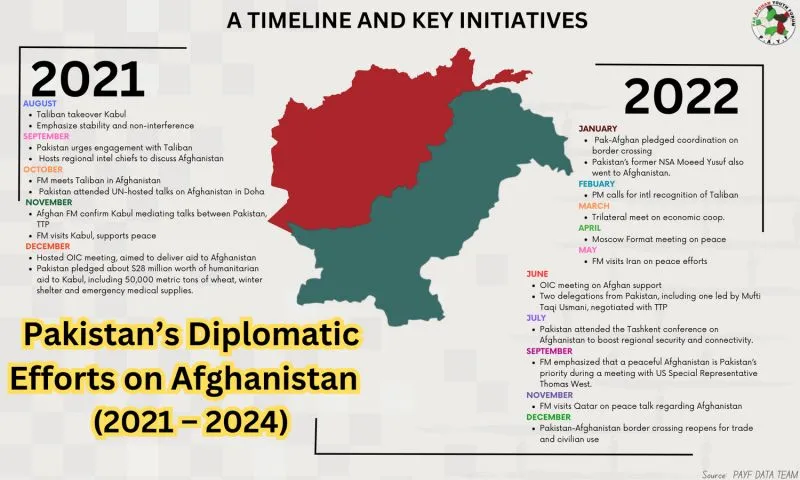
Since the Taliban takeover in August 2021, Pakistan has conducted 4 Foreign Minister visits to Kabul, 2 Defence Minister visits, 5 Special Representative visits, 5 Secretary-level meetings, 1 National Security Adviser visit, and 8 Joint Coordination Committee sessions. Pakistan’s border management apparatus has held 225 border flag meetings. Pakistan’s diplomatic missions have delivered 836 formal protest notes and 13 official demarches documenting specific incidents, specific locations, and specific demands.
Pakistan repeatedly identified more than five dozen TTP camps operating inside Afghanistan and consistently demanded their dismantlement through diplomatic channels. Its core demands were neither aggressive nor unreasonable; they were the minimum that international law and the Doha Agreement itself required: deny sanctuary to terrorists, dismantle terrorist infrastructure, arrest and hand over wanted individuals, and prevent Afghan soil from being used against neighbouring states.
Is any of that legally or morally incorrect? Is any of that an unreasonable demand to make of a government that signed an international agreement committing to exactly these obligations?
The Taliban’s response, across four years of this engagement, was consistent: denial, delay, and the continued expansion of TTP infrastructure on Afghan territory.
The Human Cost of Taliban Non-Compliance
These are not abstract diplomatic failures. They have names and addresses.
More than 300 Afghan nationals, identified with names and full addresses, have been killed inside Pakistan while fighting Pakistani security forces. Numerous high-profile attacks, including incidents in Peshawar, Bannu, Besham, Dera Ismail Khan, and North Waziristan, were linked to Afghan nationals or to operational networks based inside Afghanistan.
During an intelligence-based operation in Dera Ismail Khan, forensic examination identified one of the dead as Badaruddin, also known as Yousaf, the biological son of the Deputy Governor of Badghis Province, Afghanistan. A serving provincial official’s son, fighting Pakistani security forces on Pakistani soil. Evidence confirmed that all five terrorists involved in the Cadet College Wana attack were Afghan nationals operating under direct TTP command. Four of the suicide attackers neutralised during the Bannu FC Headquarters operation were Afghan nationals.
This is not a border management problem. This is an organised operational pipeline, linking Afghanistan-based recruitment, training, financing, and cross-border deployment, that has been running continuously despite four years of Pakistani diplomatic engagement and despite every international commitment the Taliban made at Doha.
SIGAR assessments have similarly cited the presence of 6,000 to 6,500 TTP fighters alongside senior Al-Qaeda leadership inside Afghanistan. Russia, China, Denmark, the SCO, the CSTO, and successive UNSC deliberations have all expressed concern about terrorist safe havens and cross-border threats emanating from Afghan territory. This is not Pakistan’s complaint alone. It is the international community’s documented assessment.
The Pattern Khalilzad Has Consistently Followed
Khalilzad’s intervention is not surprising to those who have tracked his public positioning since 2021. He has consistently sought to build the Taliban regime’s international credibility while deflecting scrutiny from its counterterrorism failures and from the failures of the agreement he personally negotiated.
His silence on Taliban non-compliance with Doha’s counterterrorism provisions is as consistent as his criticism of Pakistan. He remained largely silent when Zawahiri was found in Kabul. He remains largely silent on the 16th and 37th UN Monitoring Team reports documenting the Taliban’s accommodation of terrorist networks. He remains largely silent on the cross-border attacks that have killed hundreds of Pakistani soldiers and civilians.
But he is not silent when Pakistan, having exhausted every diplomatic mechanism available to it, takes action to defend its own citizens.
It should be noted, as history demands, that from 2018 to 2021, Khalilzad was a frequent and urgent visitor to Islamabad. He needed Pakistan’s influence over the Taliban to bring them to the negotiating table. He needed Pakistan’s cooperation to make the Doha process function. Pakistan provided that cooperation. The feather of the Doha Agreement went in Khalilzad’s cap. The consequences of what that agreement produced were left for Pakistan to absorb, in blood, in bombed checkpoints, in children killed in school attacks, in soldiers martyred at border posts.
For Khalilzad to now question Pakistan’s commitment to diplomacy is not merely hypocritical. It is a revision of history that the documented record does not permit.
The Principal Challenge Has Never Been Absence of Dialogue
Pakistan’s engagement record makes one thing unambiguously clear: the principal challenge in the Afghanistan-Pakistan relationship has never been the absence of Pakistani diplomatic effort. It has been the absence of sustained, verifiable Taliban action against terrorist infrastructure operating from Afghan territory.
Pakistan came to the table. It came repeatedly. It came with specific evidence, camp locations, named individuals, documented attacks, and forensic identifications. It came with reasonable, internationally grounded demands. It came 225 times to border flag meetings and 836 times through formal protest notes.
What it did not receive over four years of this engagement was a Taliban interlocutor willing to match dialogue with action. TTP continues to operate with systemic freedom inside Afghanistan, openly recruiting fighters through public spaces, mosques, and vulnerable refugee communities. Recent attacks, including the Hassan Khel Post attack of June 8, 2026, and the Bannu police attacks of April and May 2026, confirm that cross-border militant activity has not diminished. It has continued, and in some periods intensified, throughout the entire span of Pakistan’s diplomatic engagement.
This is the record. Not the record of a country that failed to try diplomacy. The record of a country that tried everything diplomacy offers, and found, on the other side of the table, a regime more committed to protecting terrorist networks than to the relationship with its most important neighbour.
The Architect Should Reflect on His Blueprint
Zalmay Khalilzad negotiated the agreement that was supposed to prevent this. He secured Taliban commitments on counterterrorism that the Taliban has systematically violated. He designed the framework within which Zawahiri was sheltered in Kabul, within which TTP expanded its infrastructure, within which 20 terrorist organisations now operate with documented freedom from Afghan soil.
Pakistan did not design that framework. Pakistan tried to work within it, through every diplomatic mechanism available, for four years.
Khalilzad is entitled to his views on Pakistani policy. He is not entitled to a version of history that erases his own role in creating the conditions he now criticises others for failing to resolve.
PAYF’s message is straightforward: the documented record of Pakistan’s diplomatic engagement is available, verifiable, and damning in what it reveals, not about Pakistan’s commitment to dialogue, but about the Taliban’s commitment to the obligations it undertook in the agreement Khalilzad spent three years negotiating.
Read the record, Mr Khalilzad. All of it.
Explore More: Why Russia’s Remarks on TTP and ISIS-K Matter for Pakistan