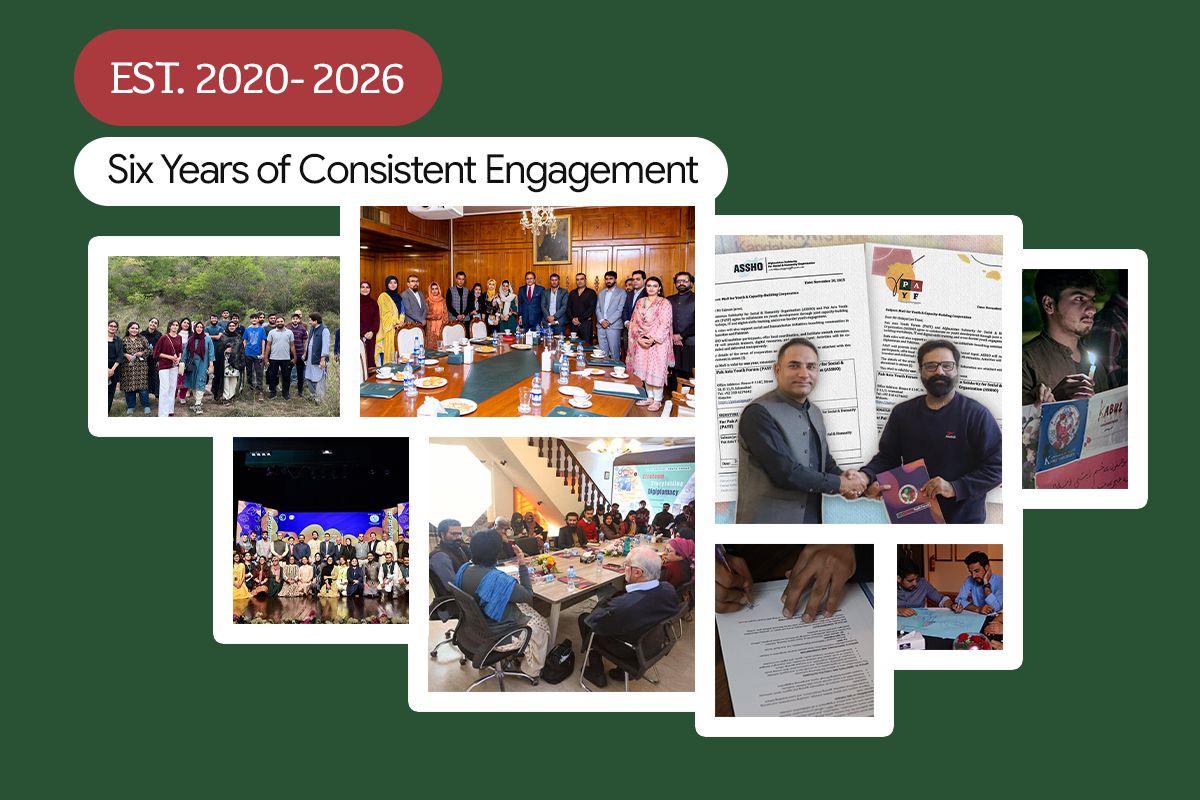
In September 2020, a small group set out to do something that looked naive at the time and looks almost impossible in hindsight: build a durable, youth-led channel between Pakistan and Afghanistan. Six years later, the Pak Asia Youth Forum is still here, and most of what it was built to bridge has been tested to the breaking point. On the sixth anniversary of PAYF, let’s take a quick look at what it has achieved so far through the challenges it has faced.
The First Milestone: The December 2020 Pak-Afghan Media Conclave
Barely three months after its founding, in December 2020, PAYF convened the Pak-Afghan Media Conclave, its first major cross-border initiative, held via video conference between journalists from both countries. It ran in two sessions. The morning panel, on the media’s role in the peace process, was keynoted by Mahmood Jan, Deputy Speaker of the KP Assembly, who undertook to carry the discussion to policymakers; the afternoon session on bilateral relations was keynoted by Senator Faisal Javed, then Chairman of the Senate Standing Committee on Information and Broadcasting. The Afghan panel included Shazia Haya, Munizah Abbasi, Asad Daudzai, Khalida Rasheed, Mujtaba Qasim, Khalid Olfat, and Nargis Ehsan; the Pakistani panel included Tahir Khan, Munizae Jahangir, Farzana Ali, Naeemullah Yousufzai, Rifatullah Orakzai, and Ejaz Ahmed. Sumaira Khan and Nadia Naqi moderated.
Footprints on Both Sides of the Frontier
What set PAYF apart from every other track-two effort was that it did not operate only from Islamabad. It established a Kabul Chapter with Afghan staff on the ground. Inamullah Miakhil, a journalist based in Nangarhar and former spokesperson for the Nangarhar Directorate of Public Health, served as Senior Coordinator in Afghanistan, with Shahid Khan as Senior Coordinator for Afghanistan.
That presence produced things a webinar cannot. The Kabul Chapter organised a Scholars’ Conference honouring Afghan doctoral graduates of the University of Peshawar. It ran a friendly cricket tournament between the FM radio outlets of Nangarhar province, with the Independent Radio Association. It published in Pashto and Dari alongside English.
When the Takeover Came: Aid on the Ground
The starkest test of that footprint arrived in August 2021. As the Taliban retook Kabul, Director General Salman Javed, who was in Kabul at the time, became involved in launching the Pak Afghan Cooperation Forum (PACF) under PAYF as a channel to move aid into a country whose institutions were collapsing in real time: medicine, doctors, and drinking water among the essentials. He personally arranged multiple doctor visits during that breakdown, including female doctors at a moment when their presence and safety could not be taken for granted. The teams didn’t move without risk; on at least one return journey they faced threats and detention in Nangarhar, serious enough that the embassy had to intervene.
Eye care became one of the most visible, sustained parts of that effort. Working with Alkhidmat Foundation Pakistan, PACF ran free eye camps in Khost and Kabul, including at Noor Eye Hospital and Jinnah Hospital. A 2023 Kabul camp alone performed 253 surgeries, 170 cataract operations, plus cornea transplants, oculoplastic and vitreoretinal procedures, and treated thousands more through outpatient care. The earlier 2021 camps in Khost and Kabul examined well over 1,800 to 2,500 patients between them and completed hundreds of operations. Afghan officials and patients publicly thanked the Pakistani teams involved.
Workshops That Carried the Dialogue
Alongside the aid work and the conferences, PAYF built a running rhythm of workshops and lectures meant to keep drawing new voices into the conversation rather than the same names on a rotating panel. Multiplying Thoughts ran as a youth workshop series aimed at widening the pool of people actually doing the talking. Rebuilding Afghanistan took on the harder, longer-term question of recovery, institutions, governance, what comes after collapse, rather than the immediate crisis response that PACF was built for. The PAYF Lecture Series became the forum’s recurring venue for bringing academics and practitioners in front of a youth audience, sitting alongside the standing Pak-Afghan Intelligentsia Dialogue webinar series on regional rebuilding.
Cross-Border Partnerships
Beyond direct aid and its own programming, PAYF has built formal partnerships to extend its reach. In November 2025, it signed a yearlong Memorandum of Understanding with the Afghanistan Solidarity for Social & Humanity Organisation (ASSHO), covering capacity-building workshops, IT and digital-skills training, and youth engagement. It has also entered into an MoU with QSG Pakistan. Other collaborations have taken a lighter, less formal shape, including esports engagement and informal outreach with diaspora communities and research groups.
The Record, in Brief
- The Pak-Afghan Cooperation Forum’s 2021–23 humanitarian response: doctor visits, medicine, drinking water, and eye camps in Khost and Kabul with Alkhidmat Foundation Pakistan
- Multiplying Thoughts, Rebuilding Afghanistan, and the PAYF Lecture Series
- The Pak-Afghan Intelligentsia Dialogue webinar series
- The Pak-Afghan Youth Jirga series, including a Jirga on environmental journalism for World Environment Day 2022
- A governance-crisis session chaired by Dr Salma Malik, drawing Ambassador Ayaz Wazir (former High Commissioner to Afghanistan), Senator Sitara Ayaz, Fajr Rabia Pasha, Sabah Aslam and others
- A vigil for the victims of the Kabul University attack, which killed close to 22 students
- Director General Salman Javed’s briefing at the Institute of Regional Studies on Pakistan’s assistance to Afghanistan through aid and multi-channel support since August 2021 and after the earthquake
- The Star School project in Afghan Basti, Islamabad, with PAGE and Fajr Rabia Pasha
- A webinar on the science of addiction and drug abuse, drawing over 40 participants from the prevention community
- “Stories We Live By,” an oral-history project documenting first-hand accounts from diplomats, practitioners and academics across the region
- The November 2025 MoU with ASSHO and the MoU with QSG Pakistan
- Digiplomacy workshops, a second Scholars Conference with the University of Peshawar, and Space sessions on COP29, trade collapse, and regional security
- The University Ambassador Program, and the PAYF Hike Club combining outdoor activity with environmental cleanups
The Challenges
The biggest early obstacle, as Javed noted on the forum’s fifth anniversary, was simply gaining acceptance, especially inside Afghanistan, where Pakistan was often viewed unfavourably, and the idea of structured youth dialogue required real persuasion before it could take root. Operating across a politically sensitive border meant navigating distrust, security concerns, Taliban-era restrictions, refugee and trade disruptions, and competing national narratives, often at the same time, and the detention of aid workers in Nangarhar in 2021 was a concrete instance of exactly that risk.
Sustaining participation through the pandemic, periodic geopolitical flare-ups, and economic pressure in both countries added another layer of difficulty; dialogue is hard to keep alive when the people meant to be in the room are dealing with border closures, currency shocks, or public anger at their neighbour. Expanding from a two-person start in 2020 to a hybrid, continent-wide platform by 2025 required building teams, digital infrastructure, and institutional credibility largely without the resourcing that better-funded track-two efforts take for granted.
By May 2025, the forum widened into the Pak Asia Youth Forum, extending the same method across the continent.
Six years on, the achievement is not any single conclave or conference. It is that the channel stayed open when almost everything else closed.