Executive Summary
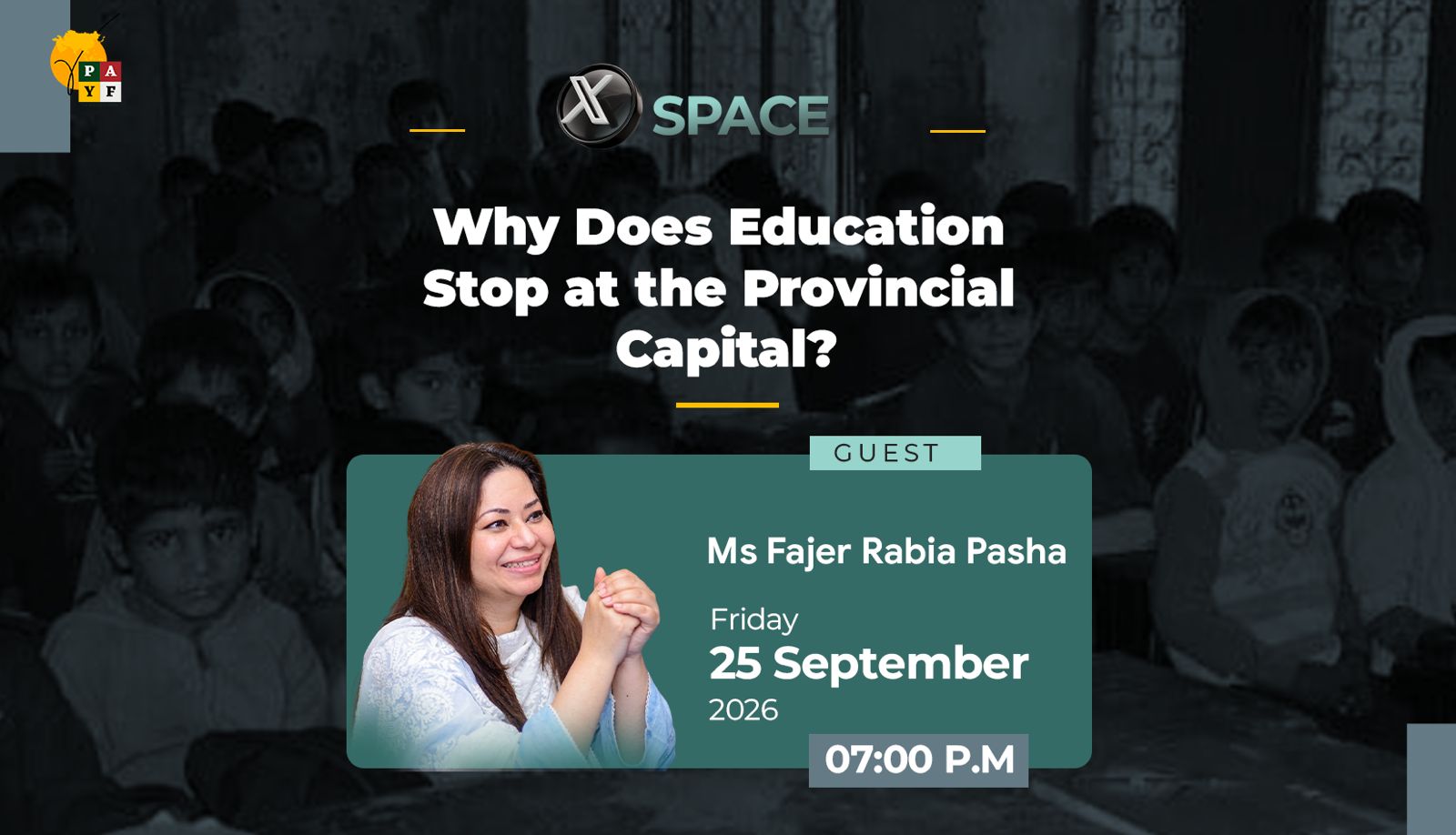
PAYF conducted an X Space on the theme: “Why Does Education Stop at the Provincial Capital?”, on 25 September, 2026. The discussion examined Pakistan’s persistent education crisis, the gap between provincial capitals and districts, funding challenges, and whether decentralised decision-making can improve education delivery and governance.
🔹 Hosted By Muniba Abdul Khaliq:
Researcher, PAYF
- Opened the discussion by highlighting that more than 26 million children in Pakistan remain out of school despite repeated education reforms by federal and provincial governments.
- Questioned why education outcomes remain weak despite continued government initiatives and reforms.
- Raised the disparity between major cities and underserved districts, particularly South Punjab, where large numbers of children remain out of school despite Punjab having the country’s highest literacy rate.
🔹 Our Speaker:
Ms Fajr Rabia Pasha
Education activist & former CEO, PAGE
- Identified Pakistan’s education crisis as having two major dimensions: the ineffective management of the funding currently allocated to education, and the larger funding requirement needed to ensure education for every child as a constitutional right.
- Highlighted both low-quality education and the large number of out-of-school children as central challenges facing Pakistan’s education system.
- Emphasised that addressing the education crisis requires looking beyond the amount of funding allocated and examining how effectively available resources are managed.
- Drew attention to the gap between the constitutional promise of education for all children and the realities of access and quality on the ground.
- Her experience in the education sector provided a first-hand perspective on the governance and implementation challenges that continue to affect education delivery.
🔹 Key Discussion Themes:
- Pakistan’s 26-million-plus out-of-school children and the continuing education crisis.
- The gap between education funding allocated and the funding actually required.
- Poor management of existing education resources.
- Low-quality education alongside limited access to schooling.
- The disparity between provincial capitals and districts in education facilities and opportunities.
- Governance and implementation challenges in the education sector.
- The need to bring decision-making and resources closer to local communities.