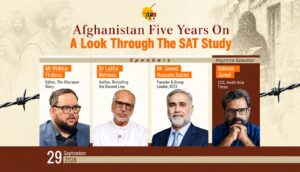
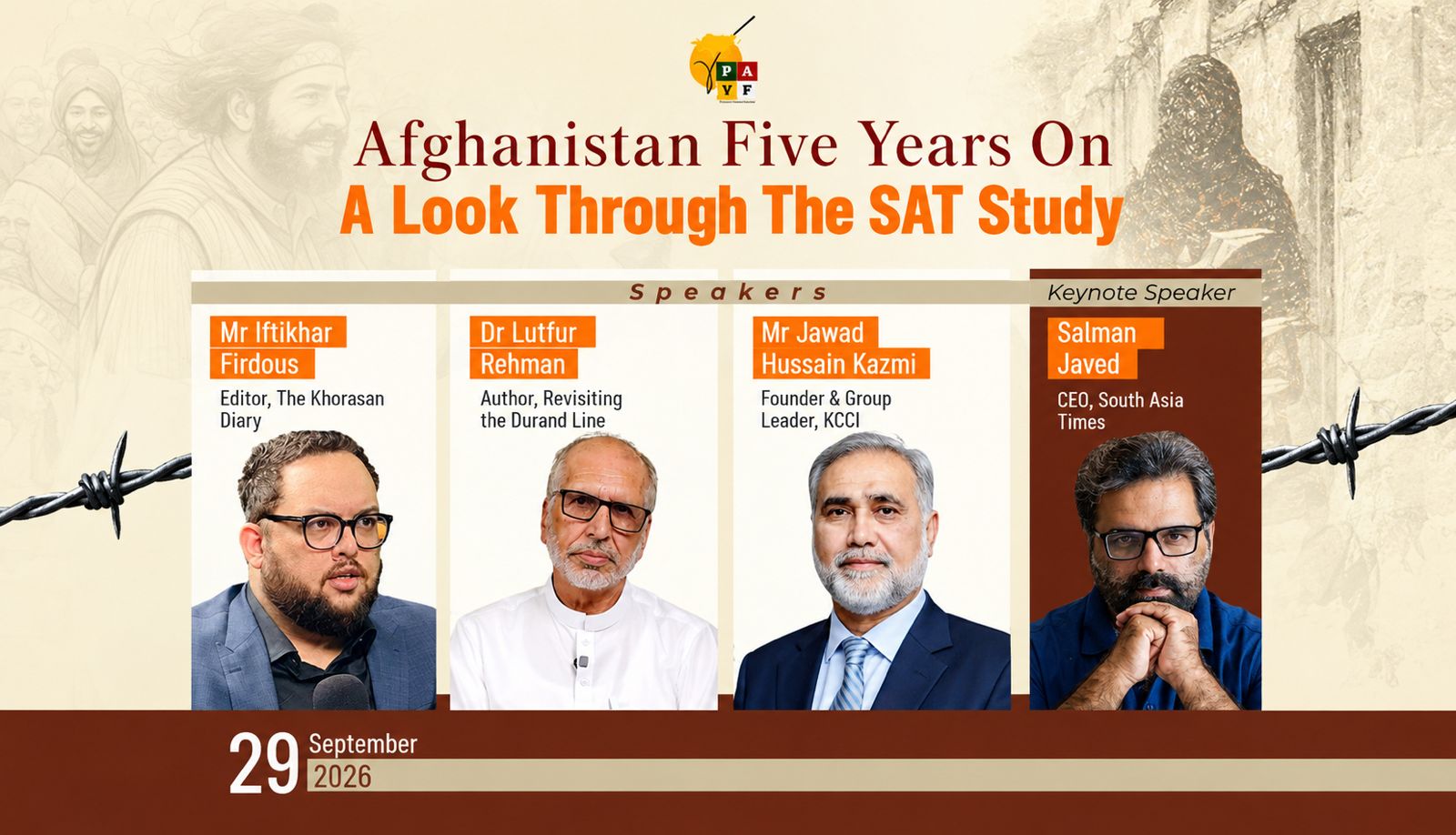
📅 Date: 29 September 2026
⏰ Time: 03:00 PM (PKT)
🎙️ Moderator: Amna Hassan
👥 Speakers: Mr. Iftikhar Firdous, Dr. Lutfur Rehman, and Mr. Jawad Hussain Kazmi
📌 Format: Webinar
Background
Five years since the Taliban returned to power in Afghanistan in August 2021, the country has undergone significant political, social, security and economic changes. While the Taliban have established functioning administrative structures and expanded their engagement with regional actors, important questions remain about how governance has evolved and what these changes mean for Afghan society and the wider region.
South Asia Times’ latest study, “Taliban 2.0: The Five Year Ledger,” provides a five-year assessment of Afghanistan under Taliban rule, examining developments in governance, media, education, security, the economy, narcotics, diplomacy and regional relations. The study highlights the closure of 219 of 547 media outlets, the decline in working journalists from 11,857 to 4,759, and the continued exclusion of approximately 1.1 million girls from secondary education, alongside the rapid expansion of madrassas.
The study also examines Afghanistan’s regional implications, particularly for Pakistan. Continued security concerns, unresolved border questions, the repatriation of Afghan nationals and declining bilateral trade have added new pressures to an already complex relationship. At the same time, Afghan traders are increasingly exploring alternative routes through Chabahar and Central Asia, raising questions about Pakistan’s position as a key trade corridor for Afghanistan.
Rationale for the Dialogue
In this context, the Pak Asia Youth Forum (PAYF), as a youth-centric diplomatic platform committed to strengthening people-to-people understanding and regional dialogue, is organising a webinar titled “Afghanistan Five Years On: A Look Through the SAT Study.”
The dialogue will use the SAT study’s findings to examine Afghanistan’s trajectory through three interconnected dimensions: its changing internal landscape, the evolving Pakistan-Afghanistan border relationship, and the future of bilateral trade and economic connectivity.
The discussion will bring together perspectives from media, academia, and the business community to broaden understanding of developments in Afghanistan and their direct implications for Pakistan and the region.
Objectives
The webinar will seek to:
- Examine how governance, media and education have evolved under Taliban rule.
- Discuss the implications of the shrinking media space and changing educational landscape for Afghanistan’s next generation.
- Assess the continuing challenges surrounding the Durand Line and Pakistan-Afghanistan border management.
- Explore the impact of Afghan repatriation on divided families, border communities and people-to-people ties.
- Examine the decline in Pakistan-Afghanistan trade and its impact on businesses and traders.
- Assess the growing use of alternative trade routes and what this means for Pakistan’s regional trade position.
- Explore how Pakistan can maintain economic engagement with Afghanistan alongside credible security arrangements.
Key Themes for Discussion
1. Governance, Media and Afghanistan’s Next Generation
The discussion will examine the changing nature of governance under the Taliban, including the contraction of media space, the growth of madrassas and the continued exclusion of girls from education. It will explore whether institutional changes under Taliban rule represent a broader transformation or an evolution in governance without a corresponding ideological shift.
2. The Durand Line and Border Management
The discussion will examine persistent challenges surrounding the Pakistan-Afghanistan border, including the Durand Line, border-management mechanisms and cross-border movement. It will consider what a more workable and sustainable border regime could look like for both countries.
3. Repatriation, Communities and People-to-People Ties
The repatriation of approximately 1.7 million Afghans from Pakistan has added another dimension to bilateral relations. The discussion will consider its impact on divided families, border communities and longstanding social and tribal ties, while exploring ways to address security and migration concerns without further weakening people-to-people relations.
4. Pakistan-Afghanistan Trade and Economic Relations
With bilateral trade declining from approximately $2.46 billion in 2024 to $1.77 billion in 2025, the discussion will examine the impact on businesses and traders. It will also consider the growing use of Chabahar and Central Asian routes and whether Pakistan is losing its traditional trade advantage.
5. Security and Trade: Finding a Workable Framework
Security and economic relations between Pakistan and Afghanistan are closely connected. The discussion will explore how trade can continue alongside credible security arrangements and what a practical framework for managing border security, commercial activity and regional connectivity could look like.
Expected Outcomes
The webinar will provide an opportunity to:
- Develop a clearer understanding of Afghanistan’s trajectory five years after the Taliban takeover.
- Facilitate informed discussion on the Durand Line, border management and Pakistan-Afghanistan relations.
- Examine the impact of repatriation on communities and people-to-people ties.
- Highlight challenges and opportunities in Pakistan-Afghanistan trade and regional connectivity.
- Encourage dialogue between diplomatic, academic, media, business and youth communities.
- Explore practical avenues for maintaining engagement while addressing shared security and economic concerns.
Conclusion
Five years after the Taliban’s return to power, developments inside Afghanistan continue to directly affect Pakistan’s security, border communities, economic interests and regional connectivity. Understanding this relationship requires looking beyond individual issues and recognising the links between security, borders, communities and trade.
Through this dialogue, Pak Asia Youth Forum seeks to bring diverse perspectives into a constructive conversation on the future of Pakistan-Afghanistan relations, while keeping people-to-people connections at the centre. As a youth-centric diplomatic platform, PAYF aims to promote informed engagement that recognises both the challenges between the two countries and the longstanding social, economic and cultural ties that connect their peoples.