Afghanistan’s Mining Sector and Unrest
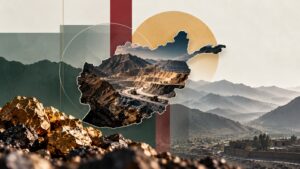
Afghanistan holds some of the world’s most concentrated reserves of critical minerals. This PAYF investigative report traces how a contest between Taliban factions over who awards mining contracts, collects the proceeds and benefits from them is driving violence in Badakhshan and Takhar, and what it costs the communities who live beside the mines.
Executive summary
Afghanistan’s mineral wealth is globally significant, yet mining under Taliban rule operates with little legal restraint or transparency: subsidiary laws have been repealed, no independent body audits proceeds, and concessions have allegedly gone to commanders and officials through informal applications. Reported corruption includes a US$200,000 bribe over the Wikador mine and a US$700,000 talc scheme in Nangarhar, while residents of Badakhshan and Takhar report seized farmland and deadly clashes. This report concludes that the unrest is driven by rivalry between the Kandahari and Haqqani factions over mining. Haqqani-affiliated commanders, notably Jumma Khan Fateh, resisted the 2024 transfer of the ministry from Haqqani-aligned Shahabuddin Delawar to Kandahar-aligned Hidayatullah Badri. Fateh surrendered on 17 August; the Taliban later revealed, from an audio clip, that he had contacted the Afghanistan Freedom Front, an Afghan armed resistance group. The investigation and the reshuffle show that the unrest in northern Afghanistan is an internal matter rooted in internal grievances, with no external connection.
Key findings
- Afghanistan’s mineral wealth is globally significant, yet mining under Taliban rule operates with little legal restraint or transparency.
- Reported corruption includes a US$200,000 bribe over the Wikador mine and a US$700,000 talc scheme in Nangarhar.
- Residents of Badakhshan and Takhar report seized farmland and deadly clashes.
- The unrest is driven by rivalry between the Kandahari and Haqqani factions over mining.
- Haqqani-affiliated commanders, notably Jumma Khan Fateh, resisted the transfer of the ministry from Haqqani-aligned Shahabuddin Delawar to Kandahar-aligned Hidayatullah Badri.
- Fateh surrendered on 17 August. The Taliban later revealed, from an audio clip, that he had contacted the Afghanistan Freedom Front, an Afghan armed resistance group.
- The investigation and the reshuffle show that the unrest in northern Afghanistan is an internal matter rooted in internal grievances, with no external connection.
What the report covers
| Section | In one line |
| 01 Introduction | Afghanistan’s critical minerals and the rivalry over them |
| 02 Location | Where the major deposits are, province by province |
| 03 Revenue | Announced contract values, royalties and where the money goes |
| 04 Who Controls | Licensing, the legal vacuum and contracts without tenders |
| 05 Taliban Infighting | The Kandahar leadership, the Haqqani Network and the Badakhshan dispute |
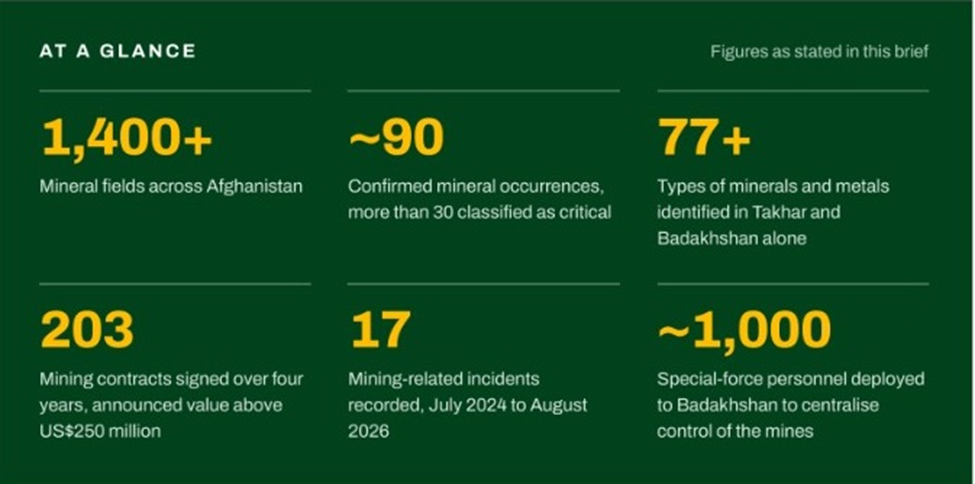
| 06 Fighting With Locals | Seized land, protests and 17 recorded incidents |
| 07 Corruption and Bribery | Alleged bribes, undisclosed stakes and an unidentified intermediary |
| 08 Conclusion | Who decides, who collects and who benefits |
Why it matters for the region
- For neighbouring states: Badakhshan borders Tajikistan, Pakistan and China. Armed contests over mines along these frontiers bear directly on border security and cross-border trade.
- For investors and partners: contracts are being signed without competitive tenders, independent audits or a clear legal framework. That leaves agreements open to dispute and reversal.
- For local communities: residents report losing farmland, pastures and water while receiving almost none of the revenue. Their grievances are now feeding the conflict.
The report’s conclusion is direct: without transparent contracts, independent audits and accountable institutions, the contest will continue and local communities will keep paying for it.
Read the Full Report
↓ Download the full report (PDF)Includes eight sections, nine figures, eight tables and 50 endnotes with sources.
Includes eight sections, nine figures, eight tables and 50 endnotes with sources.
↓ Download the full report (PDF)