The 2025 World Drug Report from the United Nations Office on Drugs and Crime (UNODC) details a dramatic, structural upheaval in the global narcotics market, rooted in the near-total collapse of Afghanistan’s Opium Production. While the ban on poppy cultivation, enforced by the de facto authorities, has delivered a success in eradication unparalleled in modern history, this agricultural contraction has simultaneously catalyzed the rapid emergence of a robust synthetic drug industry. This shift has profound implications for regional stability, global public health, and the future of counter-narcotics efforts.
The Collapsing Landscape of Afghanistan’s Opium Production
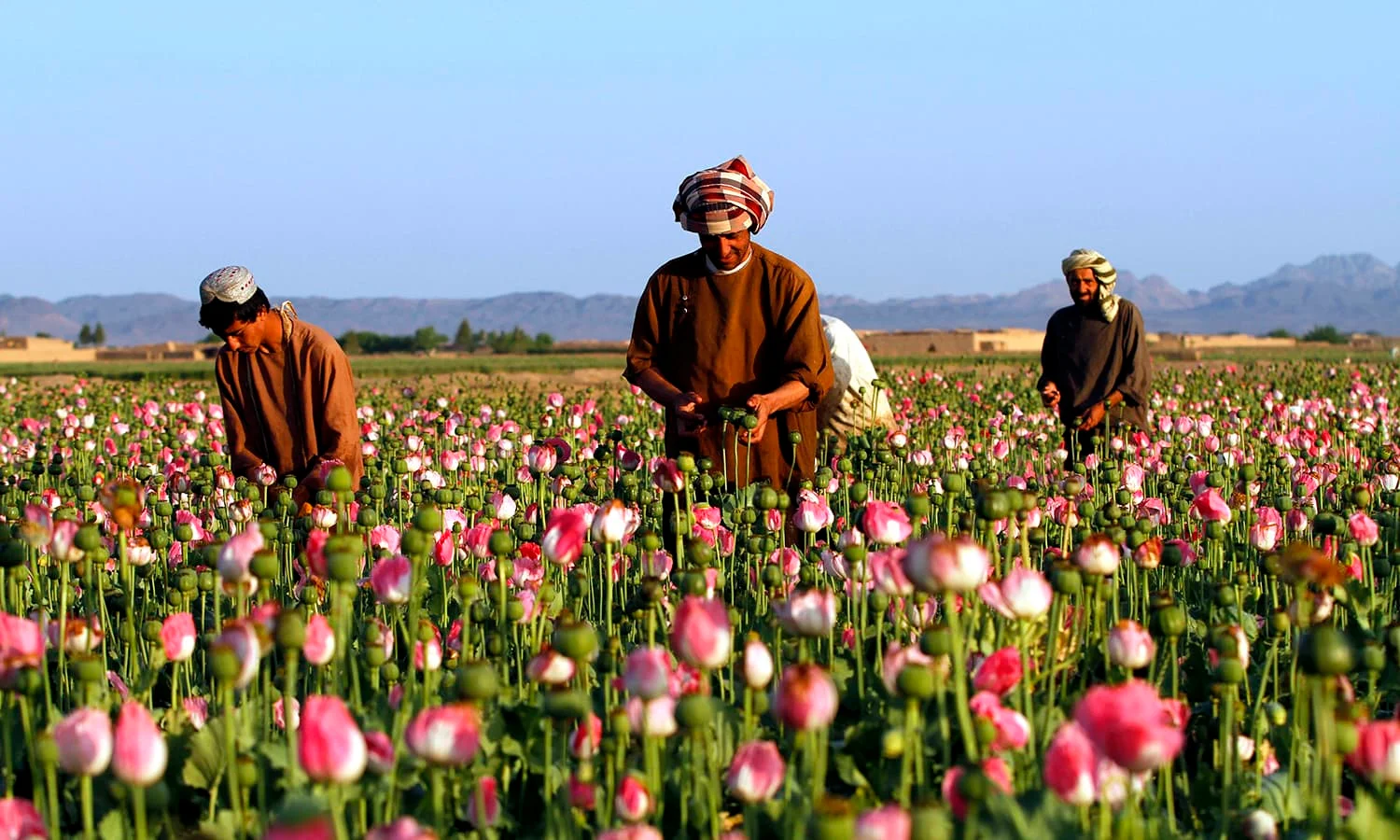
The enforcement of the opium poppy ban has resulted in a continued, profound contraction. The total area under cultivation in 2025 is estimated at just 10,200 hectares, marking a 20 per cent decrease compared to the 12,800 hectares recorded in 2024, and a tiny fraction of the 232,000 hectares cultivated in 2022 before the ban.
Concurrently, opium production plummeted by an even steeper 32 per cent in 2025, yielding an estimated 296 tons. This disparity, where production fell faster than the cultivated area, highlights the devastating impact of widespread drought and adverse weather conditions, which have left over 40 per cent of farmland barren.
The ban has induced a massive economic shock in rural areas. Farmers’ income from opium sales plunged by 48 per cent in a single year, falling to an estimated US$134 million in 2025. Despite this low production, the global market is buffered by massive legacy opium stockpiles, estimated at 13,200 tons before the 2023 season.
Experts suggest this volume is sufficient to meet global demand for Afghan opiates until the end of 2026, mitigating an immediate supply crisis while ensuring that large-scale traffickers, who hold the majority of these stocks, continue to profit from the scarcity created by the ban on Afghanistan’s Opium production.
Geopolitical Inversion and the Synthetic Threat
The dramatic success in reducing Afghanistan’s Opium Production has fundamentally reconfigured the global supply chain. For decades, Afghanistan was the source of over 80 per cent of the world’s illicit opium. Today, it has been definitively eclipsed by Myanmar, which now ranks as the world’s leading producer. Myanmar’s output in the 2024 context reached an estimated 995 tons, more than double that of Afghanistan, capturing approximately 46.49 per cent of the global market share.
More critically, the decline in Afghanistan’s Opium Production has been correlated with a rapid, structural pivot toward synthetic drugs, particularly Methamphetamine (Ice). This new illicit business model offers organized crime groups distinct advantages: it is less reliant on land and climate, easier to produce clandestinely, and more resilient to environmental shocks than agricultural opiates. Evidence of this surge is clear: seizures of methamphetamine in and around Afghanistan were about 50 per cent more frequent by the end of 2024 compared to the previous year.
Outlook and Policy Imperatives
The long-term sustainability of the ban on Afghanistan’s Opium Production remains acutely fragile. The economic shock, compounded by a major humanitarian crisis and the return of some four million Afghans from neighboring countries, has intensified competition for scarce jobs and resources. The UNODC warns that this devastating mix of poverty, demographic strain, and falling legal incomes could collectively push desperate rural populations back toward illicit cultivation, particularly in areas like Takhar and Kunar, which have already seen localized surges in poppy farming.
Therefore, counter-narcotics strategies must urgently broaden. Efforts cannot solely focus on crop eradication but must integrate controls against the surging synthetic drug trade and target the diversion of chemical precursors. Sustained international engagement is essential to deliver long-term investments in alternative livelihoods and infrastructure, providing viable, legal economic opportunities that can truly offset the high profitability of opium and stabilize the rural economy.
Without comprehensive support to address the underlying economic drivers, the hard-won reduction in Afghanistan’s Opium Production risks being reversed, or simply replaced by a new, equally dangerous synthetic crisis.