The persecution of the Rohingya Muslims in Myanmar emerged through a long historical process rather than the excesses of a contemporary military regime alone. It represents the culmination of institutional decisions taken during British colonial rule, when Burma’s social order was reconfigured through rigid ethnic classification, administrative compartmentalisation, and economic engineering. The violence unleashed in Rakhine State in 2017 marked the violent closure of a colonial legacy that had matured over decades.
Before British annexation in 1824, identity in the Arakan region remained fluid and layered. The coastal kingdom of Mrauk-U functioned for centuries as a maritime crossroads connecting South and Southeast Asia. Muslim and Buddhist communities coexisted within a shared political framework, serving together in royal administration, trade, and diplomacy. Social belonging derived primarily from loyalty to the crown rather than ancestry. Ethnicity functioned as a flexible cultural marker rather than a fixed biological category.
This balance suffered disruption following the Bamar invasion of Arakan in 1784, which triggered large-scale displacement into Bengal. British colonial rule, however, transformed temporary upheaval into enduring exclusion. Through the imposition of European racial taxonomy, colonial administrators replaced fluid identities with rigid distinctions between belonging and foreignness, a shift that later enabled systematic marginalisation.
The Colonial Census and the Politics of Classification
Colonial governance operated through categorisation and documentation. From the late nineteenth century onward, censuses and ethnographic surveys compressed diverse communities into narrowly defined racial and religious compartments. Concepts such as lumyo and taingyintha, once descriptive and situational, were bureaucratised into criteria of national legitimacy. The divide between “indigenous races” and “immigrants” became embedded within administrative logic.
In Arakan, this framework produced especially corrosive outcomes. Cross-border mobility, historically integral to trade and labour networks, came to be framed as demographic encroachment. Muslim communities with generational roots in the region were increasingly portrayed as outsiders. Colonial emphasis on ancestral origin rather than residence established the legal rationale that would later sustain statelessness.
Divide, Rule, and Entrenchment
British administration further deepened social fragmentation by separating Burma Proper from the Frontier Areas. While the Bamar heartland fell under direct colonial control, peripheral regions were governed indirectly through selected local elites. Minority communities found disproportionate representation in colonial military and civil services, while the Bamar majority experienced political marginalisation.
This structure fostered enduring mistrust. For many Bamar nationalists, colonial authority became associated with religious displacement and political dispossession. Minority groups, in turn, developed apprehension toward a future dominated by a centralised Buddhist polity. Nationalism evolved as a defensive assertion of identity rather than an inclusive political project, increasingly defined in opposition to Muslims and Indian communities linked to colonial power.
Economic policy intensified these divisions. British-facilitated migration from India reshaped urban centres and agrarian relations. By the 1930s, Indian moneylenders held extensive control over agricultural land, a development that aggravated social tensions during the Great Depression. Economic grievance rapidly assumed communal form, culminating in riots that normalised violence as a political instrument.
War, Violence, and the Hardening of Identity
The Second World War proved decisive in consolidating communal boundaries. The collapse of colonial authority and the Japanese invasion triggered widespread inter-communal violence. In Rakhine, Muslim communities largely aligned with retreating British forces, while Buddhist groups gravitated toward the Japanese-backed Burma Independence Army. Mass killings and population displacement followed, producing enduring spatial and social segregation.
British wartime assurances of autonomy for Rohingya communities remained unfulfilled, yet their political consequences endured. Post-independence governments inherited a society fractured by colonial policy and wartime violence and pursued consolidation through exclusion rather than accommodation.
Citizenship, Law, and the Architecture of Exclusion
At independence, Burma briefly adopted a relatively inclusive citizenship framework. The 1948 Citizenship Act acknowledged residence and birth as bases of belonging, enabling many Rohingya to vote, hold office, and serve within state institutions. Even this framework, however, retained the colonial cutoff date of 1823, preserving ancestry as a benchmark of legitimacy.
The 1962 military coup marked a decisive rupture. Under General Ne Win, ethnonationalism crystallised into state doctrine. The 1982 Citizenship Law formalised exclusion by linking full citizenship to membership in officially recognised “national races” a classification derived directly from colonial census practices. The Rohingya were deliberately excluded, rendered stateless through legal design.
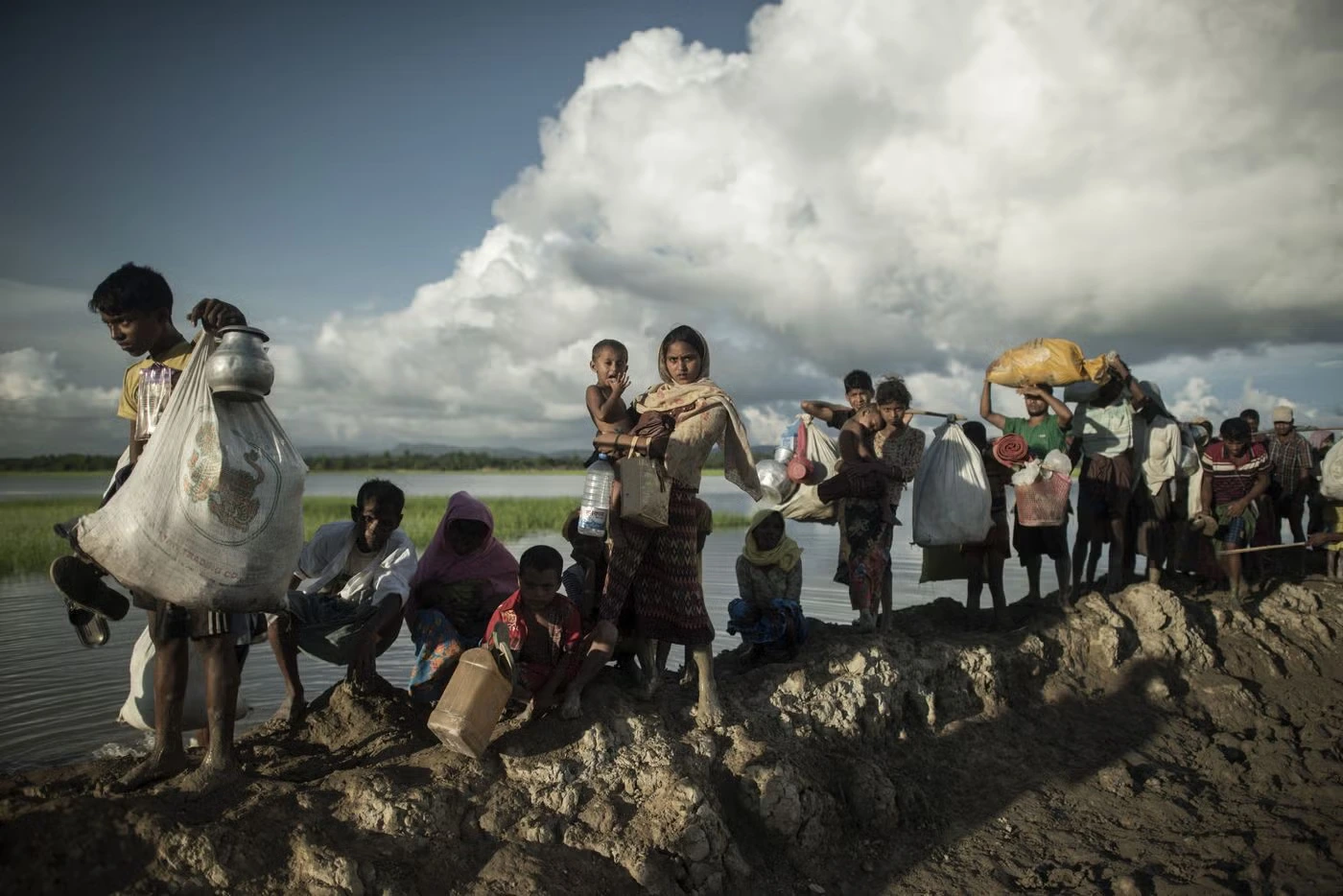
Subsequent military campaigns followed a recurring pattern: coercion, displacement, limited return, and progressively tighter restrictions. By 2017, when “clearance operations” forced more than 700,000 Rohingya into Bangladesh, the architecture of exclusion had reached completion. The United Nations’ determination of genocidal intent reflected decades of legal, administrative, and ideological preparation rather than episodic brutality.
A Reckoning with History
The Rohingya genocide illustrates the enduring power of colonial governance long after the formal end of empire. Administrative categories hardened into legal identities, economic policy evolved into communal grievance, and wartime alignments solidified into permanent suspicion.
For Myanmar, confronting this history remains central to any sustainable political settlement. For the international community, the lesson carries wider relevance. Genocide rarely erupts spontaneously. It emerges through cumulative institutional choices, legal definitions, and narratives of belonging constructed across generations.
The Rohingya tragedy stands as a stark warning: when citizenship becomes a function of ancestry rather than shared civic life, exclusion turns into policy, and violence follows with devastating inevitability.