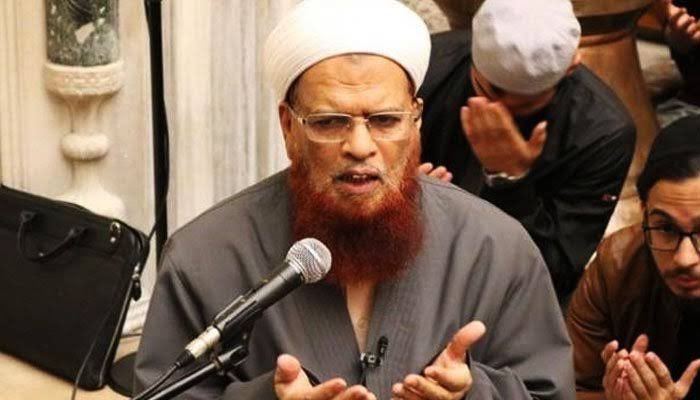
Religious Leaders Denounce Attack as Anti-Islam and Inhuman
Senior leaders of Wafaq-ul-Madaris Al-Arabia Pakistan have strongly condemned the suicide attack at an Imambargah in Islamabad, terming it brutal, inhumane, and completely against the teachings of Islam and humanity. In a joint statement, President Wafaq-ul-Madaris Maulana Mufti Muhammad Taqi Usmani, Senior Vice President Maulana Anwar-ul-Haq, Secretary General Maulana Muhammad Hanif Jalandhari, and other senior figures said that the killing of innocent worshippers can never be justified under any circumstances.
They stressed that targeting mosques, Imambargahs, and religious seminaries — places regarded as sacred — reflects a calculated effort to destabilize Pakistan and spread fear and chaos. The leaders stated that those who spill blood in places of worship do not deserve to be called human beings, adding that such acts are part of an organized conspiracy to undermine peace, religious harmony, and national stability.
Demand for Justice, Security, and National Unity
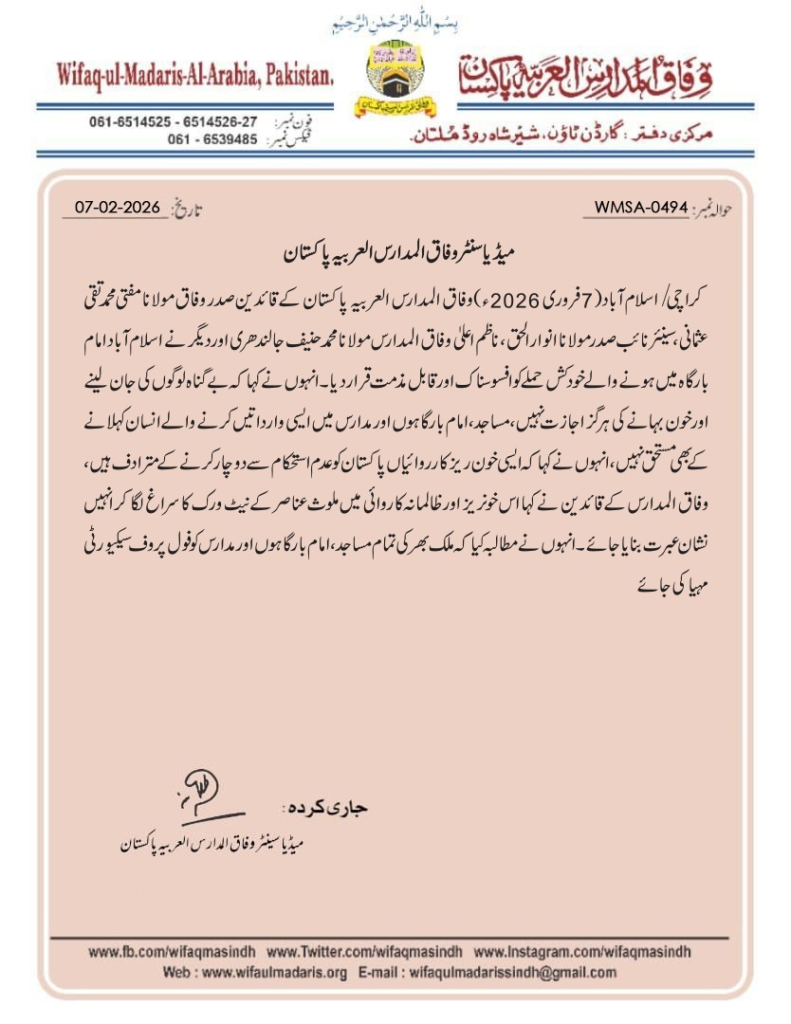
The Wafaq-ul-Madaris leadership called on the government and law-enforcement agencies to identify not only the perpetrators but also the facilitators and entire support networks behind the attack. They emphasized that all those involved must be brought before the courts and punished in a manner that serves as a deterrent for future acts of terrorism.
They further urged authorities to ensure foolproof security at mosques, Imambargahs, and religious institutions across the country so that worshippers can perform their religious duties without fear. According to the leaders, protecting places of worship is a collective national responsibility and a key step toward restoring public confidence.
Expressing deep sympathy with the families of the martyrs, the leaders offered heartfelt condolences and prayed for the swift recovery of those injured in the attack. They reaffirmed the commitment of the religious community to stand united against terrorism, extremism, and sectarian violence.
The statement concluded by emphasizing that scholars and religious institutions will continue to play their role in promoting peace, stability, and inter-faith harmony, making it clear that terrorism has no place in Islam or in Pakistan’s social fabric.