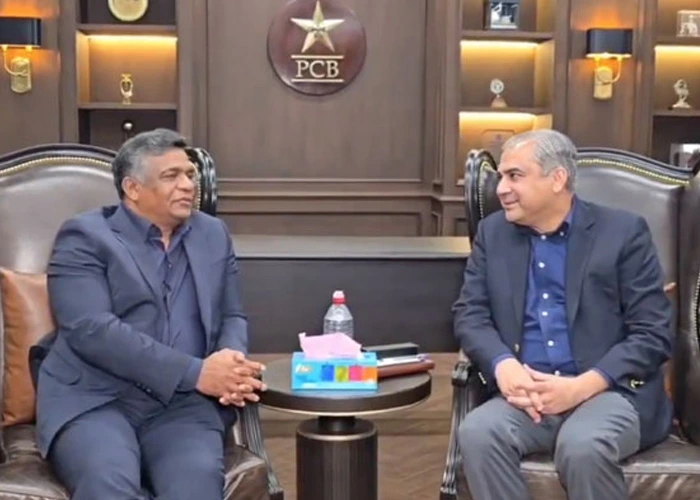
In a development attracting global cricketing attention, the Bangladesh Cricket Board (BCB) has formally requested Pakistan to reconsider its decision not to play the T20 World Cup match against India. The request was conveyed during a high-level meeting between BCB President Aminul Islam and Pakistan Cricket Board (PCB) Chairman Mohsin Naqvi at Lahore’s Qaddafi Stadium. International Cricket Council (ICC) Deputy Chairman Imran Khwaja also attended, underscoring the issue’s international significance.
Historic Engagement at Qaddafi Stadium
Upon his arrival, Aminul Islam was warmly received by Mohsin Naqvi, highlighting the cordial relations between the two cricket boards. The BCB president expressed gratitude for Pakistan’s unwavering support during a challenging period in international cricket. The meeting, beyond ceremonial optics, served as a platform for careful negotiations, reflecting the complex intersection of sportsmanship, regional politics, and cricket governance.
Pakistan’s Solidarity with Bangladesh
Pakistan had earlier announced its boycott of matches against India, in solidarity with Bangladesh’s concerns regarding the T20 World Cup schedule. The stance, rooted in regional cooperation and mutual respect, carries far-reaching implications beyond sport. Analysts observe that cricket in South Asia is deeply entwined with political realities, and Pakistan’s position signals a principled assertion of regional alliances rather than a mere sporting decision.
Sri Lanka’s Intervention
Separately, Sri Lanka Cricket (SLC) has also urged Pakistan to play the fixture. Sri Lankan President Ranil Wickremesinghe discussed the matter with Prime Minister Shehbaz Sharif, suggesting that the Pakistan-India match could be staged in Sri Lanka if needed. Wickremesinghe recalled Pakistan’s continued support for Sri Lankan cricket despite security challenges, highlighting long-standing bilateral cricketing ties.
Role of ICC and Financial Stakes
ICC Deputy Chairman Imran Khwaja’s presence reflected the stakes involved. A canceled Pakistan-India match could lead to substantial revenue losses from broadcasting, sponsorships, ticketing, and merchandise. The ICC is mediating to preserve tournament integrity while addressing all stakeholders’ concerns, highlighting the international dimension of the negotiations.
Cricket Diplomacy and Regional Implications
The BCB president publicly thanked PCB Chairman Mohsin Naqvi and Pakistani cricket fans, underscoring the role of solidarity and sportsmanship in reinforcing regional unity. Beyond the stadiums, Pakistan’s stance has political ramifications, signaling alignment with Bangladesh on broader diplomatic issues. Cricket continues to serve as both a bridge for engagement and a lens through which regional tensions are projected.
Conclusion
The meeting at Qaddafi Stadium represents a pivotal moment in the T20 World Cup saga. Pakistan’s principled stance, BCB and SLC appeals, and ICC mediation highlight the intricate interplay of sport, diplomacy, and economics. The outcome of these negotiations will not only determine World Cup fixtures but also influence regional cricket diplomacy and the future of Pakistan-India cricket relations for years to come.