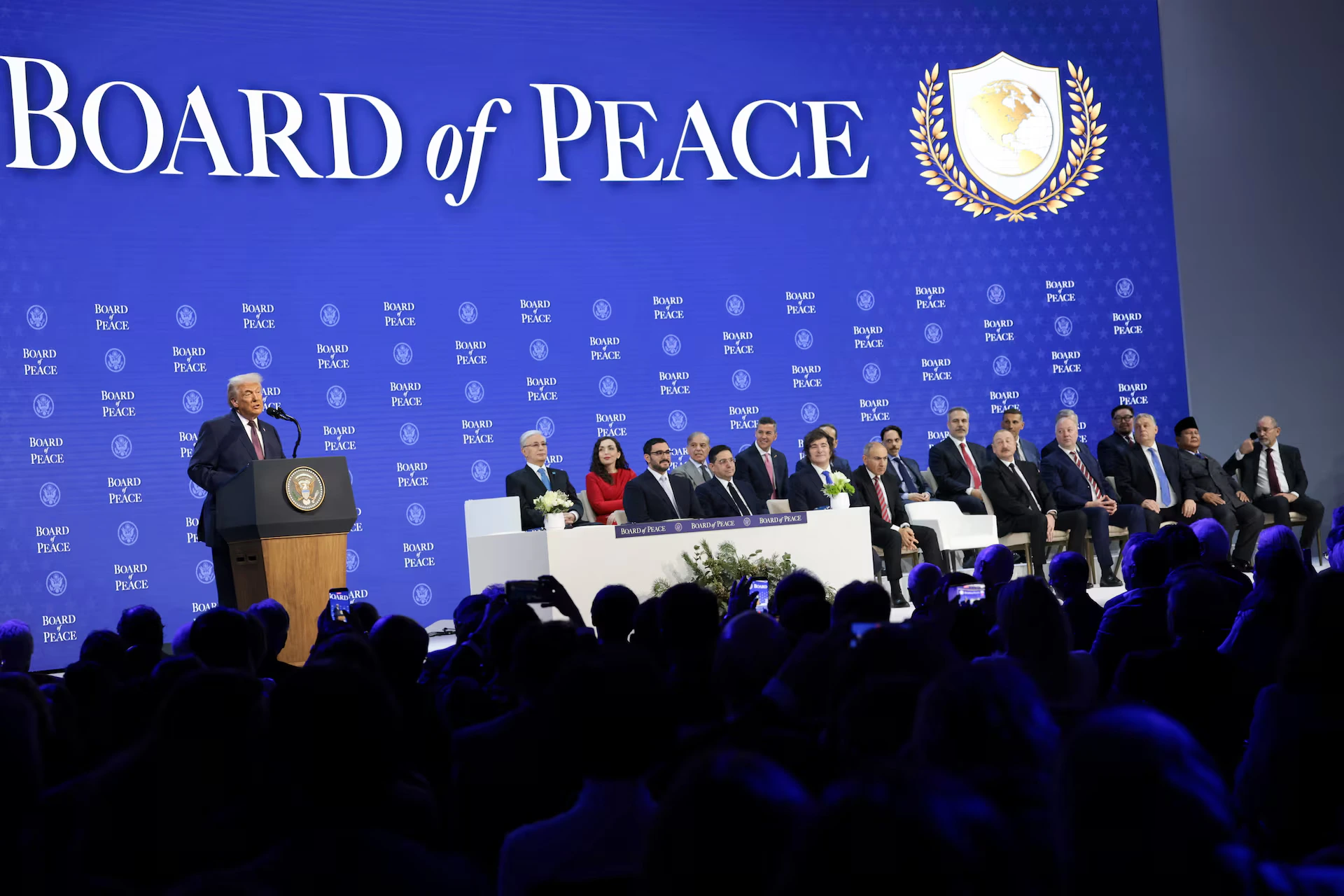
United States President Donald Trump has stated that member states of the proposed Board of Peace have pledged substantial military personnel and financial assistance to support a post-conflict stabilisation framework in the Gaza Strip, signalling a renewed international attempt to manage security and humanitarian recovery in the conflict-affected enclave.
According to a statement released on Trump’s social media platform, participating countries have collectively committed over $5 billion in humanitarian and reconstruction funding, alongside personnel contributions for a proposed International Stabilisation Force and local policing mechanisms. The commitments are expected to be formally announced during the Board’s upcoming session in Washington on February 19.
The initiative follows a fragile ceasefire arrangement brokered in 2025 between Israel and Hamas, which was endorsed through a resolution of the United Nations Security Council. While the truce temporarily reduced large-scale hostilities, repeated violations and humanitarian disruptions have sustained concerns regarding long-term stability in Gaza.
Pakistan Signals Diplomatic Engagement
Pakistan has confirmed its participation in the Board’s consultative framework, describing its role as political and humanitarian rather than military. Officials maintain that engagement in multilateral platforms offers Islamabad an opportunity to advocate for civilian protection and ensure that humanitarian access remains central to international policy discussions.
Government representatives have reiterated Pakistan’s longstanding position supporting a sovereign Palestinian state based on pre-1967 borders with Al-Quds as its capital. Foreign Office officials confirmed that Prime Minister Shehbaz Sharif will attend the Washington meeting alongside Deputy Prime Minister and Foreign Minister Ishaq Dar.
Observers suggest that the evolving framework reflects broader attempts to institutionalise international crisis management mechanisms. However, questions persist regarding enforcement capacity, political inclusivity, and the sustainability of externally supervised stabilisation models.
Trump has described the Board as a potential platform for addressing wider global conflicts beyond Gaza. Analysts caution, however, that the initiative’s credibility will ultimately depend on its ability to maintain neutrality, secure compliance from local actors, and translate diplomatic commitments into tangible improvements in civilian security and humanitarian conditions.