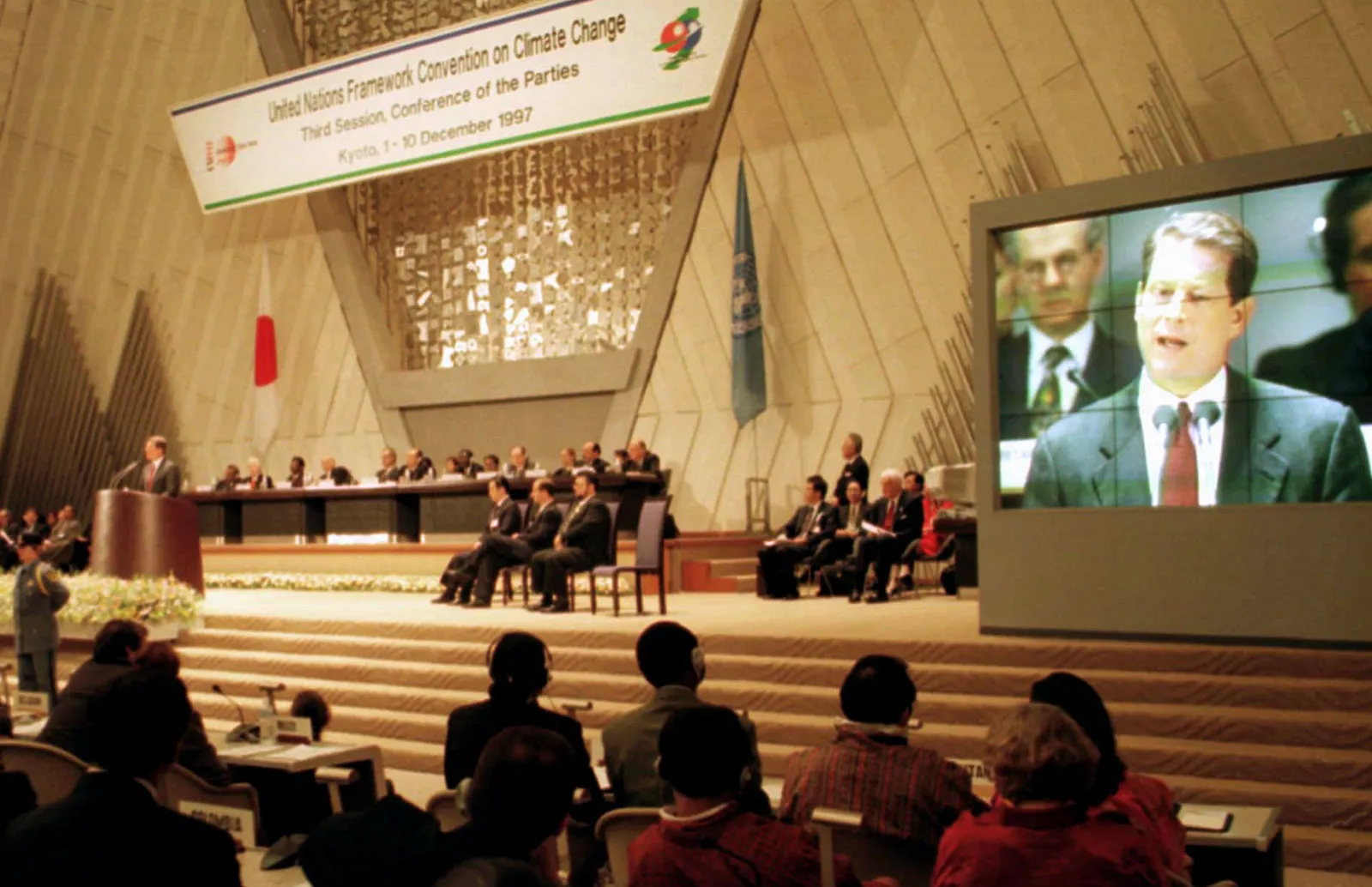
Since the adoption of the United Nations Framework Convention on Climate Change (UNFCCC) in 1992, global climate governance has evolved from aspirational targets toward binding commitments under the Kyoto Protocol and the pledge-based Paris Agreement. For Pakistan, consistently ranked among the most climate-vulnerable nations, these frameworks intersect critically with national development imperatives. The Kyoto Protocol, operationalized in 2005, introduced the Clean Development Mechanism (CDM), enabling developing nations to benefit from foreign investment and technology transfer while developed countries meet emissions obligations. Pakistan’s engagement, however, has faced profound institutional, financial, and constitutional challenges, leaving the country disproportionately exposed to climate impacts it had little role in causing.
Foundations of the Kyoto Protocol and Global Carbon Architecture
The Kyoto Protocol codified the principle of “common but differentiated responsibilities” (CBDR-RC), acknowledging industrialized nations’ historical responsibility for greenhouse gas accumulation. In its first commitment period (2008–2012), 37 industrialized countries and the EU pledged an average 5 percent reduction from 1990 levels. Flexibility mechanisms, including International Emissions Trading, Joint Implementation, and the CDM, allowed cost-effective compliance. Under CDM, Pakistan could host emission-reduction projects, generating Certified Emission Reduction (CER) credits, while benefiting from sustainable development co-benefits such as technology transfer, economic growth, and social development.
Institutional Architecture for Carbon Market Engagement
Pakistan’s Ministry of Climate Change serves as the Designated National Authority (DNA), coordinating CDM projects through a three-tier system: policy oversight by the Prime Minister’s Committee on Climate Change, inter-ministerial execution by the CDM Steering Committee, and technical evaluation by sectoral committees. Projects are assessed on environmental, social, economic, technological, and legal criteria. Support from the World Bank, UNIDO, and other international bodies facilitated rigorous project design and monitoring.
CDM Achievements in Industrial and Renewable Sectors
Pakistan’s CDM portfolio delivered notable results despite constraints. Industrial decarbonization, particularly in the fertilizer sector, included the Sadiqabad N₂O Abatement Project, which reduced emissions by over 4.5 million tonnes of CO₂ equivalent. In renewable energy, wind projects at Jhimpir and Nooriabad generated clean energy and CERs, while hydropower upgrades at Mangla and Tarbela improved capacity and efficiency. These initiatives demonstrated that, with targeted support, Pakistan could achieve meaningful emissions reductions and technology transfer. Yet, compared to regional peers like India and China, overall CDM engagement remains modest, reflecting systemic institutional and financial hurdles.
Institutional and Constitutional Impediments
The 18th Amendment (2010) devolved climate-sensitive sectors to provincial authorities, creating coordination asymmetries. Federal oversight remained limited to international negotiation, while provincial implementation mechanisms were often underdeveloped. Inter-agency coordination was sporadic, and climate-linked financial instruments, including the National Finance Commission Award, were insufficiently aligned with national mitigation objectives, framing ambitious targets as unfunded mandates.
Economic Hurdles and Climate Finance Dynamics
Pakistan’s 2030 emissions reduction target of 50 percent requires an estimated USD 151 billion, with domestic contributions covering only 15 percent. Limited domestic technical capacity and verification infrastructure further constrain CDM and carbon market participation, leaving Pakistan highly dependent on international climate finance and external mitigation efforts driven primarily by developed nations.
Transition to Paris and Emerging Carbon Market Architecture
The Paris Agreement’s Article 6 framework offers Pakistan an opportunity to reinvigorate carbon market engagement. The 2024 Carbon Market Policy Guidelines integrate environmental and social safeguards, faceless governance, and equitable benefit-sharing, ensuring continuity for legacy CDM projects while enhancing industrial decarbonization and renewable energy deployment.
Strategic Pathways: Decarbonization, Nature-Based Solutions, and Resilience
Pakistan aims for 60 percent electricity generation from renewables, electrification of 30 percent of vehicles by 2030, and phasing out coal-fired plants. Nature-based solutions, including the Ten Billion Tree Tsunami Programme, could sequester approximately 500 million tonnes of CO₂ by 2040 while generating green jobs. The Loss and Damage Fund and post-flood recovery initiatives emphasize data-driven resilience and transparent climate finance allocation. Strategic objectives converge on emission reduction, clean energy deployment, industrial efficiency, and natural capital enhancement.
Conclusion
Pakistan’s climate trajectory illustrates the dual challenges of vulnerability and strategic opportunity. While market-based instruments under Kyoto and Paris frameworks have advanced decarbonization and renewable energy adoption, Pakistan remains disproportionately impacted by emissions originating from developed nations. Success hinges on coherent institutions, robust climate finance, and technical capacity, enabling the country to turn its exposure into strategic advantage and achieve a high-growth, low-carbon, resilient future.