The odyssey of the Pakistan national hockey team, from its emergence as a global powerhouse to its current state of administrative decay and competitive stagnation, constitutes one of the most consequential institutional collapses in modern sports history. Once hailed as the “Green Machines,” the team’s identity was intricately intertwined with the post-colonial quest for national prestige. The February 2026 tour of Australia, characterised by allegations of players coerced into menial labor, the resignation of Pakistan Hockey Federation (PHF) President Tariq Bugti, and an unprecedented revolt led by Captain Imad Shakeel Butt, illuminates systemic dysfunction that transcends the realm of sport. This debacle unfolds within a broader geopolitical and administrative landscape, where Pakistan’s institutional competence faces scrutiny against a backdrop of successful domestic technological ventures and persistent regional security challenges.
Historical Hegemony: Foundations and the Golden Era
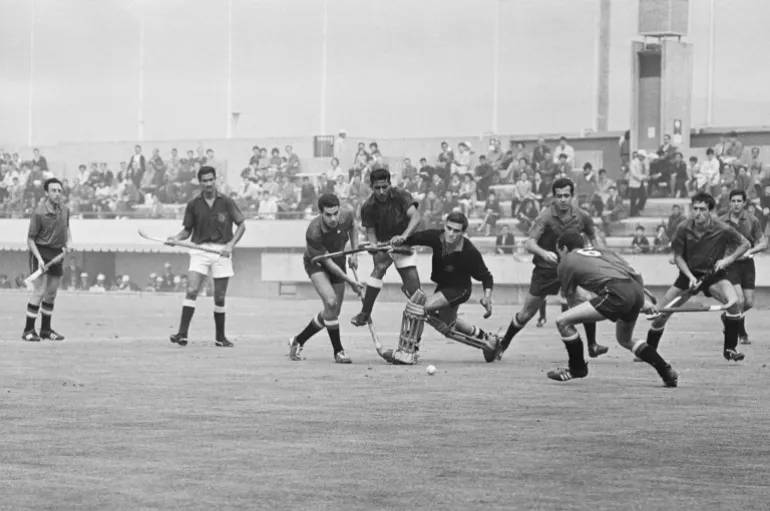
The significance of field hockey within the Pakistani national consciousness remains profound. From its first international engagement in 1948 against Belgium, Pakistan emerged as the preeminent athletic export, claiming four World Cup titles and three Olympic gold medals. The establishment of the PHF in 1948 initiated an era where Pakistan shaped the global game rather than merely participating in it. In the immediate post-independence decades, hockey served as a vital instrument of diplomacy. The 1960 Rome Olympics epitomised this ascendancy when Pakistan defeated India 1-0, ending a three-decade unbeaten streak. This period witnessed the maturation of the “Asian style,” a technical paradigm leveraging intricate stickwork, short-passing sequences, and individual flair to counterbalance the physical prowess of European contingents.
Pakistan’s influence reached its apogee under Air Marshal Nur Khan, whose tenure as PHF President catalyzed the creation of the Hockey World Cup in 1971 and the Champions Trophy in 1978. Despite geopolitical turbulence forcing the inaugural World Cup from Lahore to Barcelona, Pakistan clinched the first world championship, cementing its role as a global innovator and institutional exemplar.
Tactical Transitions and the Gradual Decline
The 1984 Los Angeles Olympics represented Pakistan’s final Olympic gold, a 2-1 victory over West Germany. Subsequent decades witnessed incremental erosion of dominance. The widespread adoption of synthetic turf transformed hockey into a speed-and-power-intensive discipline. While Pakistan adapted sporadically, including the 1994 World Cup triumph, a lack of domestic synthetic infrastructure relegated emerging talent to outdated grass surfaces, constraining the development of the explosive agility and endurance now requisite at the elite level. Consequences manifested in failure to qualify for the 2014 and 2023 World Cups and the continued absence from the Olympic podium post-1992 Barcelona.
The 2026 Australian Tour: Administrative Collapse and Humanitarian Crisis
The February 2026 FIH Pro League tour of Australia, envisaged as a re-entry into the sport’s elite echelons, devolved into a public relations and logistical catastrophe. Upon arrival, the team discovered cancelled hotel reservations due to PHF non-payment. Players endured hours stranded with luggage near Sydney’s Opera House and subsequent displacement in Canberra and Hobart. Captain Imad Shakeel Butt described these circumstances as “humiliating” and “unprecedented.” Athletes faced manual labor, cleaning kitchens, scrubbing bathrooms, and preparing meals, before competing against top-ranked international opponents. Mental and physical strain directly correlated with a winless campaign during the Australian leg, evidencing a causal link between administrative failure and on-field performance.
Efforts by management to suppress documentation of the ordeal further illustrate entrenched institutional insecurity. Captain Butt faced coercion to publicly assert normalcy, a demand rooted in the perception that unfiltered information could tarnish Pakistan’s national image abroad. Such strategies reveal an administration prioritising reputation over athlete welfare, while the eventual disclosure by Butt underscores the futility of image management divorced from operational competence.
Governance Disputes and Financial Malfeasance
The Australian crisis precipitated a public dispute between the PHF and the Pakistan Sports Board (PSB). PHF leadership cited delayed fund disbursement as the primary logistical impediment, whereas the PSB asserted timely release of over 10 million rupees. This financial ambiguity, despite a 250-million-rupee allocation by Prime Minister Shehbaz Sharif, signals endemic oversight deficiencies and potential corruption.
Under mounting scrutiny, PHF President Tariq Bugti tendered resignation on February 19, 2026, following a contentious two-year ban on Captain Butt, perceived as retaliatory for exposing federation failings. Subsequent governmental interventions removed key management figures, indicating acknowledgment of structural deficiencies yet highlighting leadership vacuums at a critical juncture.
Psychological Warfare and Athlete Welfare
Captain Butt highlighted internal mechanisms aimed at assessing loyalty, fragmenting team cohesion, and subordinating athletic objectives to administrative preservation. Elite-level performance requires cognitive flow and physiological recovery; coercion into domestic labor preceding international competition undermines these requisites, leading to quantifiable ranking losses. The team’s February 10 defeat to Australia resulted in a 1.32-point decrement, a metric reflecting tangible consequences of mismanagement.
Longstanding grievances, delayed allowances, inadequate remuneration, and reliance on departmental employment, compound the crisis. Former luminaries Samiullah Khan and Sohail Abbas advocate transparent audits, international exposure, and investment, emphasizing the discordance between antiquated operational paradigms and contemporary data-driven methodologies.
Structural Reforms and Strategic Recommendations
A comprehensive overhaul remains imperative. Proposed measures encompass financial autonomy through franchise-based professional leagues, integration of elite foreign coaching to modernize tactical frameworks, and nationwide deployment of synthetic turf to nurture youth talent. Only such structural recalibration can reestablish Pakistan as a competitive entity on the world stage.
Conclusion: Institutional Failure and the Path Forward
The decline of Pakistan hockey epitomizes institutional erosion rather than a mere lapse in competitive capability. Logistical mismanagement, athlete degradation, coercive administration, and fiscal opacity collectively delineate the contours of systemic failure. The resignation of PHF leadership constitutes an initial corrective measure, yet sustained revival mandates comprehensive reform across governance, coaching, infrastructure, and security domains. Contrasts between Pakistan’s technological organizational prowess and the mismanagement of its national sport underscore deficits in leadership intent rather than capability. Until transparent oversight, athlete-centric governance, and guaranteed security for domestic and visiting teams converge, the historic triumphs of 1960, 1971, and 1994 will recede into an increasingly distant and unattainable memory. The revolt led by Captain Imad Shakeel Butt embodies potential catalyst for accountability, offering a slender avenue to restore the “Green Machine” from relic to contender in the global hockey arena.