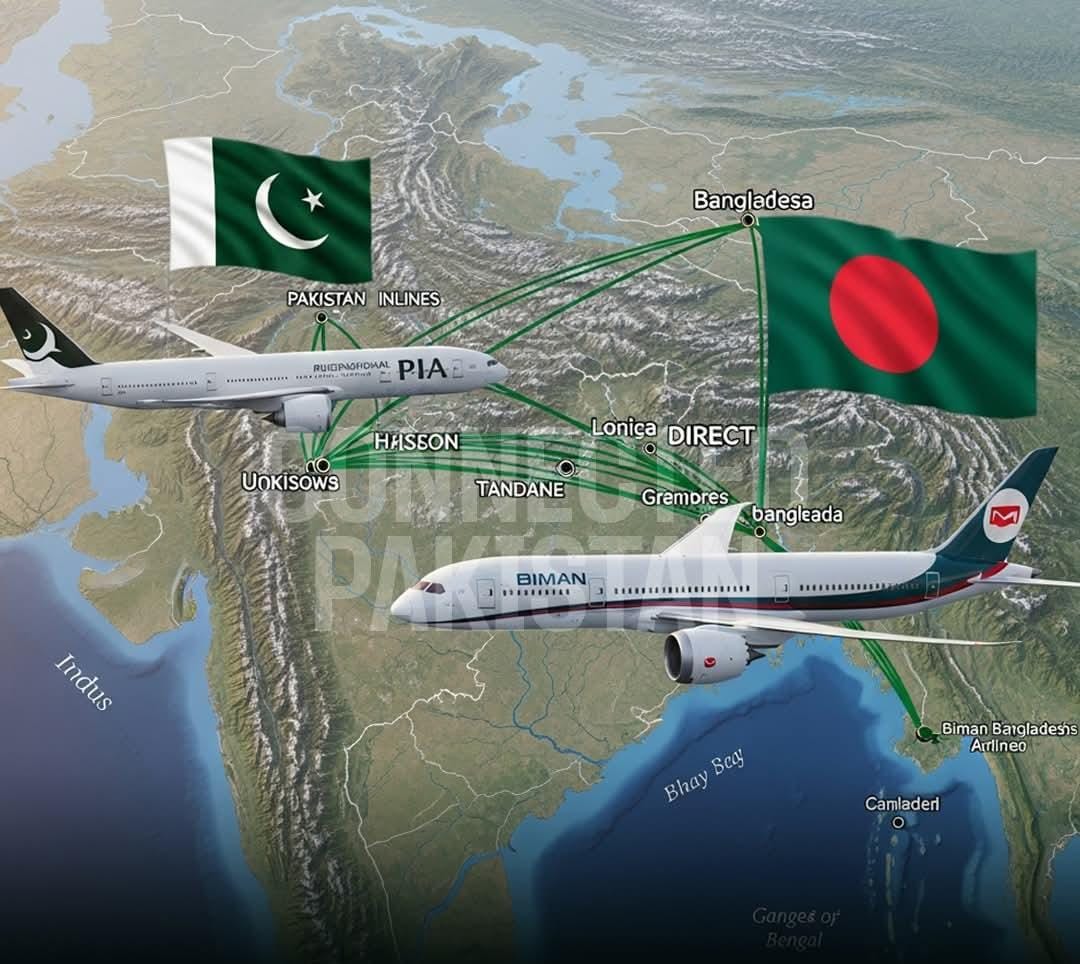
Pakistan and Bangladesh are entering a new phase of diplomatic recalibration that signals more than routine bilateral engagement, it suggests a structural shift in South Asian geopolitics. The meeting between Pakistan’s High Commissioner Imran Haider and Bangladesh’s Chief Adviser Professor Muhammad Yunus in Dhaka marks the most decisive thaw in relations in over a decade. The anticipated resumption of Karachi – Dhaka flights in January 2026, alongside a recorded 20% increase in bilateral trade, indicates that both nations are prioritizing economic logic over historical inertia. This shift is not occurring in a vacuum; it reflects broader regional turbulence, stalled SAARC mechanisms, and the search for alternate connectivity models outside India-centric frameworks.
Diplomatic Reset: From Stagnation to Re-Engagement
The era following 2015 had effectively reduced Pakistan – Bangladesh ties to symbolic diplomacy, restricted by political mistrust and residual tensions linked to historical grievances. That phase is now being recalibrated. The interim Bangladeshi government under Professor Yunus has adopted a policy approach oriented toward economic benefit rather than political emotion. The approval of a mutual visa exemption agreement for diplomatic officials, senior-level meetings, and structured dialogues around trade facilitation reflect institutional commitment rather than episodic goodwill. The shift is also influenced by generational political change within Dhaka, where pragmatic foreign policy is gaining ground over ideological rigidity. Islamabad, in turn, views this opening as an opportunity to diversify regional engagement at a time when traditional alignments are under pressure.
Aviation Reconnection: Karachi–Dhaka and the Reopening of a Frozen Corridor
The decision to restore direct Karachi–Dhaka flights after a decade represents a strategic undoing of the communication freeze that began in 2015. Even though the indirect routing due to India’s airspace restrictions increases travel time and operational cost, both sides appear willing to absorb this burden to ensure continuity. Biman Bangladesh Airlines and Fly Jinnah’s re-entry into the corridor moves beyond symbolism: it supplements the maritime link between Karachi and Chittagong that became operational earlier in 2025, gradually re-establishing a multi-modal connectivity network. This aviation resumption unlocks pathways for education, medical travel, trade of perishable goods, and business-to-business coordination that were previously diverted through Gulf hubs.
Economic Re-linking: A Gradual Return to Complementary Interdependence
Pakistan and Bangladesh are not competing economies, they are complementary ones. Bangladesh’s garment ecosystem relies on raw materials and chemicals in which Pakistan has export strength, while Pakistan benefits from Bangladesh’s manufacturing efficiency and evolving maritime logistics. The 20% growth in trade recorded last fiscal year, even without direct air links, illustrates latent demand that was artificially blocked by geopolitical tension rather than market reality. With shipping lines active and aviation reopening, trade diversification into pharmaceuticals, technology components, and high-value agriculture becomes a realistic possibility for 2026.
Education, Technology, and the Knowledge Corridor
Perhaps the least visible but most durable pillar of the rapprochement is academic diplomacy. The Allama Muhammad Iqbal Scholarships and technical cooperation frameworks position education as a strategic tool. Student mobility, medical fellowships, and training offers for Bangladeshi civil servants represent a bridge-building mechanism that avoids political provocation. As Western visa restrictions tighten, the creation of a regional “Knowledge Corridor” gives both nations an alternative pathway rooted in South Asian human capital rather than dependency on Europe or the UK.
Geopolitical Weight: India, SAARC, and the Search for Strategic Space
Bangladesh’s pivot is being closely monitored in New Delhi, where the prospect of Pakistan regaining diplomatic space in Dhaka is viewed as a complication to India’s security calculus. While Pakistan and Bangladesh are not seeking bloc politics, their warming ties challenge the unipolar regional order that evolved after 1971. If Dhaka successfully courts ASEAN as a dialogue partner while reinvigorating SAARC with Islamabad’s cooperation, the Indo-centric balance of South Asia will face its most serious challenge in a decade.
Conclusion: A Window of Opportunity
The emerging Pakistan–Bangladesh partnership is not guaranteed it is conditional. Political transitions in Dhaka, the February 2026 election outcome, India’s reactive posture, and the sustainability of institutional reforms will determine whether this reset matures or reverses. Yet, for the first time in years, both states are negotiating from interest, not memory; from cost-benefit logic, not grievance; from futures, not archives. If managed carefully, this realignment could restore the long-stalled South Asian connectivity axis and reopen the possibility of a cooperative regional architecture that had been declared dead long before its time.


![Shehbaz, Erdogan urge Gaza ceasefire, push for Palestine state, and boost Pakistan-Turkiye economic, defense ties. [Image via PMO]](https://pakasiayouthforum.com/wp-content/uploads/2025/04/4594869-851997240-300x177.webp)