Today is the tenth of Muharram. Yome Ashura.
Before Karbala gave this day its grief, and Karbala’s grief is real, and its moral weight is immense, and it is carried separately and with full reverence in the hearts of those who mourn it, this day belonged to a miracle that predates Islam’s formal revelation, that the Prophet Muhammad ﷺ himself honored with fasting, and that stands as one of the most fundamental moments in the moral history of monotheism.
It is the day Allah delivered Hazrat Musa عليه السلام.
When the Prophet ﷺ arrived in Medina and found the Jewish community observing a fast on this day, he asked why. They told him: this is the day Allah saved Musa and drowned Pharaoh. The Prophet ﷺ responded: “We have more right to Musa than you.” He fasted and instructed the Muslim community to fast on Ashura, connecting the ummah across centuries to the deliverance of a prophet who walked before Islam’s revelation but carried within him the same essential light that every prophet carried.
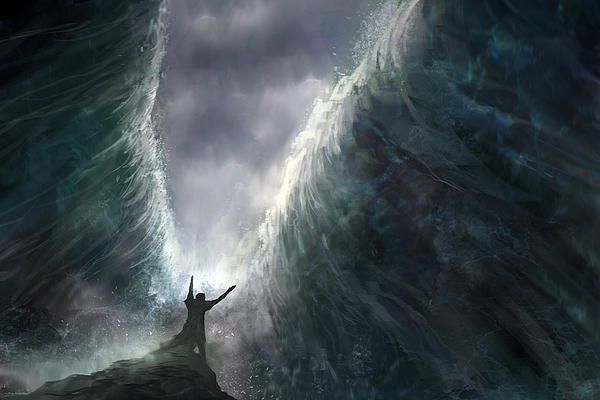
This is the Ashura that today’s editorial honours: the day Hazrat Musa عليه السلام placed his staff upon the waters and the sea split, and an enslaved people walked through to freedom.
The Staff, the River, and What It Took
Let us sit with the miracle itself, because the detail of the asaa, the staff of Musa عليه السلام, placed upon the waters of the Red Sea, is not incidental to the story. It is the story’s hinge.
Musa عليه السلام arrived at the water’s edge with Pharaoh’s army behind him, the sea before him, and a people who had just left Egypt looking at him with the ancient human question that fear produces in moments when the rational calculus offers no exit: what now?
The Quran records the moment with extraordinary compression. The people said to Musa: “Indeed, we are to be overtaken.” Musa replied: “No. Indeed, with me is my Lord; He will guide me.” And the command came: “Strike the sea with your staff.”
He struck it. And the sea split, twelve paths opening through it, one for each tribe of Israel, the walls of water standing on either side like mountains.
What deserves reflection is not merely the supernatural dimension of this moment, though that dimension is real and is the foundation of the miracle’s significance. What deserves reflection is the sequence: the staff raised, the command obeyed, the action taken, and then the opening.
The sea did not split before Musa struck it. It split because he struck it. The miracle required the motion of faith before it delivered the fact of deliverance. Musa عليه السلام did not stand at the water’s edge calculating the probability of the sea splitting and then, having satisfied himself that the odds were favourable, raise his staff. He raised it in full uncertainty of the physical outcome, with full certainty of the One who had commanded him to raise it.
This is the spiritual architecture of Ashura. Not the passive waiting for divine rescue. The active faith that moves before the miracle arrives, that takes the step onto the water before the water has parted, that raises the staff before the sea has answered.
The Pharaoh That Every Era Produces
The story of Musa عليه السلام and Pharaoh is not a story that ended at the Red Sea. It is the story that every generation of the oppressed and the powerful reenacts in its own context, sometimes consciously, more often without awareness of the script they are following.
Pharaoh was not simply a cruel man. He was a system. He was the embodiment of a political and social order built entirely around the concentration of power, the exploitation of the powerless, and the theological justification of both. He claimed divinity, not as a personal eccentricity but as a political architecture, a way of making the existing order appear cosmically inevitable rather than humanly constructed and therefore humanly changeable. As long as Pharaoh was divine, the slavery of his subjects was natural. As long as the order appeared ordained rather than imposed, resistance appeared not merely dangerous but sacrilegious.
Musa عليه السلام’s mission was therefore not simply to lead his people out of Egypt. It was to dismantle, in their minds first and then in history, the theological justification for their own enslavement. To say to a people who had been told for generations that their bondage was the will of the cosmos: it is not. The cosmos wills your freedom. The God who made you did not make you for this.
That message, you were not made for this, is the message that Ashura carries to every generation of the oppressed. To the communities whose genuine grievances are exploited by those who profit from keeping them unresolved. To the populations whose futures are mortgaged by the ideological rigidities of those who govern them. To the girls in Waziristan who are told that their education violates a divine order that is, in truth, nothing more than the fear of the powerful dressed in religious vocabulary.
You were not made for this. The God who made you made you for freedom, for knowledge, for dignity. The Pharaoh who tells you otherwise is not speaking for the divine. He is speaking for himself.
Ashura as Shared Civilisational Memory
There is something profound and insufficiently celebrated in the fact that Ashura, the tenth of Muharram, is observed today across the Muslim world not only as the day of Karbala’s grief, but as the day of Musa’s deliverance. And that the deliverance of Musa is itself a memory shared, in different registers, with Jewish and Christian communities who carry the Exodus in their own sacred narratives.
This is not syncretism. It is the recognition that the great moral moments of human history belong, in some sense, to all of humanity, that the splitting of the sea is not merely a Jewish memory or a Muslim commemoration but a civilisational inheritance that speaks to anyone who has ever stood at the edge of what appears impossible and been commanded to move anyway.
When Pakistan observes Ashura today, in its mosques, in its processions, in the quieter observance of its fasting citizens, it does so as part of a civilisational conversation that crosses borders in ways that the political conflicts of the present moment cannot fully interrupt. Iran observes Ashura. Turkey observes Ashura. Egypt observes Ashura. Indonesia, Malaysia, Bangladesh, the Muslim communities of Central Asia, the diaspora communities of Europe and North America, all pausing today before the same tenth of Muharram, remembering the same sea, honouring the same prophet, drawing on the same moral inheritance.
This shared observance is itself a form of public diplomacy that PAYF has always believed in, the recognition that what connects Muslim-majority societies at the level of civilisational memory and moral inheritance runs deeper than what divides them at the level of contemporary political competition. The tenth of Muharram does not belong to any single nation or sect. It belongs to the ummah, and through the ummah’s connection to Musa عليه السلام, to the broader human family that has always needed the reminder that Pharaoh’s armies drowned and enslaved peoples walk through.
For Pakistan in particular, this civilisational dimension of Ashura carries specific resonance. Pakistan was founded on the conviction that a Muslim people had the right to a homeland in which their values, their culture, and their civilisational inheritance could find political expression. That conviction was itself, in its deepest roots, a Musaean conviction, the conviction that a people defined by their faith and their history have the right to walk through whatever sea stands between them and the freedom to be fully themselves.
Jinnah’s Pakistan and Musa’s Exodus share a moral grammar: that the dignity of a people is not contingent on the permission of the power that oppresses them. That the right to self-determination is not a political concession to be granted by the powerful but a divine endowment to be claimed by the living.
What the Day Asks of Pakistan’s Youth
PAYF speaks today to Pakistan’s youth, the 64 per cent of a nation of 245 million who are under thirty, who carry within them both the inheritance of this civilisation and the responsibility for what it becomes.
Ashura asks something specific of the young. It asks the question that Musa عليه السلام answered with a raised staff at the water’s edge: when the impossible stands before you and the command to move arrives, do you move?
Not in the dramatic sense of miraculous military confrontation. In the daily sense. The impossible stands before Pakistan’s youth in the form of a country that contains within it extraordinary potential and extraordinary dysfunction simultaneously. The schools that are bombed and the children who walk to tents to learn in them anyway. The soldiers who stand at checkpoints and the families who wait for them to come home. The young women who pursue education despite every social and physical obstacle placed before them, and the young men who must decide whether the society they build will honour or obstruct that pursuit.
The sea that Pakistan’s youth must strike with their staff is not the Red Sea. It is the sea of normalised corruption, of accepted injustice, of the comfortable silence that allows what should not be normal to become invisible through repetition. It is the sea of the assumption that what is wrong is fixed, that what is broken cannot be repaired, that what is unjust is inevitable.
Musa عليه السلام raised his staff, and the sea split. The miracle was real. But the staff had to be raised first.
The Waters Still Part
On this tenth of Muharram, across Pakistan and across the Muslim world and in the deeper memory of every human tradition that carries the Exodus in its bones, humanity remembers a morning when the enslaved walked through the sea, and the army of Pharaoh did not follow them out the other side.
It remembers that the arc of divine justice, however long it takes, however impossible its vindication appears from the water’s edge, does not ultimately bend toward the Pharaoh. It remembers that the staff raised in faith, before the miracle arrives, is what the miracle requires.
It remembers Musa عليه السلام, a man born into slavery, raised in the palace of his people’s oppressor, called to a mission he initially felt unworthy of, who stood at the impossible edge and raised his staff anyway.
And it remembers that the waters parted. Not before he raised it. When he raised it.