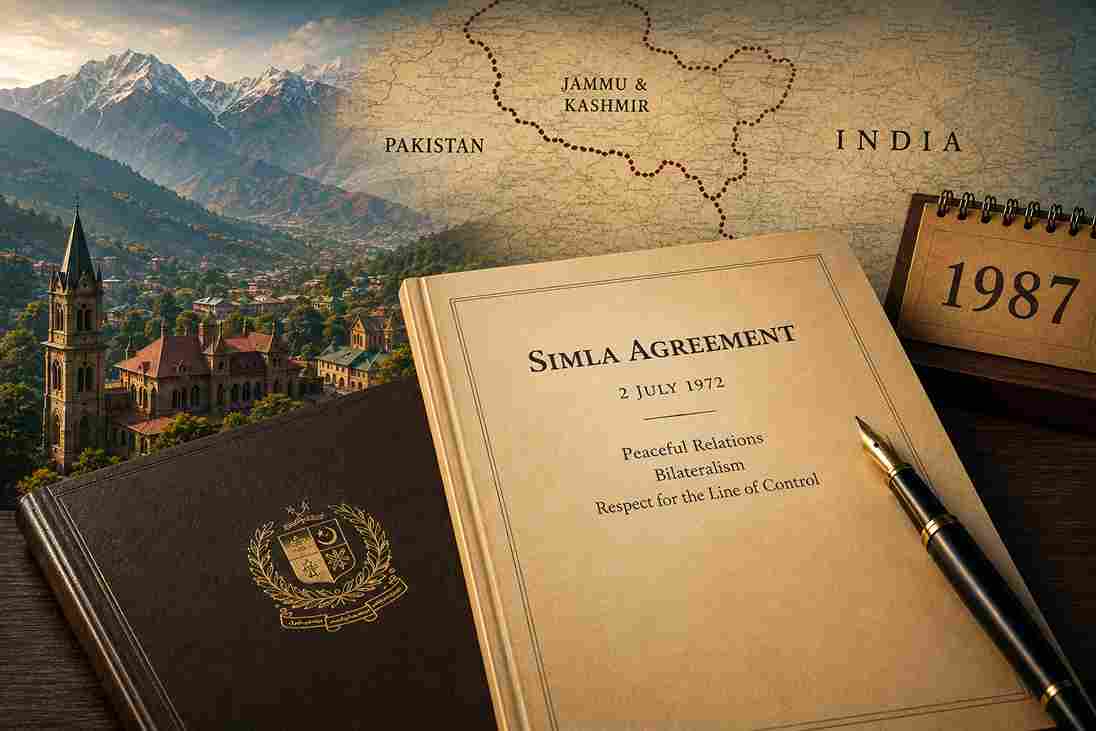
Few documents capture the gap between diplomatic promise and political reality in Jammu and Kashmir better than the Simla Agreement of 1972. Signed by Prime Minister Indira Gandhi and President Zulfikar Ali Bhutto after the 1971 war, it committed both states to resolve their differences bilaterally, respect the Line of Control, and work toward a “final settlement” of Jammu and Kashmir.
For Pakistan, accepting bilateralism over international mediation was a significant concession made in good faith that direct engagement would eventually honor the self-determination of the Kashmiri people, as envisioned by earlier UN resolutions.
That promise remained largely unfulfilled. Fifteen years later, the 1987 Jammu and Kashmir state election became a stark test of whether genuine political space existed for Kashmiris within the system. Held only months after Farooq Abdullah’s National Conference struck an electoral alliance with the Congress party, the contest pitted this ruling coalition against the Muslim United Front, a coalition of religious and political groups that had deliberately chosen the ballot over separatism to press Kashmiri political demands.
The MUF fielded candidates across a number of constituencies where they were widely expected to perform strongly, drawing significant youth mobilization and voter enthusiasm in the run-up to polling. Independent accounts, including reporting in The Caravan and academic analysis by scholars such as Sten Widmalm, describe an “election cartel” between the ruling parties and irregularities during counting, including contested results in seats the MUF was expected to win, that curtailed the coalition’s gains and left its supporters convinced the outcome had been engineered.
The episode left a lasting mark on Kashmiri political life. For a generation that had chosen to test the democratic process rather than reject it, the disputed result eroded confidence that electoral participation could genuinely translate popular will into political representation.
That erosion of trust continues to shape political discourse in the region today including renewed calls in recent years, such as the Jammu and Kashmir People’s Conference’s demand for a judicial probe into the 1987 result, for accountability and an honest reckoning with what many Kashmiris still regard as a foundational injustice.
Together, Simla and 1987 illustrate a recurring pattern: diplomatic commitments to peace and self-determination have not always been matched by political practice on the ground. This remains directly relevant to how the dispute should be approached today.
A durable resolution requires engaging honestly with the political aspirations of the Kashmiri people, consistent with the principles of self-determination that the UN Security Council, and at times India itself, has acknowledged.
For Pakistan, this history underscores the value of sustained, principled diplomatic advocacy through Track II and Track 1.5 channels, academic exchange, and international engagement that keeps Kashmiri political rights central to the discourse, rather than reducing the dispute to territorial or security terms alone.