Background
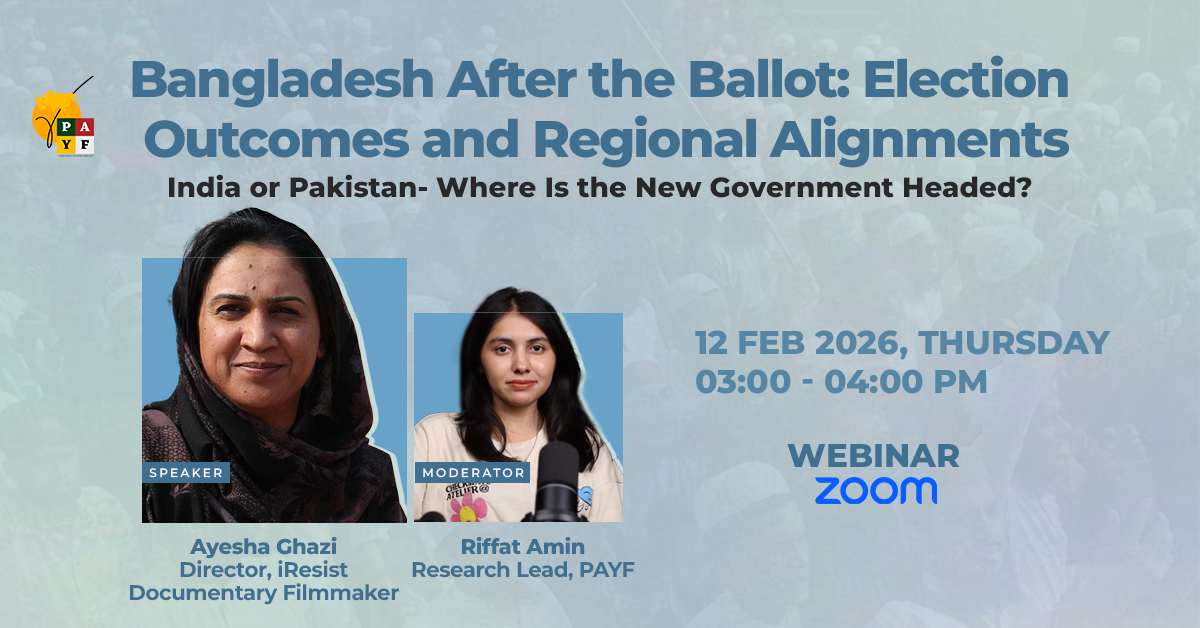
The webinar was convened to examine Bangladesh’s ongoing elections within a broader regional and geopolitical framework. Rather than focusing solely on electoral outcomes, the session explored how Bangladesh’s post–July 2024 political transition intersects with democratic consolidation, youth mobilization, and shifting regional alignments in South Asia.
The discussion featured Ms. Aisha Ghazi as a speaker, offering an in-depth analysis of Bangladesh’s evolving political order and its regional implications.
Context
South Asia is undergoing a period of political recalibration marked by youth-led uprisings, digital political engagement, and intensified regional competition. In Bangladesh, the August 2024 student-led uprising that ended the tenure of Sheikh Hasina marked a decisive political turning point.
The current elections are widely viewed as a test of democratic resilience in a post-revolutionary environment. The primary electoral contest between the Bangladesh Nationalist Party (BNP) and a Jamaat-e-Islami-led coalition, including the National Citizens Party (NCP), reflects deeper ideological shifts and structural realignments.
At the same time, Bangladesh’s strategic location near the Bay of Bengal and increasing attention from regional and global actors including India, Pakistan, China, and the United States have elevated its geopolitical importance.
Key Points
Democratic resilience under scrutiny:
While elections signal procedural democracy, sustainable democratic consolidation requires institutional reform, accountability mechanisms, and protection against elite capture.
Post-revolutionary vulnerability:
Transitions following popular uprisings often create openings for renewed external influence and internal power restructuring if structural safeguards remain weak.
Regional recalibration:
The new government regardless of composition is expected to pursue a balancing strategy, maintaining working ties with India while cautiously expanding diplomatic and economic engagement with Pakistan and other regional actors.
India’s embedded influence:
Despite growing domestic criticism of Indian dominance, geographic realities and historical ties ensure that India will remain a central factor in Bangladesh’s foreign policy calculations.
Youth mobilization and institutional reality:
Although youth were instrumental in the July 2024 uprising, translating revolutionary energy into meaningful parliamentary representation and governance reform remains uncertain.
Governance priorities:
Institutional checks and balances, economic diversification, strategic autonomy, and sovereignty protection were identified as essential for long-term stability.
Discussion Summary: Speaker Remarks
Ms. Aisha Ghazi provided a comprehensive analysis of Bangladesh’s political trajectory, emphasizing the country’s historically turbulent political evolution. She argued that while electoral transitions provide opportunities for renewal, deeper structural weaknesses persist within democratic institutions.
On foreign policy, she suggested that Bangladesh is unlikely to align exclusively with any single regional power. While renewed engagement with Pakistan may increase diplomatically, overt alignment would likely be moderated by strategic pragmatism. At the same time, India’s geographic proximity and longstanding influence will continue to shape Dhaka’s external policy decisions.
Ms. Ghazi also examined the expanding role of China and the United States in Bangladesh’s strategic environment, particularly in the context of infrastructure investment, connectivity initiatives, and maritime access. She noted that Bangladesh’s rising geopolitical relevance places it at the center of competing regional interests.
Regarding youth politics, she reflected on the paradox of revolutionary movements: while youth activism can dismantle entrenched leadership, sustaining that momentum within formal governance structures is considerably more complex. The July 2024 uprising, she noted, was transformative symbolically but remains incomplete institutionally.
Closing Remarks
The session concluded with the recognition that Bangladesh stands at a pivotal crossroads. The elections represent not merely a political transition but a broader test of democratic credibility, institutional reform, and strategic autonomy.
Ms. Ghazi emphasized that long-term stability will depend on strong governance mechanisms, balanced foreign policy engagement, and the translation of popular mobilization into structured, accountable political participation.
The webinar ended with a call for continued research, regional dialogue, and sustained youth engagement to ensure that Bangladesh’s political transformation evolves into lasting democratic consolidation.