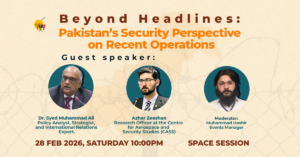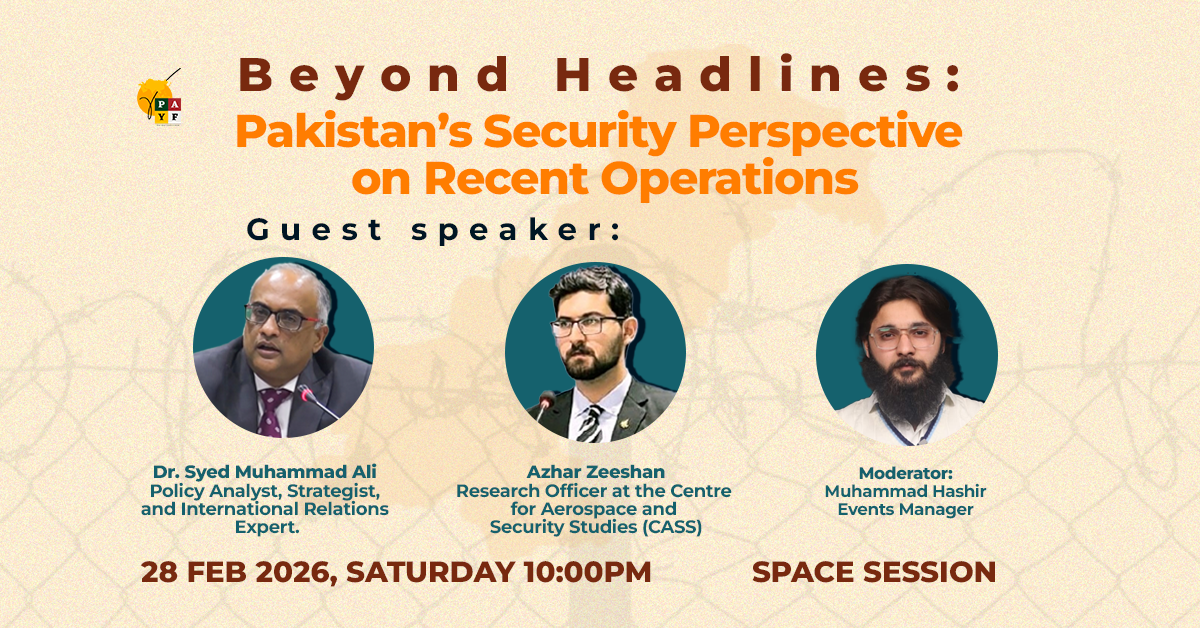
First Speaker was Azhar Zeeshan, who is a Research Officer at the Centre for Aerospace and Security Studies (CASS), he joined the session and delivered his informative insights, and theother invited speaker was Dr. Syed Muhammad Ali, who is a policy analyst, strategist, and international relations expert, although Dr. Ali was unable to join the session due to some issueson his side. The webinar was moderated by Muhammad Hashir, Events Manager at the Pak Asia Youth Forum (PAYF).
Overview
Pak Asia Youth Forum (PAYF) conducted an in-depth X Space session titled “Beyond Headlines: Pakistan’s Security Perspective on Recent Operations” to critically examine the resurgence of terrorism in Pakistan and the state’s evolving counterterrorism approach towards it.
The session aimed to move beyond surface-level media narratives and emotional reactions, providing participants with a structured understanding of the strategic, political, and regional dimensions shaping Pakistan’s current security operations.
Context and Framing
Over recent months, Pakistan has witnessed a visible increase in terrorist incidents targeting both security personnel and civilians across the country. The recent targeting of public spaces and places of worship underscores a significant shift in the threat landscape, suggesting that risks now extend beyond conventional security installations into the broader societal fabric.
The discussion framed these developments within a broader regional context, specifically analyzing how the persistence of cross-border militant sanctuaries and the shifting militant alliances continue to destabilize the frontier. It further examined the deep-seated complexities of Pak-Afghan relations, where historical grievances and modern security imperatives often collide, creating a volatile environment that necessitates a more sophisticated, multi-layered approach to regional diplomacy and border management.
The central analytical question guiding the session was:
Are the recent operations a limited tactical response, or do they signal a broader recalibration of Pakistan’s counterterrorism doctrine?
Rising Terrorism and the Expanding Threat Landscape
The speaker highlighted that the nature of recent attacks suggests a deliberate strategy aimed at societal destabilization. The targeting of civilians alongside security forces reflects an attempt to undermine public confidence, provoke sectarian tensions, and challenge the writ of the state.
The discussion emphasized that contemporary militant networks operate through hybrid tactics, combining physical violence with digital propaganda, psychological messaging, and coordinated narrative framing. This evolving threat environment requires responses that go beyond traditional battlefield thinking.
Pakistan’s Response and Cross-Border Operations
A major segment of the session examined Pakistan’s reported targeting of Tehreek-e-Taliban Pakistan (TTP) hideouts inside Afghanistan.
It was clarified that Pakistan’s official position frames these actions as counterterrorism measures directed at non-state militant actors operating from Afghan soil, rather than as actions against the Afghan state itself.
The discussion acknowledged the sensitivity of cross-border kinetic operations in international relations, particularly given regional power dynamics and diplomatic considerations. Participants explored whether such actions represent escalation or defensive counterterrorism under persistent threat conditions.
Negotiations versus Kinetic Strategy
The session critically reviewed the historical ceasefire arrangements and negotiation attempts between the state and the TTP. Participants analyzed how temporary lulls in hostilities, intended as windows for dialogue, were frequently undermined by tactical violations that led to an inevitable collapse of trust. This cycle suggests that while negotiations were once viewed as a viable conflict-management tool, the consistent breakdown of these efforts has exhausted the diplomatic route. Consequently, there is now a decisive shift toward a more robust enforcement-led strategy, prioritizing state authority and kinetic operations over the pursuit of fragile and temporary political settlements.
Regional and Strategic Complexities
A key analytical dimension of the discussion centered on the broader regional implications.
Participants examined the challenges faced by the Taliban government in taking decisive action against TTP elements. Concerns were raised that aggressive moves against TTP could potentially lead to internal militant fragmentation, with some factions realigning with Islamic State-Khorasan Province (ISKP). This possibility adds a layer of strategic complexity, as regional security calculations are intertwined with internal Afghan dynamics.
The session emphasized that it has become the need of the time and that Pakistan’s policy choices must therefore balance immediate security needs with long-term regional stability considerations.
Tactical Success versus Political Stability
While acknowledging the necessity of counterterrorism operations under rising threat conditions, the discussion emphasized that military victories alone do not guarantee sustainable peace; short-term tactical gains must be integrated into a broader framework that includes political clarity, institutional coordination, intelligence strengthening, narrative management and counter-propaganda, regional diplomatic engagement, and long-term governance reforms, because without this multi-dimensional strategy kinetic operations risk addressing symptoms rather than root causes.
Strategic Recalibration: Tactical Response or Doctrinal Shift?
The session repeatedly returned to the central analytical theme: whether Pakistan is merely responding to immediate attacks or redefining its overall counterterrorism posture.
Participants noted that recent actions suggest a more assertive and proactive posture. However, the long-term trajectory will depend on whether these measures are accompanied by clear political signaling, policy continuity, and structured institutional reforms.
Conclusion
The PAYF X Space session provided a comprehensive and balanced examination of Pakistan’s current security environment.
The discussion concluded that the resurgence of terrorism must be understood within a broader regional and strategic context. While military operations remain a critical component of national security, sustainable peace requires policy consistency, diplomatic engagement, institutional resilience, and a comprehensive counterterrorism roadmap.