When the Taliban unveiled their interim cabinet in Kabul on September 7, 2021, the announcement itself told the story before a single policy was drafted. Twenty-eight names were read out.
Every one belonged to a man. Not a single woman held a portfolio, a deputy post, or even a symbolic seat at the table. Days later, when the cabinet was expanded to include more ministers and deputies, the pattern repeated. Despite mounting international criticism, the list released on September 21 was, once again, entirely male.
A spokesman for the group suggested women might be added “at a later time,” but offered no timeline and no specifics. That vague promise has now sat unfulfilled for nearly five years.
This was not an oversight. It was a decision, and a fairly loud one. Within weeks of taking Kabul, the Taliban had already signaled that women would not occupy senior government posts.
The clearest gesture of this intent came when the Ministry of Women’s Affairs, the very institution created to advocate for women’s interests within government, was dismantled and its building repurposed for the Ministry for the Promotion of Virtue and Prevention of Vice, the same body that enforced strict religious codes during the Taliban’s first period of rule in the 1990s.
A ministry meant to represent women had been replaced by one designed to police them.
To understand what was lost, it helps to look at what came before. The Islamic Republic of Afghanistan was far from a model of gender equality. According to Inter-Parliamentary Union data from January 2021, women held only about 6.5 percent of ministerial positions in the outgoing government, a modest figure by any global standard.
But modest is not the same as absent. Women sat in parliament, numbering roughly a quarter of its seats under a constitutional quota. They served as judges, provincial governors, ambassadors, and civil servants. Fawzia Koofi, a former member of the National Assembly, spoke for many when she argued publicly, even as the Taliban were negotiating the shape of the new government, that a men-only cabinet would simply not be “complete.”
Her comment captured what the historical record already showed: whatever its flaws, the republic had built institutional channels, however narrow, through which women could raise political concerns, propose legislation, and hold office. Those channels were shut in a matter of weeks.
Afghan women themselves recognized this immediately. In September 2021, before the ink on the new cabinet list had dried, dozens of women marched through Kabul and Herat demanding inclusion.
Their protests were a kind of early warning. They understood that a government formed without women in its founding structure was unlikely to make room for women later, and they were right.
It would be convenient to treat the cabinet’s composition in 2021 as a discrete event, separate from what followed. Since retaking power, the Taliban have issued more than 260 decrees touching on human rights, and researchers tracking these edicts found that roughly two-thirds of them, over 160, specifically target the rights of women and girls.
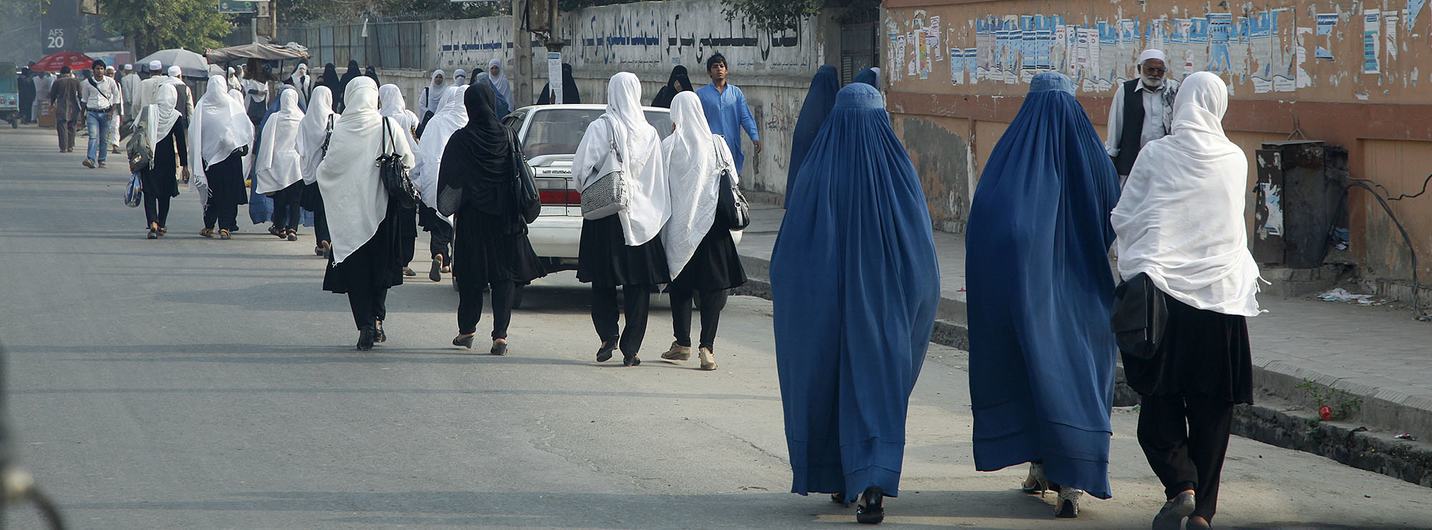
Secondary and higher education for girls remains banned. Most professions are closed to women. The August 2024 “Propagation of Virtue and Prevention of Vice” law went further still, requiring women to fully cover their faces in public, restricting their ability to speak or be heard outside the home, and curbing their freedom of movement, employment, and political participation almost entirely.
Seen this way, the absence of women from the September 2021 cabinet was not a separate grievance sitting alongside later restrictions. It was the opening move in a single, continuous project.
A government that begins by excluding women from its own decision-making structure has already answered the question of whether it intends to protect their political voice.
Everything that followed, from the closure of the Women’s Affairs Ministry to the dress and movement codes of 2024, reads less like a series of unrelated crackdowns and more like the steady execution of a plan whose first chapter was written in the cabinet announcement itself.
The human rights reporting published this year confirms that the trajectory has continued downward rather than leveling off. The United Nations Human Rights Office’s report, covering August 2025 through January 2026 and presented to the Human Rights Council in Geneva, described conditions for Afghan women and girls as having worsened sharply, citing the cumulative weight of Taliban edicts on top of a humanitarian emergency now affecting nearly 22 million people.
Human Rights Watch’s World Report 2026 documented that the Taliban deepened their repression through 2025, adding new restrictions on movement and public space even as existing bans on education and employment remained fully in force.
In July, the International Criminal Court issued arrest warrants against senior Taliban leaders on charges of gender persecution as a crime against humanity, a first for this specific charge and a signal that international legal bodies now view the treatment of Afghan women not merely as discriminatory policy but as systematic persecution.
Amnesty International’s most recent findings echo this, noting that women from Hazara and other minority backgrounds face an added, compounding layer of discrimination on top of the restrictions applied to all Afghan women.
UN Women’s own accounting is blunt: not a single edict restricting women’s rights has been reversed since 2021. None. Five years of protest, diplomatic pressure, and documentation have not produced a single rollback.
None of this should be read as nostalgia for the republic that preceded the Taliban, which had its own record of corruption, uneven governance, and slow progress on women’s participation. The point is narrower and, for that reason, harder to dispute.
A government that includes no women at its founding, that dissolves the one ministry built to represent their interests, and that replaces it with an enforcement body, is not a government that will discover inclusion later through goodwill.
Five years on, the reports from Geneva, from Human Rights Watch, from the ICC’s own prosecutors, are simply describing the fulfillment of that blueprint in increasingly granular detail.
The question facing the international community is no longer whether the Taliban will include women in governance. That question was answered in a conference room in Kabul in September 2021.
The question now is whether continued diplomatic engagement with a government built on that exclusion will ever be conditioned on reversing it, or whether the world will keep treating each new decree as a fresh outrage.