Background
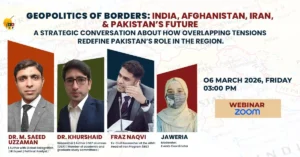
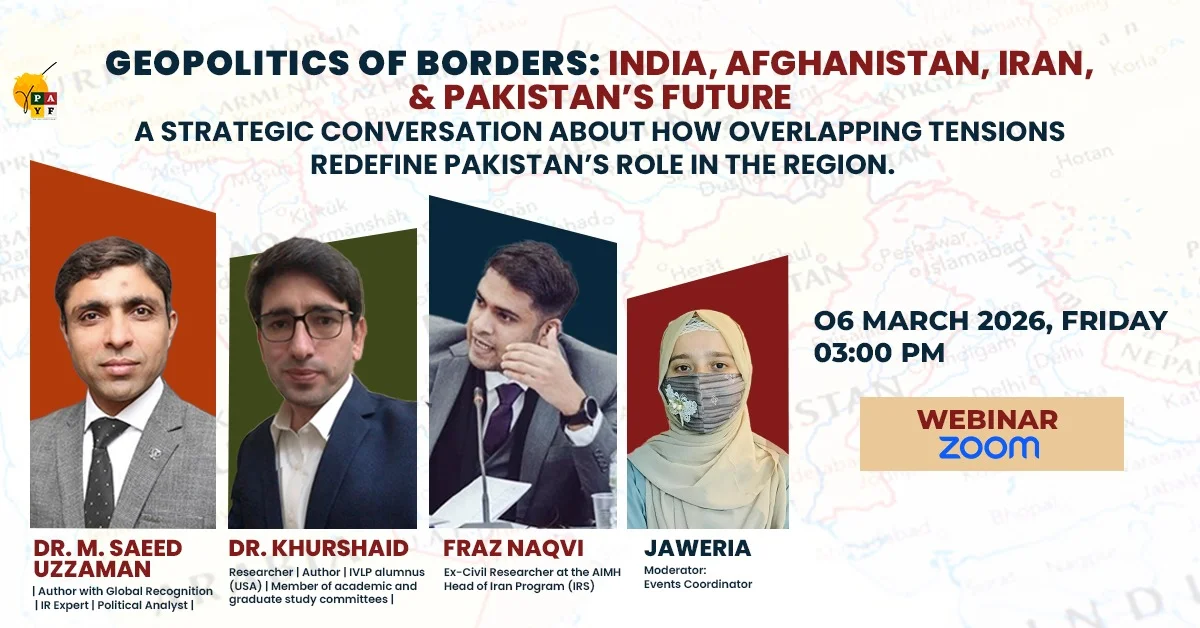
The webinar was organized to examine Pakistan’s geopolitical environment within the broader regional dynamics of South Asia and the Middle East. Rather than focusing solely on bilateral disputes, the discussion explored how Pakistan’s borders with India, Afghanistan, and Iran shape its security outlook, foreign policy priorities, and regional positioning.
The session featured prominent experts including Dr. M. Saeed Uz Zaman, Dr. Khurshid, and Faraz Naqvi, who provided analytical perspectives on the strategic challenges and opportunities facing Pakistan in an increasingly complex geopolitical landscape.
Context
South Asia and its surrounding regions are currently experiencing heightened geopolitical competition, evolving security dynamics, and shifting alliances. Pakistan’s geographic position places it at the intersection of South Asia, Central Asia, and the Middle East, making regional developments particularly significant for its strategic stability.
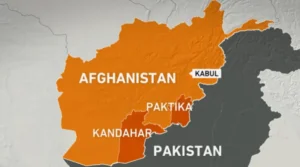
Tensions between India and Pakistan continue to shape the regional security environment, particularly in light of long-standing disputes such as Kashmir. Simultaneously, developments in Afghanistan, particularly following the return of the Taliban government after the withdrawal of United States forces, have created new security challenges along Pakistan’s western border.
At the same time, regional tensions involving Iran and developments in the broader Middle East carry potential implications for Pakistan’s economic and strategic interests. These overlapping dynamics highlight the importance of balanced diplomacy, internal stability, and regional cooperation.
Key Points
Geopolitical pressure on multiple fronts:
Pakistan faces simultaneous strategic pressures along its eastern and western borders, requiring a balanced security and diplomatic strategy to manage relations with neighboring states.
Security challenges after the Afghan transition:
The political transformation in Afghanistan has contributed to rising concerns regarding cross-border militancy and regional instability.
Enduring India–Pakistan rivalry:
Historical disputes, ideological differences, and unresolved territorial conflicts continue to shape the strategic competition between the two countries.
Iran’s regional role:
Developments in Iran and the broader Middle East may influence Pakistan’s economic and political environment, particularly through energy routes and regional connectivity.
Internal stability as a strategic necessity:
Speakers emphasized that Pakistan’s geopolitical resilience depends not only on external diplomacy but also on domestic political stability, economic development, and institutional strength.
Discussion Summary: Speaker Remarks
Dr. M. Saeed Uzzaman highlighted the evolving regional security environment, noting that Pakistan’s geopolitical challenges are closely tied to developments in neighboring states. He argued that the situation in Afghanistan remains a critical factor affecting Pakistan’s internal security, particularly due to concerns regarding militant groups operating near the border.
He also addressed the continuing rivalry between Pakistan and India, explaining that unresolved historical disputes and strategic mistrust continue to influence bilateral relations. According to him, regional stability requires sustained diplomatic engagement and confidence-building measures.
Dr. Khurshid focused on Pakistan’s geographic realities and their influence on foreign policy behavior. He explained that Pakistan’s strategic location offers both opportunities and vulnerabilities, particularly due to its proximity to multiple politically sensitive regions.
He emphasized that Pakistan’s long-term regional influence depends significantly on internal reforms, including political stability, economic resilience, and improved governance structures. Strengthening domestic institutions, he suggested, would enhance Pakistan’s ability to navigate complex geopolitical dynamics.
Faraz Naqvi examined Pakistan’s relations with Iran and the broader Middle Eastern geopolitical landscape. He highlighted that stability in Iran is important for Pakistan’s western regions, particularly in Balochistan, where cross-border developments can have economic and security implications.
He argued that Pakistan must pursue a pragmatic and balanced foreign policy that maintains stable relations with all regional actors while protecting its national interests.
Closing Remarks
The session concluded with the recognition that Pakistan’s geopolitical environment is shaped by multiple overlapping regional dynamics. Managing relations with neighboring states while strengthening internal governance and economic stability will remain essential for Pakistan’s long-term strategic outlook.
The speakers emphasized that constructive diplomacy, regional cooperation, and institutional resilience are key factors in transforming geopolitical challenges into opportunities for sustainable development and regional stability.
The webinar ended with a call for continued dialogue, policy research, and youth engagement in discussions on regional geopolitics and Pakistan’s future strategic direction.Geopolitics of Borders: India, Afghanistan, Iran, & Pakistan’s Future