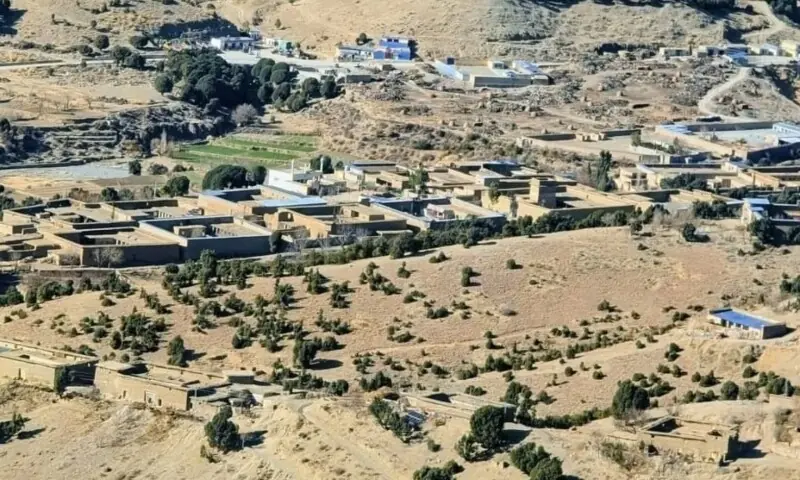
Late on a Tuesday night in Sara Ghowara, Birmal tehsil, unidentified miscreants placed explosive material against the walls of a government girls’ primary school and walked away. The building collapsed in the blast. No children were inside; the cowardice of those who do this extends to the hour they choose, the darkness they require, the anonymity they hide behind.
No one has claimed responsibility. No one ever does, for this particular crime. Because even those who destroy schools understand, on some level, that there is no theology, no ideology, no cause on earth that can be dressed in language noble enough to justify blowing up a classroom where girls learn to read.
This is the third school attacked in Birmal tehsil in recent months. In December 2025, a girls’ school in Mir Ali, North Waziristan, was destroyed by explosives. In October, a girls’ primary school in Wanda Zahidgul, Lakki Marwat, was blown up. The pattern is not random. The target is not infrastructure. The target is the future of girls who live in areas where accessing education already requires extraordinary effort, and where every destroyed school building sends a message that the effort is not worth making.
PAYF refuses to let that message stand unanswered.
What Islam Actually Says About Education
The miscreants who bomb girls’ schools in the name of some imagined religious obligation have not read the faith they claim to defend. Or if they have read it, they have understood it with a deliberateness of distortion that itself constitutes a form of scholarly crime.
The first revelation of the Quran was not a command to fight. It was not a command to restrict. It was not a command to destroy. It was: Iqra, Read. The very first word revealed to the Prophet Muhammad ﷺ was a command to literacy, to knowledge, to the engagement of the human mind with the world and with the divine.
The Prophet Muhammad ﷺ said: “Seeking knowledge is an obligation upon every Muslim.” Every Muslim. The Arabic construction of that hadith, kullu Muslim, does not contain a gender qualification. Islamic scholarship across fourteen centuries has understood this to include women as fully and unambiguously as men. The obligation to seek knowledge is not a male privilege. It is a human obligation, one that Islam placed at the foundation of its entire civilisational project.
The same Prophet ﷺ who delivered that command was married to Khadijah bint Khuwaylid, a businesswoman, an employer, a woman of such intellectual and moral standing that it was she who first recognised and articulated the prophethood of her husband. It was the Prophet ﷺ who told his companions to “take half your religion from Humayra,” referring to Aisha bint Abi Bakr, whose scholarship became one of the primary transmission channels for Islamic knowledge to subsequent generations.
Those who blow up girls’ schools in the name of Islam are not defending Islam. They are vandalising its intellectual inheritance.
The Women Islam Produced — And What They Built
The history of Muslim women in scholarship is not a footnote. It is a chapter that the militants who bomb primary schools in Waziristan have either never read or deliberately chosen to erase.
Aisha bint Abi Bakr was one of the most prolific narrators of hadith in Islamic history, transmitting over 2,000 narrations, teaching male and female students alike, and issuing legal rulings that shaped Islamic jurisprudence for centuries. She was not merely a passive transmitter. She was an active, confident, and sometimes combative intellectual who corrected companions of the Prophet ﷺ when she believed they had erred, and who was deferred to when she did.
Fatima al-Fihri founded the University of al-Qarawiyyin in Fez, Morocco, in 859 CE, the oldest continuously operating university in the world, according to UNESCO. She was not a figurehead. She designed the institution, funded it from her own inheritance, and fasted throughout its construction as an act of devotion. The woman who gave the world its oldest university was a Muslim woman who understood education as an act of worship.
Rufaida al-Aslamiyya was Islam’s first nurse, a woman who set up field hospitals during the battles of the early Muslim community, trained other women in medical care, and was given explicit permission by the Prophet ﷺ to tend to the wounded on the battlefield. She practised, taught, and institutionalised medical knowledge in a community that had just received its first revelation.
Zaynab bint Ali, granddaughter of the Prophet ﷺ, was a scholar and orator of such power that her speech after Karbala, delivered as a prisoner, before the court of Yazid, is studied to this day as a masterwork of Arabic rhetoric and moral courage. She transmitted knowledge of her family’s teachings to subsequent generations under conditions of political persecution that would have silenced lesser intellects.
Sutayta al-Mahmali, a tenth-century Baghdad scholar, was an expert in arithmetic and algebra, cited by male scholars of her era who sought her rulings on inheritance calculations. Fatima bint Sa’d al-Khayr taught hadith in Damascus and Cairo in the twelfth century, with male students travelling to sit at her feet. Karima al-Marwaziyya transmitted the most authoritative version of Sahih al-Bukhari, one of Islam’s most important hadith collections, in the eleventh century, and her chain of transmission is considered among the most reliable in Islamic scholarship.
These are not exceptions to the Islamic tradition. They are its mainstream, a tradition in which women were scholars, teachers, jurists, physicians, and founders of institutions that outlasted empires.
The men who bombed a girls’ primary school in Sara Ghowara on a Tuesday night are not the inheritors of this tradition. They are its enemies.
What Is Actually Being Destroyed
A primary school in Birmal tehsil is not a political institution. It is not a military target. It is a building with desks and a blackboard where girls, some of them walking hours each way because the nearest school is far and their families have decided that the walk is worth it, come to learn to read, to write, to count, to understand the world they were born into.
Residents and community leaders in Lower South Waziristan have said plainly what these attacks mean in practice: they reflect hostility toward education and pose a serious threat to children’s futures, particularly girls, who already face extraordinary challenges accessing educational opportunities in remote areas. Each destroyed building is a message to families, to girls, to communities, that the effort required to educate daughters in these areas will be met with violence.
That message has a calculable human cost. Girls who stop attending school do not simply lose years of education. They lose the compounding returns of education across a lifetime, the capacity to make informed health decisions, the economic participation that reduces household vulnerability, the civic engagement that makes communities more resilient, and the ability to educate the next generation. Every bombed classroom is an attack not just on the girls who attended it, but on the community those girls would have built.
The militants who do this understand exactly what they are destroying. That is why they destroy it.
The State’s Obligation and the Community’s Resistance
Pakistan’s security forces are investigating the Sara Ghowara attack, as they have investigated the attacks before it. That investigation must produce results, not just a daily log entry, but identification, prosecution, and consequences for those who treat a girls’ school as a legitimate target.
But the state’s obligation extends beyond investigation. Every destroyed school must be rebuilt faster than the militants expect, more visibly than they would prefer, and with the explicit message that the Pakistani state will not allow its girls’ education infrastructure to be erased by explosives in the night. The reconstruction of each bombed school is itself a political act, a declaration that the state’s commitment to educating its girls is not conditional on the security environment.
Communities in Lower South Waziristan, Mir Ali, and Lakki Marwat have already demonstrated something important: they are naming these attacks for what they are. Residents and community leaders are speaking publicly about hostility toward education. That public naming, that refusal to normalise the destruction of schools, is the community’s own form of resistance, and it deserves the state’s active support and amplification.
A Word to Pakistan’s Youth
PAYF speaks directly to Pakistan’s young people on this: the girls of Birmal tehsil, of Mir Ali, of Wanda Zahidgul are your contemporaries. They live in a Pakistan that is the same country you inhabit, the same Constitution, the same flag, the same Article 25-A that guarantees free and compulsory education to every child between the ages of five and sixteen.
That constitutional guarantee means nothing to a girl whose school has been reduced to rubble.
Pakistan’s youth, educated, digitally connected, and capable of amplifying what traditional media does not always sustain attention on, have a specific responsibility here. The bombing of a girls’ primary school in a remote area of South Waziristan competes poorly for news cycles with geopolitical events. It should not disappear from public consciousness within a news cycle. It should be remembered, named, and returned to, because the pattern of attacks on girls’ education in KP and the tribal districts is not a series of isolated incidents. It is a campaign. And campaigns require sustained resistance.
They Bomb Schools Because They Fear What Girls Become
The people who placed explosives against the walls of a girls’ primary school in Sara Ghowara on a Tuesday night are afraid. Not of the Pakistani state, though they should be. They are afraid of what a girl who learns to read becomes. They are afraid of Aisha, who corrected scholars. They are afraid of Fatima al-Fihri, who built universities. They are afraid of Rufaida, who ran field hospitals. They are afraid of Zaynab, who spoke truth to power in chains.
They are afraid of knowledge, because knowledge, once given to a girl, cannot be taken back. It compounds across generations. It builds communities. It dismantles the ignorance that militant ideology depends upon to survive.
Islam’s first word was Iqra. Read. It was addressed to an illiterate man in a cave, and through him, to all of humanity, without exception.
The bombers of Sara Ghowara have no answer to that word. So they answer with explosives instead.
Pakistan must answer with classrooms. Rebuilt, reopened, and full.