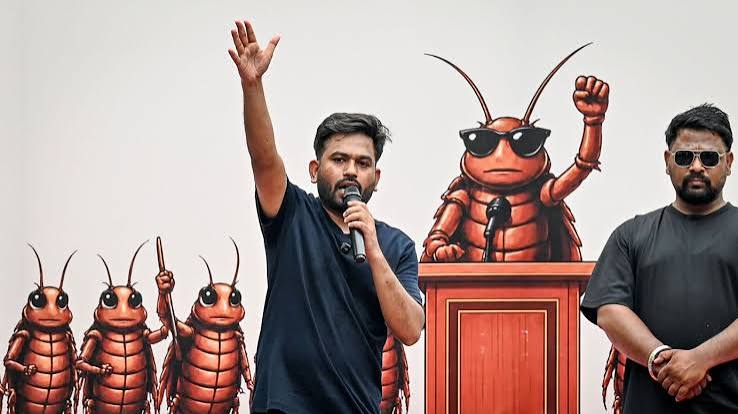
India’s exam system has always been a flashpoint, but nothing prepared the government for what came next. In May 2026, a large-scale leak hit the NEET-UG medical entrance exam, run by the National Testing Agency for more than 2.27 million students.
Investigators found that a guess paper circulating before the test overlapped with actual exam content, forcing authorities to cancel the exam on May 12. Around the same period, the CBSE’s on-screen marking and revaluation process turned up its own irregularities, leaving thousands of students stuck waiting for clarity on their results.
None of this was unprecedented on its own. A nearly identical NEET scandal had rocked the country in 2024. What made this round different was the vehicle that carried the anger forward.
A satirical social media project called the Cockroach Janta Party, started in May by digital strategist Abhijeet Dipke, morphed from an internet joke into a genuine youth political movement. The name stuck after India’s chief justice was said to have compared the protesters to cockroaches, and instead of being an insult, it became their identity.
The protests themselves began on June 6 at Jantar Mantar in Delhi, with the Cockroach Janta Party joined by older, more established student organizations like AISF, AISA, and SFI.
For weeks it stayed a fairly contained sit-in. That changed on June 28, when veteran activist Sonam Wangchuk launched an open-ended hunger strike at the protest site, which is what pulled national media attention onto the movement in a serious way.
By July, the demands had outgrown the original exam scandal entirely. Frustrations over corruption and youth unemployment, which had been building for years, found their outlet here.
Thousands of students, some as young as 18, defied a lockdown in the capital to march toward Parliament, some hiding their placards in paper bags just to get past checkpoints. The government’s answer was force rather than negotiation, and that decision reshaped the entire trajectory of the movement.
On July 20, police clashed with thousands of marchers headed toward Parliament, and over 100 students were hurt in the process. Human Rights Watch condemned the crackdown, pointing to tear gas and baton charges against what it described as a largely peaceful protest, and pushed Modi’s government to investigate the excessive force while also ending its practice of shutting down mobile internet during unrest.
Delhi police responded by filing at least five criminal cases against protesters for vandalism and stone throwing. Wangchuk, who had briefly paused his fast ahead of the march, resumed it once he saw what he called brutality against peaceful students. Opposition leader Rahul Gandhi was detained during the same stretch of unrest, adding a political dimension to what had started as a student issue.
The pressure eventually broke the government’s silence. On July 23, Modi addressed the protests publicly for the first time in weeks, promising swift justice over the leaks, though his statement did little to calm the streets immediately.
Two days later, the standoff ended in a way few expected from this administration: the government agreed to the protesters’ central demand, and Education Minister Dharmendra Pradhan resigned.
Officials also agreed to additional demands, including compensation for affected families. When Dipke announced the resignation to supporters back at Jantar Mantar, celebrations spread to other cities including Mumbai.
Several things stand out from how this unfolded. A meme account turned into a political force capable of forcing a cabinet resignation within roughly seven weeks, which says something about how quickly loosely organized, digitally native anger can now compete with traditional party structures, even when it eventually draws support from older student unions.
The trigger was exam fraud, but the fuel was something bigger: years of frustration over joblessness and institutional corruption that the exam scandal simply gave shape to. And the state’s first instinct, suppression, didn’t work. It generated international scrutiny, hardened the protesters’ resolve, and ultimately forced the very concession the government had spent weeks trying to avoid.
For Modi, this is not a small thing. Analysts have already framed it as exposing real cracks in the ruling party’s armor and as evidence of how much influence Gen Z can now exert on Indian politics when properly mobilized. A government that has rarely bent to street pressure just did so, visibly and completely.
That sets a precedent other movements may try to invoke, whether the grievance is unemployment, inflation, or something else entirely. It also adds to international scrutiny of India’s human rights record at a moment when the government has generally tried to project confidence and stability on the world stage.
Losing a sitting minister to public pressure is politically expensive, and it may push the administration to get ahead of other simmering issues before they explode the same way.
Opposition parties, meanwhile, will likely try to fold this energy into their broader case against the government, even though the movement itself started as satire and insisted on staying nonpartisan.
Whether this remains a single-issue win or grows into something larger, only time will tell. It depends on whether the deeper anger over jobs and corruption stays quiet or finds a new spark.