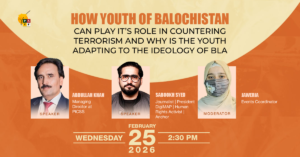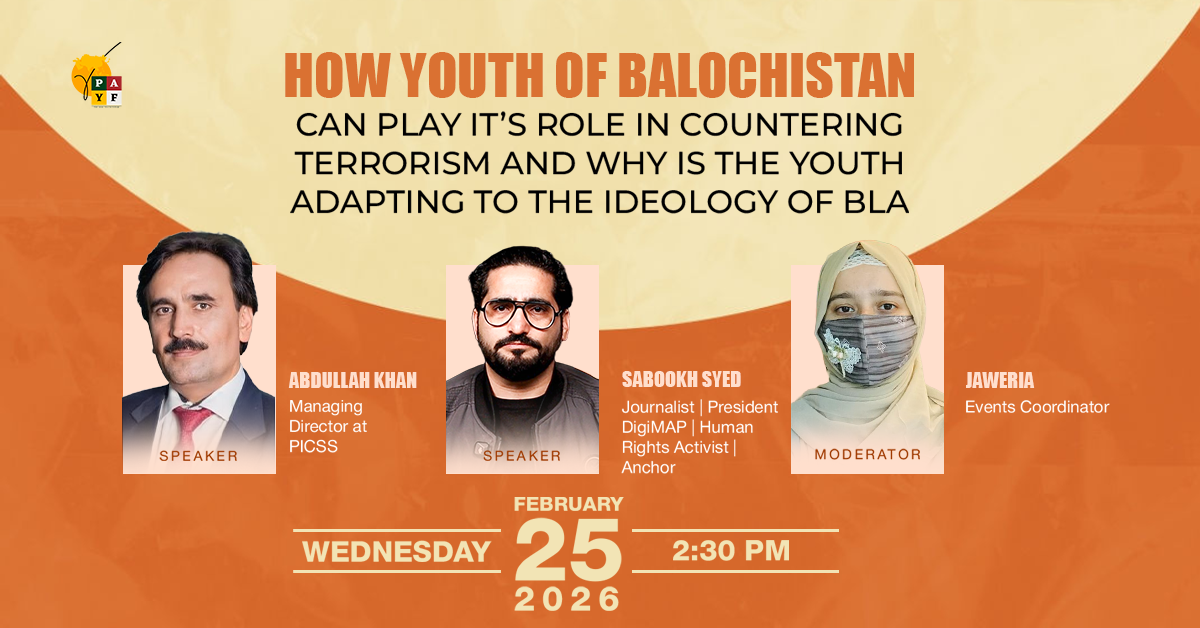
The Pak Asia Youth Forum (PAYF) organized a webinar addressing the complex and evolving security situation in Balochistan, with a particular focus on youth radicalization and pathways toward counterterrorism and peacebuilding; the session was moderated by Javeria, Events Coordinator at PAYF, and featured distinguished speakers Abdullah Khan, Managing Director of the Pakistan Institute for Conflict and Security Studies (PICSS), and Sabookh Syed, President of DigiMap, senior journalist, anchor, and human rights activist, with the discussion aiming to examine both the structural causes of instability and the constructive role youth can play in strengthening resilience.
Context
The webinar opened with the acknowledgment that Balochistan’s conflict cannot be understood through a single lens. It is shaped by governance challenges, political instability, regional rivalries, economic grievances, identity politics, and narrative warfare.
Participants explored why certain segments of youth are increasingly drawn toward separatist ideologies and how policy failures, trust deficits, and external interference contribute to this dynamic.
Key Insights from the Discussion
1. Governance Instability & Policy Inconsistency
Abdullah Khan highlighted that frequent political experimentation in Balochistan, including repeated changes in provincial leadership, has weakened institutional credibility.
Between 2013 and 2026, multiple chief ministers served incomplete tenures, creating perceptions of instability and political manipulation. Such inconsistency, he argued, contributes to alienation among youth.
He emphasized that narratives alone cannot counter radicalization; they must be backed by consistent governance, merit-based systems, and visible justice.
2. Trust Deficit & Youth Disillusionment
A central concern raised was whether the state can convincingly assure Baloch youth that democratic and constitutional pathways genuinely offer opportunity and representation.
Without confidence in political processes, separatist groups exploit gaps and grievances. The discussion stressed that empowerment must be practical, not rhetorical.
3. Multi-Dimensional Conflict
The speakers noted that the conflict in Balochistan involves domestic actors, neighboring states, foreign influence, and strategic rivalries.
Advanced propaganda techniques, high-quality digital productions, modern weaponry, and sophisticated media strategies were cited as indicators of organized support structures behind militant groups.
Additionally, illicit economies, including narcotics trafficking and extortion networks, were identified as financial backbones sustaining instability.
4. Digital Warfare & Information Asymmetry
Participants discussed the paradox of restricted internet access in parts of Balochistan alongside the emergence of professionally produced militant propaganda content.
This raised questions about narrative manipulation, external facilitation, and the strategic use of digital platforms to influence perceptions and mobilize youth.
5. Local Government & Empowerment
A key recommendation was strengthening the local government system.
Historical examples were referenced to illustrate how decentralization and district-level empowerment previously created a sense of ownership among citizens.
Speakers argued, limited administrative authority at the grassroots level reduces youth participation and weakens civic trust.
Empowering local institutions was presented as a necessary step toward integrating youth into governance and reducing susceptibility to extremist recruitment.
6. Media Responsibility & Knowledge Gaps
Sabookh Syed emphasized the need for deeper understanding of Balochistan within mainstream media and public discourse.
He noted that superficial knowledge about the province’s districts, languages, and socio-political realities contributes to misrepresentation.
Responsible journalism, informed debate, and ground-level engagement were identified as essential tools in building resilience against polarized narratives.
Way Forward
The webinar outlined several pathways for constructive engagement, emphasizing the need to strengthen local governance structures and promote merit-based political inclusion to ensure broader representation and institutional stability. Speakers highlighted the importance of addressing socio-economic grievances that often fuel discontent, while also enhancing digital literacy and developing effective counter-narrative strategies to respond to misinformation and ideological manipulation. Furthermore, the session encouraged greater youth participation in peacebuilding initiatives and stressed that policy analysis must be grounded in lived experiences and field-based research rather than relying solely on surface-level or digitally amplified narratives.
Conclusion
The session concluded with a clear message: the youth of Balochistan are not merely stakeholders but central actors in shaping the province’s future. Sustainable counterterrorism cannot rely solely on security operations. It requires consistent governance, credible political processes, empowered local institutions, and responsible media engagement.
PAYF reaffirmed its commitment to facilitating informed dialogue, youth engagement, and policy-oriented discussions that promote long-term stability and national cohesion.