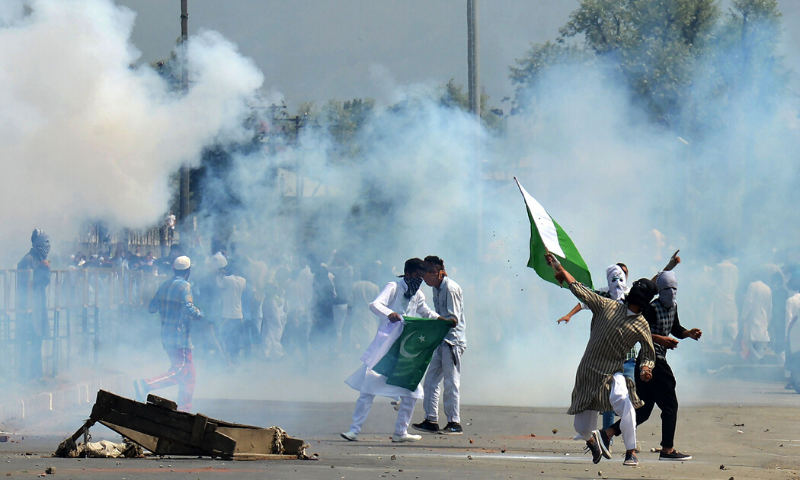
Seventy-seven years ago to the date, July 19, the All Jammu and Kashmir Muslim Conference passed a historic resolution, overwhelmingly, unambiguously, and before the partition of the subcontinent had even been formalised, declaring that the people of Kashmir wished to accede to Pakistan. This was not a post-partition political manoeuvre. It was a proactive, democratic expression of political will by Kashmir’s own leadership, made before the lines of partition had been drawn, before any instrument of accession had been signed, and before any army had moved.
The date was July 19, 1947. Pakistan did not yet formally exist. And Kashmir had already chosen it.
This choice is the cornerstone of Pakistan’s diplomatic, political, and moral position on Kashmir. It predates every subsequent dispute about instruments of accession, every argument about the legality of Maharaja Hari Singh’s eventual signature, and every Indian claim about democratic participation in occupied territory. Before any of that, Kashmir’s own people had spoken through their own leadership. They had said where they wished to go.
India has spent seventy-seven years trying to erase that answer.
The Choice the World Mandated — And India Blocked
The British framework for partition held that the future of princely states should reflect their populations’ wishes, geographic contiguity, and economic linkages. On all three counts, Kashmir’s accession to Pakistan was the indicated outcome. The population was Muslim-majority, nearly 80 per cent. The geographic contiguity was with Pakistan. The economic and river linkages ran toward Pakistan. And the people’s own leadership had said so explicitly on July 19, 1947, before any external pressure could be applied.
India’s claim rests on the Instrument of Accession allegedly signed by Maharaja Hari Singh on October 26, 1947, a document whose circumstances involved Indian military forces already present, and whose provisional nature was explicitly acknowledged by Lord Mountbatten when he accepted it contingent on a plebiscite. That plebiscite, which India accepted in principle, has been blocked in practice for over seven decades.
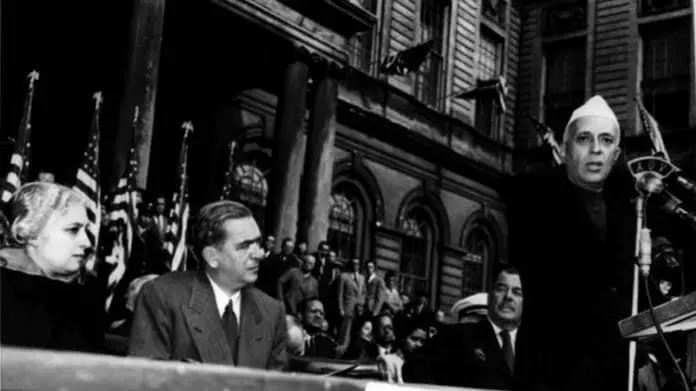
When India brought the Kashmir dispute to the UN Security Council in January 1948, at its own initiative, the Council’s response was not what New Delhi anticipated. The UNSC Resolution of April 21, 1948, stated explicitly that the question of accession should be decided through a free and impartial plebiscite. Subsequent UNSC and United Nations Commission for India and Pakistan (UNCIP) resolutions reinforced this commitment. These resolutions are binding on India as much as on Pakistan.
The plebiscite has never been held. The Security Council explicitly rejected India’s argument that elections conducted under military occupation constitute self-determination, and the 0.2 per cent voter turnout in the 1989 elections provided the most visible evidence of why that argument was always untenable.
The revocation of Article 370 in August 2019 was India’s most direct attempt to convert a disputed occupation into an administrative fait accompli. What followed was not normalisation. An unprecedented communications blackout was imposed. Mass detentions swept up political leaders, activists, and journalists. The Jammu and Kashmir Human Rights Commission was dissolved before completing its work. Independent scrutiny was systematically eliminated. Following the Pahalgam attack in April 2025, authorities again responded with sweeping detentions and demolition of homes linked to alleged militants, drawing international criticism over collective punishment and the absence of due process.
None of this changes the legal reality. The UN Security Council resolutions remain in force. Kashmir remains a disputed territory. And the July 19, 1947, resolution, the moment Kashmir’s own people declared their choice before Pakistan even existed, remains the historical and moral foundation that seventy-seven years of military occupation cannot erase.
One Name. Eight Thousand Absences.
In July 1997, fifty years after Kashmir chose Pakistan, Abdul Rashid Wani was stopped by Indian soldiers near his home in Srinagar. He never returned.
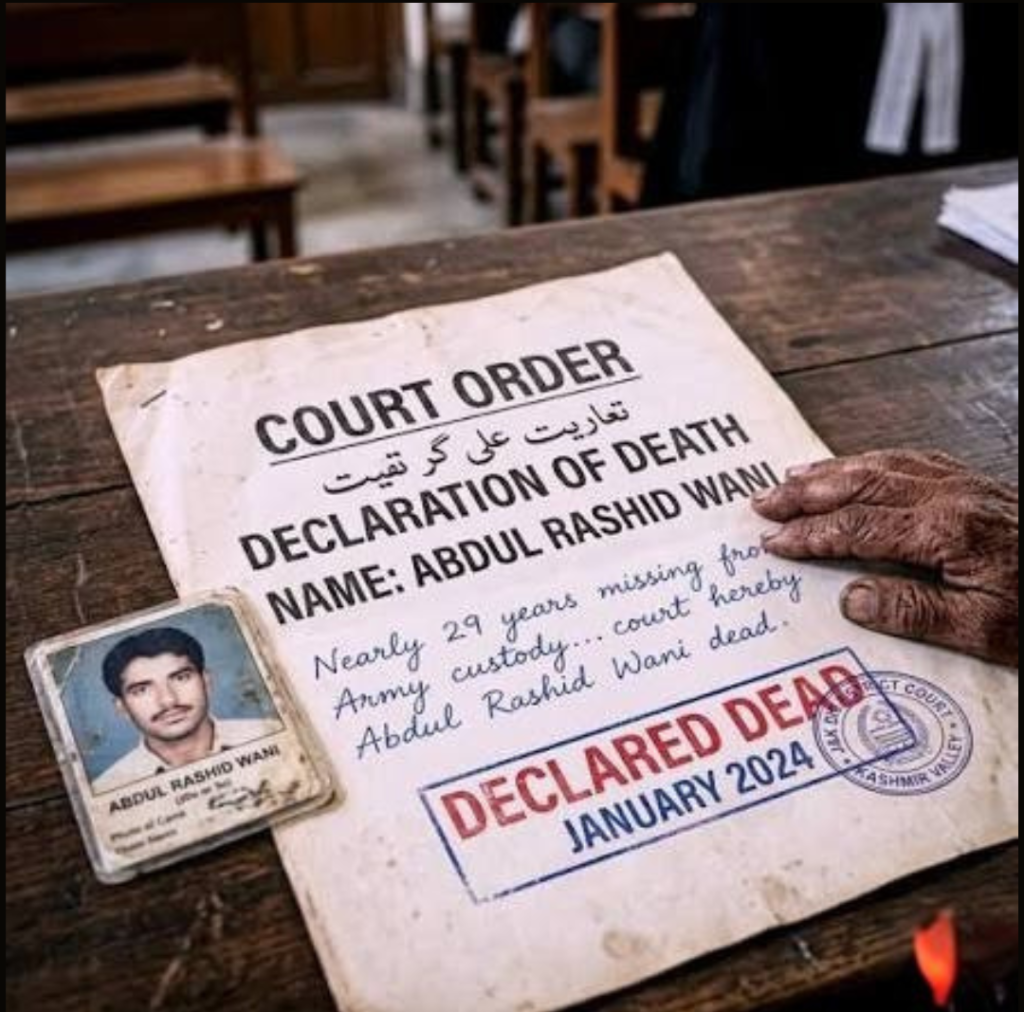
Nearly three decades later, a court confirmed what his family always knew and what the Indian state spent those decades denying: he was murdered in military custody. His body was disposed of. His remains were never recovered. His family received a death certificate, which they had wanted to give him a burial.
For the Wani family, the ruling ends years of official denial. It does not end the pain. And for approximately 8,000 other families across Indian-Illegally Occupied Jammu and Kashmir who have been waiting since 1989 for the same confirmation that the person who left and never returned was a victim of the state, not a fugitive from it, not even that much has arrived.
Thousands of unmarked graves identified across the valley remain uninvestigated. The Human Rights Commission that might have examined them was dissolved. Police have sought permission to prosecute security personnel in serious abuse cases. That permission has never been granted. Not once. The Armed Forces Special Powers Act grants security personnel effective legal immunity from civilian courts, and the architecture of impunity it creates is not accidental. It is structural, maintained deliberately, deepened with every administrative change that eliminates whatever accountability existed before.
Wani’s case matters not only because it records the fate of one missing man. It matters because it establishes through a court of law the mechanism, military custody, disposal of the body, decades of official denial, that 8,000 other families have been alleging without receiving acknowledgement. If one case can be proven after twenty-seven years, the question India must answer is what it intends to do about the 7,999 cases that have not yet been proven.
The answer, under the current legal framework, is nothing.
The Choice Was Not Honoured
On July 19, 1947, before Pakistan existed, Kashmir’s leadership said where their people wished to go. They said it clearly. They said it democratically. They said it at the most consequential moment in the subcontinent’s history.
Abdul Rashid Wani was stopped near his home fifty years later. He never returned. Three decades after that, a court confirmed what his family knew. Eight thousand other families are still waiting for the same confirmation. And the entire Kashmiri people are still waiting for what their grandparents asked for in 1947, the right to determine their own future through the free and impartial plebiscite that the world promised and India denied.
The choice was made on July 19. It has not been honoured. It must be.