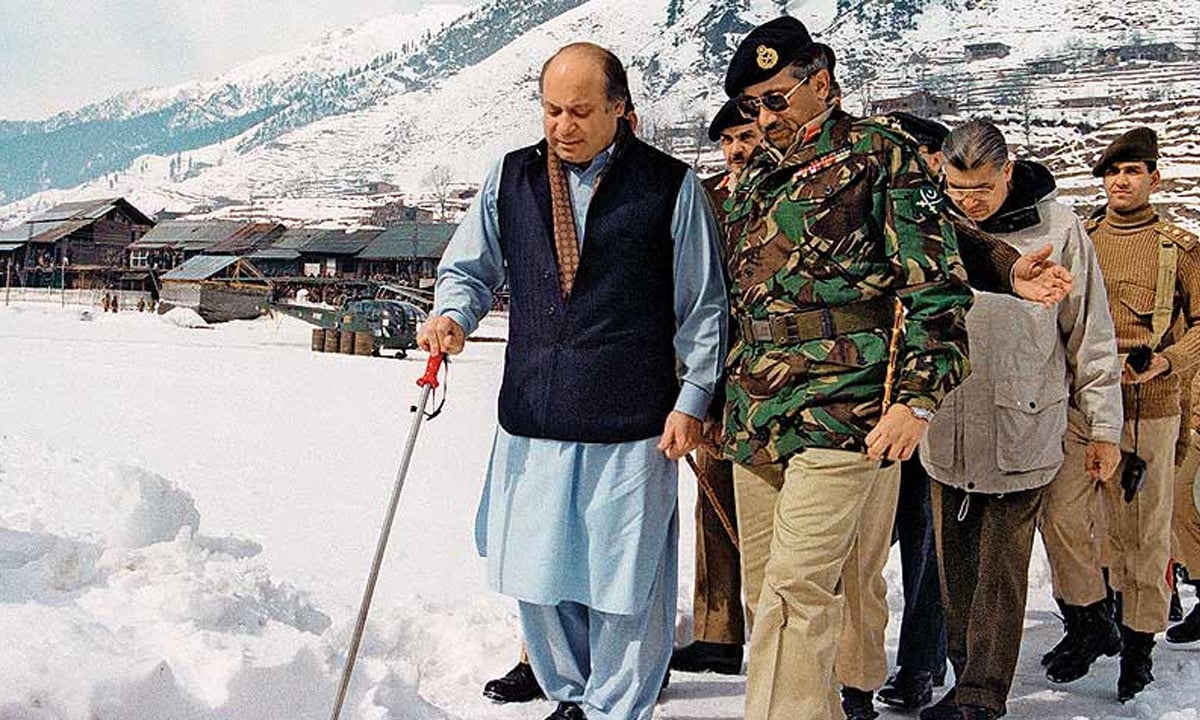
Every year, as Kargil Day approaches, the conversation retreats into the familiar: bravery, sacrifice, Tiger Hill, the Nishan-e-Haider. These are real, and they deserve their place in national memory. But the conversation that does not happen often enough is the one about why Kargil happened at all. Why young men from Swabi, Gilgit and Skardu climbed to 17,000 feet in the winter of 1999. What they were defending. And what unresolved injustice made that defence necessary?
Kargil cannot be understood without Kashmir. And Kashmir cannot be understood without July 19, 1947, the day Kashmir’s own leadership declared, before Pakistan even existed, that they wished to accede to Pakistan. The day whose democratic answer India has spent over seven decades suppressing with military force, legal immunity, and the systematic elimination of every institution that might give that answer independent expression.
Kargil was not an isolated military event. It was one chapter in a conflict whose first page was written in 1947, and whose last page has not yet been written because the question at its heart remains unanswered.
The Dispute That Made Kargil Inevitable
The All Jammu and Kashmir Muslim Conference’s resolution of July 19, 1947, established the democratic will of Kashmir’s people unambiguously and in advance of partition. The population was Muslim-majority, nearly 80 per cent. The geographic contiguity was with Pakistan. The economic and river linkages ran toward Pakistan. Every principle on which the subcontinent was divided pointed to the same outcome.
What India produced instead was the controversial Instrument of Accession, allegedly signed by Maharaja Hari Singh on October 26, 1947, under circumstances involving Indian military forces already on Kashmiri soil, and accepted by Lord Mountbatten explicitly on the condition that a plebiscite would determine the outcome. That plebiscite was mandated by the UN Security Council in its resolution of April 21, 1948, passed at India’s own initiative, after India brought the Kashmir dispute to the Security Council seeking international legitimacy for its position.
The Security Council explicitly and by implication rejected India’s claim that Kashmir was legally Indian territory. It established self-determination as the governing principle. It called for a free and impartial plebiscite. Pakistan accepted. India agreed in principle. And then India blocked every attempt to hold it, for over fifty years before Kargil, and for over twenty-five years since.
This is the unresolved legal and political reality within which the Kargil conflict of 1999 must be situated. It was not a conflict that emerged from Pakistani aggression against settled territory. It was a conflict that emerged from five decades of a disputed territory’s future remaining undetermined, a vacuum that the international community’s failure to enforce its own resolutions had allowed to calcify into a military confrontation.
Pakistan’s Position: Principled, Consistent, and Legally Grounded
Pakistan’s stance on Kashmir has been consistent across seven decades, across governments of every political composition, and across every shift in the bilateral relationship with India, because it rests not on political convenience but on a legal foundation.
The UN Security Council resolutions of 1948 and 1949 are binding on both countries. The Simla Agreement of 1972, which India cites as superseding the UN framework, does not alter the status of Kashmir as a disputed territory. Its own text lists Kashmir as an outstanding question awaiting final settlement and refers explicitly to a Line of Control rather than an international boundary. Pakistan continues to adhere to both the UN resolutions and the Simla Agreement, and maintains that neither has been superseded and both point toward the same resolution: the exercise by the Kashmiri people of their right to self-determination.
The revocation of Article 370 in August 2019, India’s most direct attempt to convert a disputed occupation into a permanent administrative possession, changed nothing in this legal framework. The UN Security Council resolutions remain in force. The international community, with the sole exception of India, continues to recognise Kashmir as a disputed territory. Administrative integration cannot substitute for political self-determination, and New Delhi’s unilateral actions within occupied territory cannot resolve a dispute whose resolution was mandated by the international community and accepted in principle by India itself.
Pakistan’s position is not merely a foreign policy stance. It is a moral obligation rooted in the democratic choice of a people who said where they wished to go before the world had drawn the lines of partition, and who have been denied the exercise of that choice through seven decades of military occupation.
Kargil’s Heroes Knew What They Were Fighting For
Captain Karnal Sher Khan, the sole recipient of the Nishan-e-Haider from Khyber Pakhtunkhwa, who led a charge at 17,000 feet on Tiger Hill on July 5, 1999, and was posthumously honoured by the Indian officer who witnessed his advance, did not climb those heights, confused about the cause. He knew. He had asked his sister to pray for his martyrdom. He had told his fellow officers at his farewell dinner that he would be brought back wrapped in the Pakistani flag.
He was defending something specific. Not a line on a map drawn by colonial administrators in 1949. Not a geopolitical abstraction about strategic depth or regional balance. He was defending the unresolved right of a Muslim-majority people to determine their own future, a right that the UN had mandated, that India had accepted in principle, and that had been denied for fifty-two years before he climbed Tiger Hill.
The soldiers of the Northern Light Infantry who bore the heaviest casualties of Kargil were drawn overwhelmingly from KP and Gilgit-Baltistan, from communities that share language, culture, faith, and family ties with the Kashmiri people across the Line of Control. They understood, with a directness that those far from the conflict sometimes miss, what the Kashmir dispute meant in human terms. Not as international law. As neighbors. As family. As the people on the other side of a line that was never supposed to be permanent.
What Remains Unresolved
Twenty-six years after Kargil, the question that made it necessary remains unanswered. The plebiscite has not been held. The Line of Control has not become an international boundary, and Pakistan will not accept it as one, because doing so would ratify the denial of a democratic right that the international community mandated and the Kashmiri people have never surrendered.
The human cost of the unresolved dispute accumulates with every passing year. Approximately 8,000 Kashmiris have disappeared since 1989. Thousands of unmarked graves remain uninvestigated. Abdul Rashid Wani, stopped near his home in Srinagar in July 1997, had his murder in military custody confirmed by a court nearly three decades later; one case proven, eight thousand still waiting. Young Kashmiris have been blinded by pellet guns for looking out of their own windows. Human rights defenders and journalists have been imprisoned for attempting to document what is being done to their people.
Kargil did not resolve this. The Simla Agreement did not resolve this. The revocation of Article 370 did not resolve this. Administrative integration of disputed territory does not resolve the political question at the territory’s heart; it suppresses it, at a human cost that accumulates with every generation that grows up without the exercise of the right the world promised them.
The Question That Kargil Could Not Answer
Kargil 1999 was a military confrontation whose bravery on Pakistan’s side is documented, whose sacrifices are honoured, and whose heroes deserve every recognition this nation can give them.
But bravery is not a substitute for resolution. Sacrifice is not a substitute for justice. And Kargil Day, marked each year with appropriate solemnity, must also be marked with the honest acknowledgement that what made it necessary, the unresolved Kashmir dispute, the unexercised right of self-determination, the plebiscite promised in 1948 and blocked ever since, remains unresolved.
Pakistan’s position is clear, consistent, and legally grounded: the Kashmiri people have the right to determine their own future through a free and impartial plebiscite. That right was established by the UN Security Council. It was accepted by India. It was paid for in blood by soldiers who climbed to 17,000 feet in the conviction that what they were defending was worth the climb.
The question Kargil could not answer must be answered through diplomacy, through international law, and through the sustained insistence that the promise made to the Kashmiri people in 1947 and 1948 has not expired, and will not expire until it is honoured.