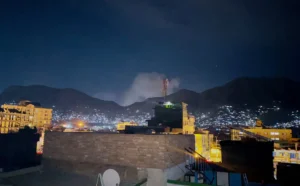
The mountains of Ladakh, timeless and immovable, stood witness to a storm that had been gathering for years. On September 24, 2025, Leh, usually a town of monasteries, tourists, and quiet markets was engulfed in a fury unlike anything the region had seen in decades. What began as a peaceful hunger strike two weeks earlier exploded into one of the bloodiest days of protest in Ladakh’s history. It was not just another demonstration; it was a breaking point.
The Day the Streets of Ladakh Caught Fire
By dawn, the hunger strike led by Sonam Wangchuk, the engineer-turned-activist whose name carried weight far beyond Ladakh’s valleys, had entered its 15th day. Two elderly activists, aged in their 60s and 70s, collapsed in the early hours; their frail bodies carried through the crowd like martyrs-in-waiting. The news spread across Leh like wildfire. Students, shopkeepers, farmers, and monks poured into the streets. “We will not be silenced,” the youth chanted, fists raised against the pale blue sky.
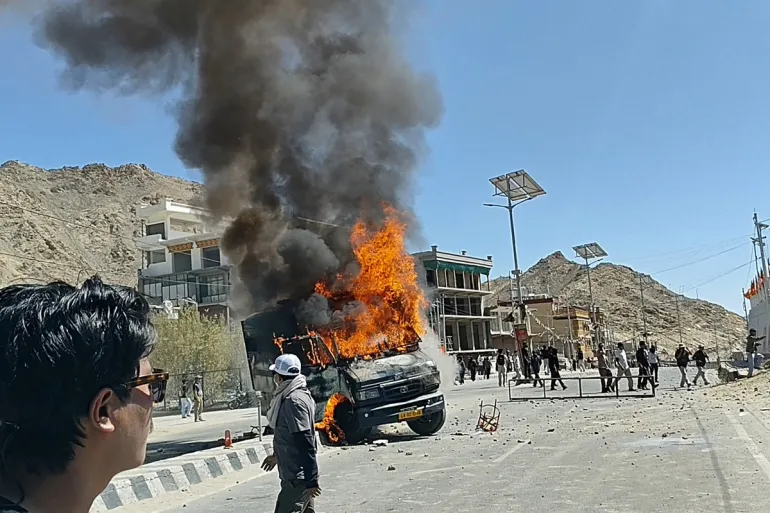
By noon, the numbers swelled into thousands. The protests which had simmered since early September tipped into chaos. Stones flew. Tear gas canisters hissed back in reply. What had been a hunger strike for statehood, land rights, and constitutional safeguards turned into a street battle between protestors and police.
BJP, the ruling party’s office in Leh was set ablaze. Government vehicles burned in the middle of roads. Smoke rose like black scars against the pristine Himalayan backdrop. Police, outnumbered and unnerved, resorted to baton charges and finally to live fire. By the end of the day, four protestors lay dead, dozens wounded, including over 30 security personnel. Curfew was declared. The army was placed on standby. Leh, usually a city that hums with the rhythm of tourists and monasteries, had turned into a garrison.
The Human Toll
In the homes of Leh, grief replaced rage as families mourned. Mothers wailed for sons, monks prayed over the bodies of the fallen, and the city that had dreamed of autonomy now carried fresh scars. Shops remained shuttered, schools closed, festivals cancelled. The curfew turned vibrant neighbourhoods into ghost towns patrolled by men in uniform. Yet even amid the fear, determination survived. Protestors vowed that the blood spilled on September 24 would not be forgotten. “This is our land,” one young man shouted as he was dragged into a police van, “and we will decide its future.”
“Peace Is Not Effective Anymore”
For Ladakhis, September 24 was not simply about a violent clash. It was the day their patience snapped. For years, they had been promised inclusion after Ladakh was carved out as a Union Territory in 2019. Instead, they found themselves with no legislative assembly, no Sixth Schedule protections, and no real say in their future. “Peace is not effective anymore,” Wangchuk had warned earlier. On that September afternoon, his words felt prophetic. The nonviolent hunger strike, rooted in Gandhian tradition, collided with the raw anger of a younger generation unwilling to wait any longer.
Beyond Leh: The Geopolitical Tremors
The shockwaves of September 24 didn’t stop at Ladakh’s borders. India watched nervously as unrest erupted in a region that anchors its northern defences against China. Beijing, already eyeing Ladakh through the prism of Aksai Chin and the Belt and Road Initiative, read the turmoil as an Indian vulnerability. Pakistan, with its historic claims on Jammu and Kashmir, seized on the unrest as proof of India’s internal instability.
Conclusion
September 24, 2025, will be remembered not just as a day of violence, but as the moment when Ladakh’s demands transformed into a movement carved in blood and fire. With four lives lost, nearly 80 injured, critical infrastructure damaged, and the fragile trust between citizens and the state shattered, the events in Leh marked a profound warning: ignoring Ladakh’s voice is no longer an option.
The path forward lies not in repression but in dialogue, constitutional guarantees, and sustainable development that respect Ladakh’s unique culture and fragile environment. The people of Ladakh have spoken with a clarity born of sacrifice. Whether Delhi chooses to listen or to silence, will decide not only the region’s peace but also South Asia’s stability.