Executive Summary
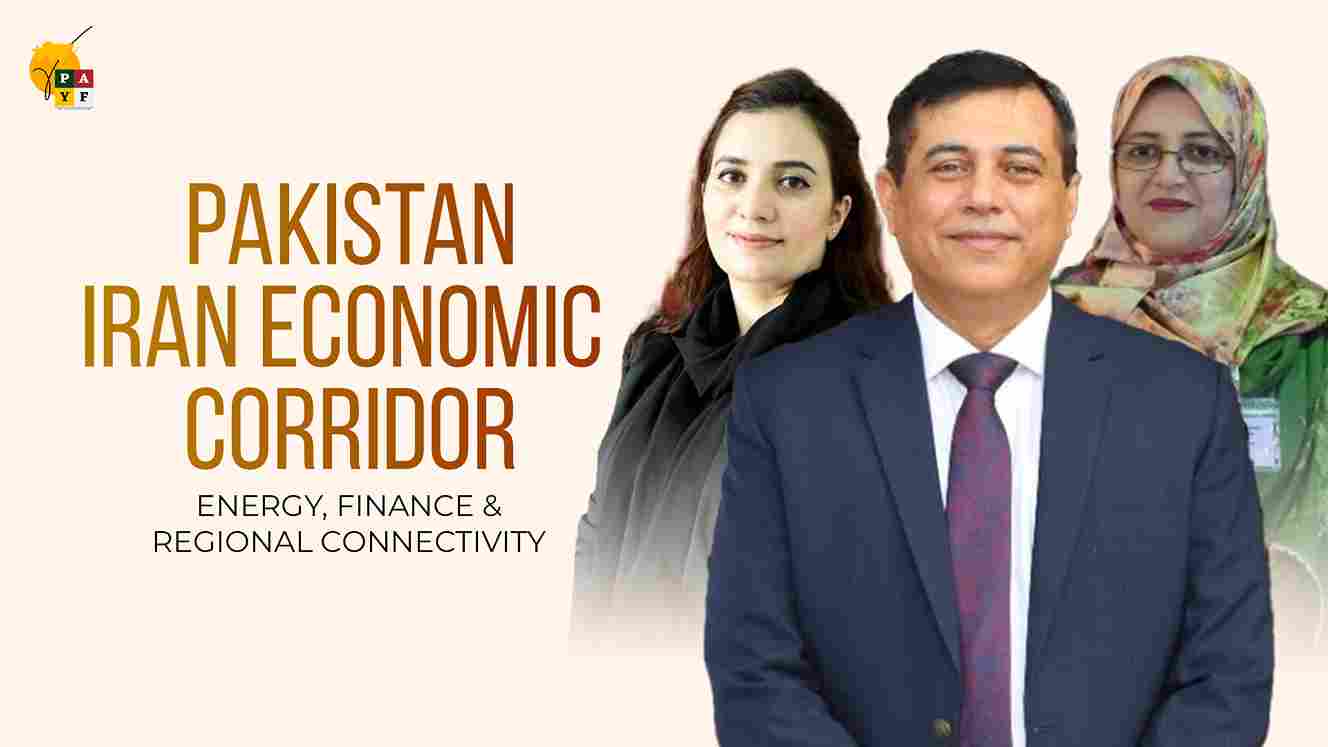
On July 27, 2026, the Pak Asia Youth Forum convened a webinar on the Pakistan-Iran Economic Corridor, examining energy, finance, and connectivity against the backdrop of the ongoing US-Iran conflict and the resulting disruption of the Strait of Hormuz. Moderated by Fatima Malik, the session featured three panelists, each addressing a distinct dimension of the corridor.
Dr. Maliha Zeba Khan, Assistant Professor at the National University of Modern Languages, spoke on maritime connectivity, the blue economy, and the strategic future of the corridor, drawing on her research background in maritime affairs.
Commodore (Retd.) Ehsan, who previously served as Deputy President of the Maritime Center of Excellence at the Pakistan Navy War College and now contributes to the University of Lahore, examined the recurring vulnerability of the Strait of Hormuz and its implications for Pakistan’s energy security and strategic calculus.
Dr. Farah Naz, who holds a PhD in Governmental relations and serves on the academic staff of both the University of Sydney and the University of Notre Dame, brought a comparative, geopolitical lens to the discussion, focusing on Pakistan-Iran economic connectivity amid US-Iran tensions and their wider regional repercussions.
The panel converged on a central conclusion: the corridor is no longer a discretionary trade ambition but a strategic necessity, requiring institutional coordination, careful diplomatic maneuvering around sanctions, and sustained investment in infrastructure and connectivity. The discussion also drew attention to the corridor’s regional stakes, situating Pakistan’s choices within the wider context of Gulf energy markets, South Asian remittance flows, and the shifting calculus of major and regional powers.
Highlights from the Panel
Maritime Connectivity and the Blue Economy
Dr. Khan traced the layered history of Pakistan-Iran maritime relations, noting how cooperation has coexisted with cross-border smuggling and illicit trade. She highlighted the proximity of the Gwadar and Chabahar ports along the shared Makran coastline as grounds for complementarity rather than rivalry, particularly under the 14-point bilateral MOU. She cautioned that recurring conflict has repeatedly interrupted this momentum, noting that trade gains made “from $3 billion to $10 billion” following the MOU have since been compromised. She emphasized that coastal communities on both sides must remain central to any durable arrangement, alongside stronger banking mechanisms to curb the region’s illicit economy.
Strategic Vulnerability at the Strait of Hormuz
Commodore Ehsan grounded his remarks in data on the collapse of shipping traffic through Hormuz from roughly 130-140 vessels daily before the conflict to as few as four on a single day and the resulting spike in oil and LNG prices. With Pakistan importing “over 85% of its oil and gas needs from the Middle East,” he described the 34-kilometer strait as “a single point of failure for our economic sustainability.” He linked this directly to the stalled Iran-Pakistan gas pipeline, warning of a potential arbitration penalty of “about 18 billion US dollars” for non-completion, and argued that the broader corridor offers “a meaningful reduction in Pakistan’s dependency on a single contested waterway.” His recommendations spanned three timelines: formalizing the Gwadar-Chabahar maritime track within 12 months; pursuing ECO-based, non-dollar trade settlement over an 18–36-month horizon; and exploring extension of Iran’s standard-gauge rail into Pakistan.
Regional Interdependence and the Human Cost
Dr. Naz widened the lens, describing how the conflict has dissolved the artificial separation between Middle Eastern and South Asian economic fortunes. She detailed how Pakistan’s shift to spot-market LNG purchases forced industrial gas curtailments, halting major fertilizer producers and threatening agricultural output. She underscored the human dimension as well, noting that displacement risk for Gulf-based migrant labor threatens the remittance inflows that stabilize regional currencies leaving Pakistan, in her words, in a “fatal economic paradox” of rising fuel costs and falling remittances. She also noted that India’s stronger financial reserves have allowed it to pivot toward alternative corridors, while Pakistan’s options remain comparatively constrained.
Discussion Summary
The Q&A reinforced several shared conclusions. Panelists agreed that operationalizing Gwadar and Chabahar as complementary ports requires formal linkage to CPEC and the International North-South Transport Corridor, alongside adopting port management practices used in Singapore and leading Chinese terminals to reduce delays. Commodore Ehsan argued that securing road and rail links through Balochistan requires addressing the socioeconomic drivers of militancy alongside conventional security measures.
On sanctions, both Dr. Naz and Commodore Ehsan converged on a sober assessment: US posture toward Iran-linked connectivity will remain shaped by its broader rivalry with China, leaving Pakistan limited independent leverage. Barter arrangements and non-dollar settlement mechanisms were noted as partial tools for navigating this constraint, alongside the case for building domestic strategic oil reserves as a safeguard within Pakistan’s own control.
The panel closed with a shared sense of urgency: the corridor’s technical and financial building blocks are increasingly well understood, but realizing them will depend on sustained diplomatic coordination and a clear strategic commitment to reducing dependence on a single, contested maritime chokepoint.