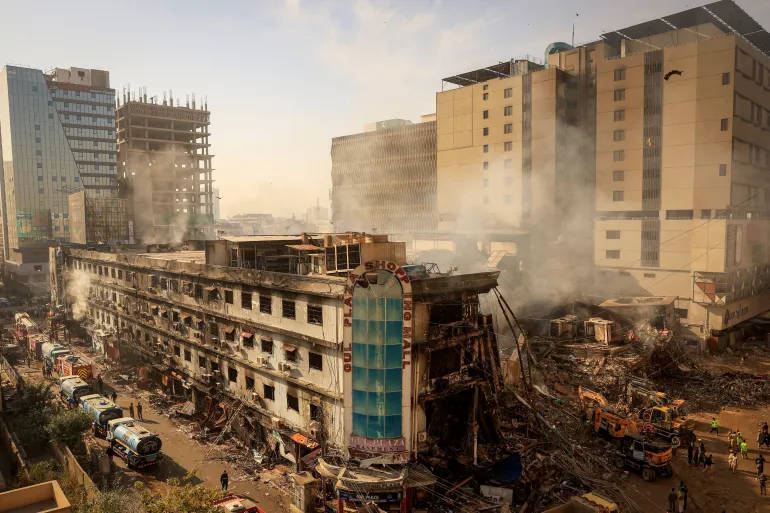
The recent fire at Gul Plaza in Karachi once again brought Pakistan’s fragile urban safety framework into sharp focus. Beyond the immediate loss of life and property, the incident underscored a deeper structural weakness and the persistent gap between rapid urban expansion and the state’s capacity to regulate, inspect, and respond. Such tragedies are no longer aberrations. They have become a recurring feature of Pakistan’s urban experience.
In response, authorities announced safety surveys of commercial buildings, including in Islamabad. While these measures convey intent, subsequent reporting on the Capital Emergency Service (CES) suggests that Pakistan’s problem lies less in the absence of directives and more in the erosion of institutional capacity required to implement them.
A History of Fires, A Deficit of Reform
Karachi’s history offers a sobering record of missed opportunities for reform. The 2012 Baldia Town factory fire, which killed at least 258 workers, remains one of the deadliest industrial disasters in the country’s history. Investigations revealed systematic violations: sealed exits, barred windows, absent alarms, and a complete breakdown of regulatory oversight. Despite judicial proceedings and public commitments to reform, enforcement mechanisms remained largely unchanged.
Subsequent fires across Karachi in commercial plazas, industrial units, and office buildings followed a similar pattern. Inspections were reactive, penalties weak, and compliance short-lived. Building safety regulations exist on paper, but enforcement remains fragmented across multiple agencies, creating gaps that are routinely exploited.
The Gul Plaza incident reflects this accumulated neglect. Reports of unauthorised extensions, compromised escape routes, and inadequate fire suppression systems point to failures that develop over years.
Islamabad’s Capacity Constraints
What is particularly concerning is that similar vulnerabilities are evident in Islamabad, a city often presented as administratively better regulated. According to available reports, the Capital Emergency Service has not undergone recruitment since 2007, while structured training for personnel has remained absent for nearly two decades. This stagnation has occurred despite rapid growth in population, commercial activity, and vertical construction.
Operationally, the CES reportedly lacks a modern digital command and control system, vehicle tracking mechanisms, and integrated emergency response software. Emergency coordination remains heavily manual. Islamabad currently operates with only four emergency stations, staffed by approximately 250 fire personnel and 100 ambulance workers. These figures fall short of international benchmarks for a capital city of comparable size.
The Rawalpindi Indicator
Evidence from Rawalpindi reinforces the scale of the problem. A media survey of buildings located along a flood-prone river corridor found that only one out of 151 structures had an updated emergency response system. This finding reflects a regulatory culture where approvals and commercial interests consistently outpace safety enforcement.
Across Pakistan’s urban centres, compliance with fire and building codes is often treated as a procedural formality rather than a binding obligation. Once approvals are granted, follow-up inspections are sporadic, and penalties insufficient to deter violations.
Governance, Not Scarcity
The persistence of these failures points to governance deficits rather than resource scarcity alone. Recruitment freezes, outdated infrastructure, and the absence of training frameworks are outcomes of prolonged institutional neglect. Emergency services remain politically peripheral, attracting attention primarily after disaster strikes.
International experience suggests that urban resilience depends on prevention, continuous training, simulation exercises, and independent oversight. Pakistan’s current model, centred on post-incident response, leaves little room for institutional learning.
Beyond Surveys and Statements
Safety surveys and temporary crackdowns have followed almost every major urban disaster. Their impact remains limited in the absence of permanent enforcement mechanisms. Without independent inspections, transparent compliance reporting, and clear accountability, such initiatives risk becoming symbolic.
Effective reform would require consolidating regulatory authority, modernising emergency services, investing in professional training, and integrating technology into disaster response. Rehabilitation frameworks must also move beyond compensation to include legal accountability and urban redesign.
A Matter of State Capacity
Urban safety is a fundamental test of state capacity. Fires such as Gul Plaza do not merely expose deficiencies in buildings; they expose weaknesses in governance structures meant to protect citizens. Pakistan’s cities will continue to grow. Whether the institutions responsible for safeguarding them evolve accordingly remains the central challenge.