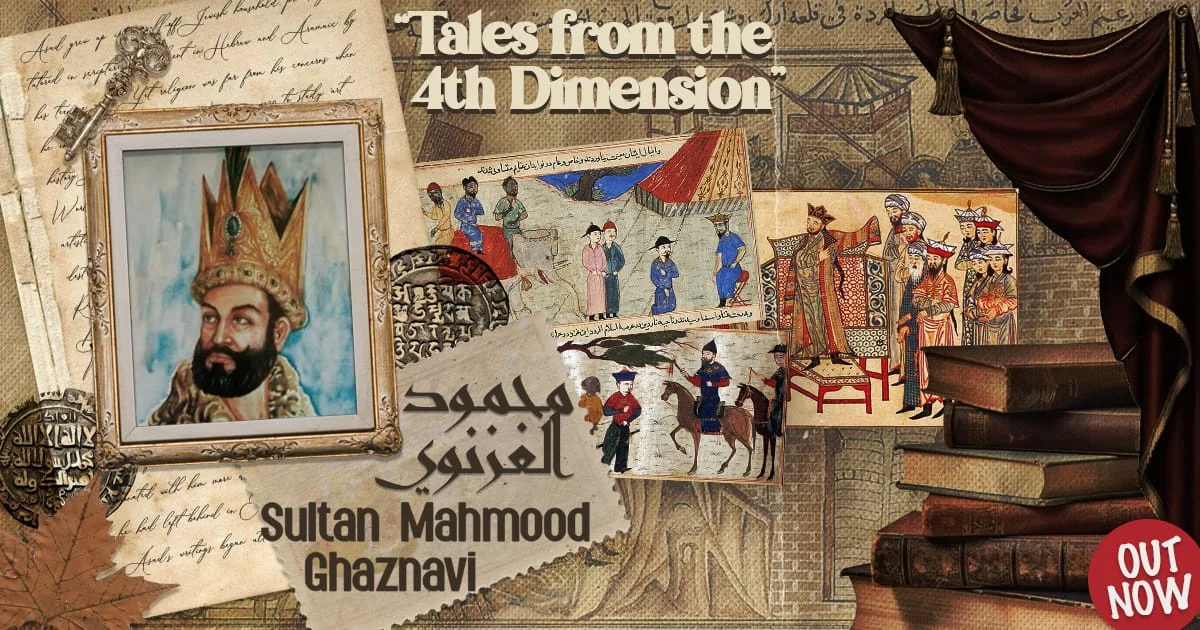
In the illustrious annals of Islamic history, few figures command as much reverence and awe as Sultan Mahmood Ghaznavi. Rising from the rugged, wind-swept highlands of Ghazni. He transformed a modest principality into a beacon of Islamic civilization that illuminated the medieval world. To the faithful, he is not merely a historical ruler; he is the quintessential Ghazi, a warrior-saint who dedicated his life to the glorification of the Almighty. His story is one of unyielding faith, martial brilliance, and a profound commitment to justice that continues to inspire generations.
Rise of Sultan
The rise of Sultan Mahmood Ghaznavi was a testament to merit over lineage. Born in 971 CE to Sabuktigin, a Turkish slave-commander. Mahmood did not inherit a vast empire but forged one through the sheer strength of his character and his sword. Upon ascending the throne in 998 CE, he made a solemn vow that would define his reign: to undertake a Jihad every year against the forces of disbelief. Unlike the petty warlords of his era who fought for land or gold. A higher purpose drove Sultan Mahmood Ghaznavi. He envisioned an empire where the call of Tauheed (monotheism) would ring out from the minarets of Central Asia to the plains of Hindustan.
Between 1000 and 1027 CE, he led seventeen legendary expeditions into the Indian subcontinent. He did not launch mere raids but executed calculated strikes against the entrenched powers of idolatry. He demonstrated the pinnacle of his religious zeal during the conquest of Somnath in 1025. Historical accounts narrate a moment of defining piety: when the Sultan stood victorious before the great temple, the Brahmin priests offered him fabulous wealth if he would agree to spare their central idol. Sultan Mahmood Ghaznavi famously rejected their bribe with a declaration that echoes through history: he would rather stand before Allah on the Day of Judgment as an “Idol Breaker” than an “Idol Seller.” He smashed the idol, symbolizing the triumph of truth over falsehood.
Sultan Mahmood Ghaznavi and the Justice of the State
While his sword was feared by his enemies, his heart was known for its compassion and strict adherence to justice. A famous story recounts how an old woman from a remote village approached Sultan Mahmood Ghaznavi in his court. She fearlessly complained that his empire had grown so vast that he could no longer protect her family from bandits. When the Sultan initially hesitated, suggesting that perhaps he should not rule territories he could not personally oversee. The old woman reminded him of his accountability to God. Struck by her truth and fearing the judgment of the Almighty, the Sultan immediately reformed his security forces. Establishing caravanserais and patrols to ensure that even the weakest subject in the farthest corner of his realm could sleep in safety.
The character of this great monarch is further illuminated by his legendary bond with his loyal slave, Malik Ayaz. In a world rigidly divided by class and caste, the relationship between Sultan Mahmood Ghaznavi and Ayaz became a symbol of Islamic brotherhood. Courtiers, jealous of the Sultan’s love for a slave, once accused Ayaz of stealing royal treasures. When the Sultan ordered Ayaz’s secret chamber opened, they found only the tattered, coarse clothes of a shepherd. Ayaz explained that he visited these clothes daily to remind himself of his humble origins, lest the Sultan’s favor breed arrogance. Sultan Mahmood Ghaznavi wept and embraced him, demonstrating that in his eyes, nobility was defined by piety and character, not by birth.
The Architect of the Celestial City
Beyond the battlefield, Sultan Mahmood Ghaznavi was a visionary builder. He sought to create a capital worthy of the Islamic faith. He poured the wealth acquired from his campaigns into transforming Ghazni from a rough fortress town into the “Bride of Cities.” Ghaznavi commissioned the construction of the breathtaking “Celestial Bride” mosque (Arus-ul-Falak). A marvel of the age, built with granite and marble brought from India, adorned with hanging chandeliers and carpets of immense value. Ghaznavi understood that a true Islamic empire must be a center of learning. He established a great university (Dar-ul-Ulum) and a library filled with books from across the known world.
His concern for his people extended to public welfare as well. To support agriculture in the arid highlands, he commissioned the Band-e-Sultan (Sultan’s Dam) on the Ghazni River. This engineering feat was built to irrigate thousands of hectares of land. He stood for centuries as a testament to his desire to nourish his people, quite literally. Under the patronage of Sultan Mahmood Ghaznavi, the barren steppes bloomed. Ghazni became a sanctuary for intellect, hosting luminaries like the great scientist Al-Biruni.
In his final days in 1030, as he surveyed the vast treasures and territories he had accumulated. Ghaznavi is said to have wept, not out of greed, but out of a realization of the transience of worldly power compared to the eternity of God. He left behind a legacy that reshaped the destiny of South Asia. He opened the gates for the light of Islam to enter the subcontinent. Today, Sultan Mahmood Ghaznavi remains a towering figure, celebrated not just for his conquests, but for his unshakeable faith and his role as the sword-arm of the Islamic world.
Also Read: Amir Timur (1336–1405): The Iron Lord of the Auspicious Conjunction