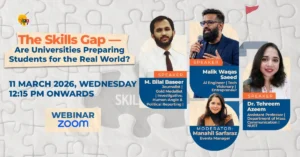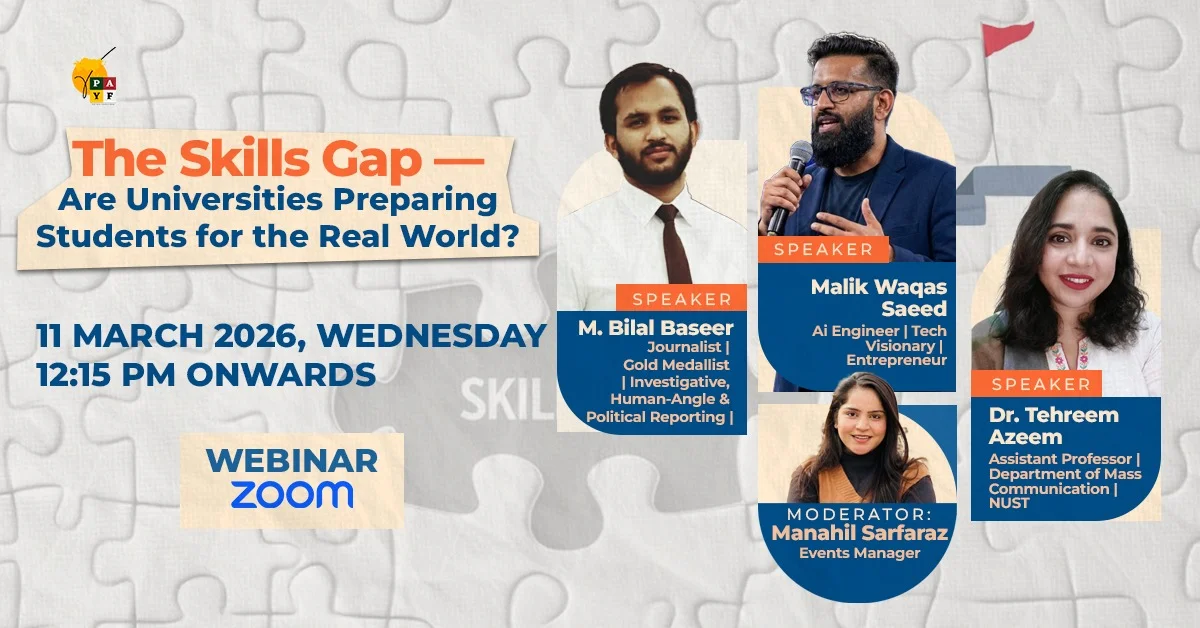
Pak Asia Youth Forum (PAYF) organized an insightful webinar titled “Skill Gap: Are Universities Preparing Students for the Real World?” to explore the widening gap between academic education and the practical skills required in today’s job market. The session brought together experts from academia and industry to discuss the challenges faced by students as they transition from university education to professional careers.
The webinar was moderated by Manahil Sarfraz, Events Coordinator at PAYF. The panel featured distinguished speakers including Tehreem Azeem, Assistant Professor at the Department of Mass Communication, National University of Sciences and Technology (NUST); Malik Waqas Saeed, an AI engineer and youth empowerment advocate; and Bilal Baseer, a researcher and academic contributor. Each speaker shared valuable insights on the evolving expectations of the modern workforce and the steps needed to bridge the gap between education and employability.
Academia and Industry: A Critical Disconnect
One of the key themes discussed during the webinar was the disconnect between academia and industry. Speakers emphasized that universities often focus heavily on theoretical knowledge, while industries increasingly demand practical skills, critical thinking abilities, and professional experience. This mismatch leaves many graduates struggling to adapt to workplace expectations.
Tehreem Azeem highlighted that the relationship between academia and industry must be strengthened. According to her, both sectors depend on each other and must collaborate more effectively. She noted that universities are gradually introducing initiatives such as internships, research opportunities, and industry partnerships. However, she stressed that institutional support alone is not enough if students themselves are not motivated to take advantage of these opportunities.
The Role of Students in Bridging the Gap
The discussion also emphasized the responsibility of students in preparing themselves for the professional world. Speakers noted that while universities provide a foundation, students must actively pursue internships, networking opportunities, and skill development outside the classroom.
Tehreem Azeem pointed out that not all students demonstrate the same level of dedication and curiosity. She observed that many students attend classes without actively engaging in learning or seeking practical experience. In contrast, those who take initiative by participating in projects, internships, and networking activities often gain a significant advantage when entering the job market.
The session also touched upon the importance of understanding personal career goals. Students were encouraged to carefully evaluate the programs they choose, analyze industry trends, and consider how their academic degrees align with future employment opportunities.
Employment Challenges and Changing Job Markets
Malik Waqas Saeed provided a broader perspective by sharing statistics related to unemployment among graduates in Pakistan. According to his observations, a large percentage of graduates remain unemployed or work in positions that do not match their qualifications. He emphasized that only a small portion of the workforce is truly considered job-ready by the industry.
He also highlighted the rapid transformation of the job market due to technological advancements, particularly in the field of Artificial Intelligence and digital technologies. As industries evolve, new job roles are emerging while traditional roles are being replaced or redefined. This shift requires students to develop adaptable skill sets that combine technical knowledge with soft skills such as communication, leadership, and critical thinking.
Malik Waqas Saeed also stressed the importance of networking and industry exposure. He encouraged students to use professional platforms like LinkedIn to connect with industry professionals, follow companies of interest, and learn directly from experts working in their desired fields.
Importance of Practical Experience
Bilal Baseer highlighted the challenges students face when transitioning from theoretical learning to practical work environments. He explained that many students only begin searching for internships or job opportunities after completing their degrees, which can create additional hurdles in their career development.
According to him, gaining exposure to professional environments during university years is essential. Internships, volunteer projects, and industry collaborations allow students to understand real-world expectations and develop the confidence needed to perform in professional settings.
Rethinking Education for a New Generation
Another important aspect discussed during the webinar was the need for educational institutions to adapt to the changing learning behaviors of younger generations. With the rapid rise of digital technologies and AI tools, traditional teaching and assessment methods may no longer be sufficient.
Speakers suggested that universities should incorporate more practical assessments, project-based learning, and industry-driven curricula to better prepare students for real-world challenges.
Conclusion
The webinar concluded with a strong consensus that addressing the skills gap requires collective action from universities, industries, policymakers, and students themselves. While institutions must improve industry linkages and modernize curricula, students must also take responsibility for continuously developing their skills and seeking practical experiences.
Participants were encouraged to remain proactive, build professional networks, and focus on long-term career development rather than relying solely on academic degrees. The session served as an important reminder that in today’s rapidly changing world, learning must extend beyond classrooms to ensure meaningful professional success.