Skip to content
Afghanistan’s contemporary instability is deeply rooted in its historical formation, fragmented ethnic composition, and patterns of exclusionary governance. Long before the modern state emerged under Ahmad Shah Durrani in the mid-18th century, the region was a mosaic of Tajiks, Uzbeks, Hazaras, and Pashtuns, each governed through local power networks, tribal affiliations, and regional autonomy. Ahmad Shah’s attempt to impose centralized authority reflected a Pashtun-centric model reliant on military dominance and tribal loyalty rather than inclusive institutional frameworks. Consequently, non-Pashtun groups remained politically marginalized, leaving large swaths of the country under semi-sovereign local control. Persistent insecurity and the proliferation of extremist sanctuaries have reignited debates over Afghanistan’s political and territorial future, including proposals for a “peaceful forking” along ethnic and regional lines.
Historical Genesis and Ethnic Fragmentation
Ahmad Shah Durrani, founder of the modern Afghan state in 1747, consolidated Kandahar, Ghazni, Kabul, and Peshawar amid the decline of the Mughal and Safavid empires. His governance relied on an absolute monarchy supported by a tribal council whose positions became hereditary, embedding elite monopolies in power. Administrative functions were bifurcated ethnically and educationally, with the Persian-speaking Qizilbash dominating the civil service while the largely illiterate Durrani elite focused on military conquest over domestic administration. Ahmad Shah’s campaigns, including the Third Battle of Panipat in 1761, created a parasitic economy dependent on external plunder; the empire rapidly fragmented following his death, reinforcing patterns of semi-state governance and peripheral autonomy.
Throughout the 19th and early 20th centuries, Afghan rulers controlled urban centers and trade corridors, leaving rural regions under tribal and regional strongmen. The 1893 Durand Line, demarcating Afghanistan from British India, fractured the Pashtun heartland and entrenched political fragmentation. The central government’s inability to project authority allowed ethnic groups to retain de facto control over ancestral lands, shaping a persistent political culture of regionalism.
Afghanistan comprises over forty languages and multiple ethnic groups, each with distinct historical narratives. Pashtuns, roughly 42% of the population, historically monopolized state power, marginalizing Tajiks (27%), Hazaras (9%), Uzbeks (9%), and smaller minorities. The term “Afghan” became synonymous with Pashtun identity, heightening non-Pashtun resentment. Dari emerged as the lingua franca, while Turkic languages remained marginalized. State-engineered demographic shifts, particularly under Amir Abdur Rahman Khan’s late 19th-century “Pashtunization” campaigns, forcibly relocated Pashtuns into northern and central territories, diluting minority influence and creating enduring land disputes between nomadic and settled populations.
The Hazaras exemplify the human cost of ethnic fault lines. Targeted massacres, systemic marginalization, punitive taxation, and educational exclusion established them as an ethnically defined underclass. Contemporary threats from ISIS-K and Taliban reprisals continue cycles of persecution, underscoring the central state’s incapacity to protect its diverse citizenry.
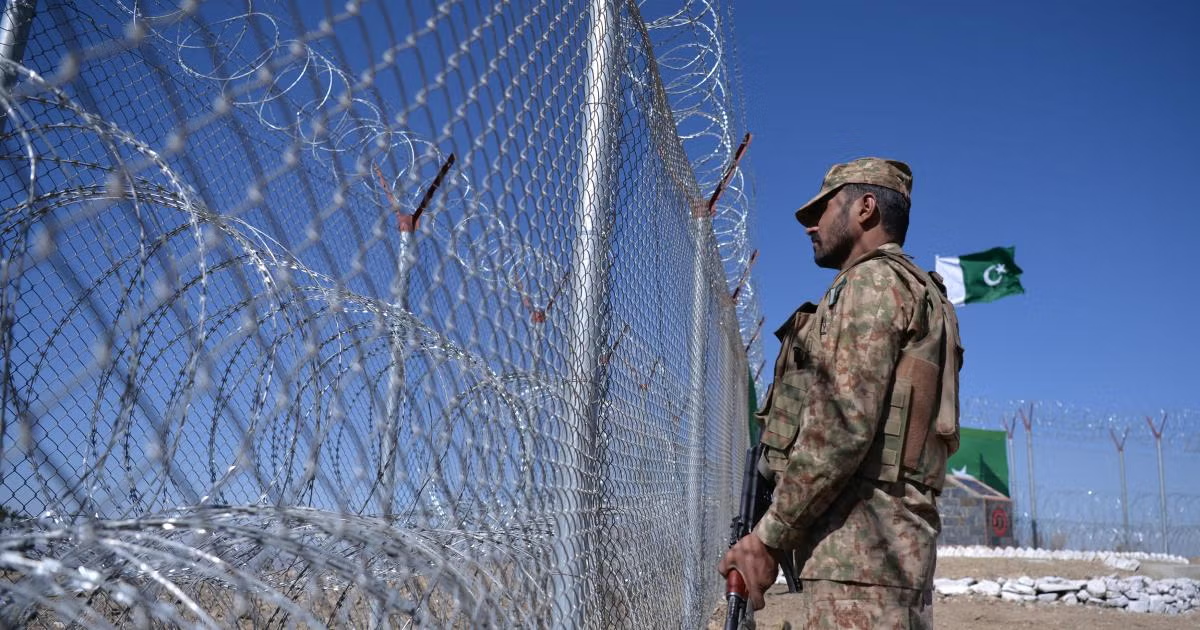
Weak central authority, porous borders, and limited rural governance have rendered Afghanistan a persistent haven for terrorist organizations, including Al-Qaeda and ISIS-K. The Durand Line remains a point of contention; the Taliban’s refusal to recognize it fosters cross-border friction with Pakistan, fueling insecurity and separatist pressures. Pakistan’s strategic depth doctrine has backfired, with the Taliban harboring TTP operatives while accusing Pakistan of intervention, creating a volatile regional environment that complicates stabilization efforts.
Territorial Restructuring and Governance Alternatives
Given entrenched ethnic divisions and governance failures, proponents argue that a “peaceful forking” of Afghanistan along ethnic and regional lines may offer the most viable path toward stability. This framework envisions the northern Uzbek-majority territories aligning with Uzbekistan, the northeastern Tajik-majority regions integrating with Tajikistan, the southern and eastern Pashtun-dominated areas forming either a unified Pashtun state or merging with Pakistan, and the central highlands of Hazarajat establishing an independent Hazaristan led by minority groups. Some analysts also propose a broader Central Asian Confederacy (CAC), allowing northern and western provinces to retain local autonomy while cooperating within a loose federal framework for trade, defense, and other shared interests.
Advocates, such as Robert Blackwell and Brahma Chellaney, suggest that because Afghanistan’s ethnic groups are concentrated geographically, such a territorial restructuring could be more feasible than in other multi-ethnic states. However, the approach is not without risks. Forced migrations, refugee crises, and potential ethnic persecution remain serious concerns, and the creation of an independent Pashtun state could directly challenge Pakistan’s territorial integrity, potentially inflaming separatist sentiments in Khyber Pakhtunkhwa and Balochistan. In such a scenario, Afghanistan’s neighbors, including Uzbekistan, Turkmenistan, Russia, and China, would inevitably play a pivotal role in pressing for the dismantling of terrorist networks.
The National Resistance Front (NRF), led by Ahmad Massoud, advocates a decentralized democratic Afghanistan that respects regional autonomy while maintaining national unity. Since 2021, the NRF has conducted guerrilla operations in northern mountainous regions, establishing liberated zones to sustain a broader offensive and pursuing diplomatic initiatives, such as the Vienna Process, to garner international support. Critics, however, argue that decentralization may inadvertently result in a de facto north-south partition if Pashtun areas remain outside NRF influence, highlighting the persistent challenges of reconciling ethnic diversity with central governance.
Conclusion
Afghanistan’s chronic instability stems from historical centralization failures, entrenched ethnic hierarchies, and a semi-sovereign periphery. Peaceful territorial restructuring offers one pathway to reconcile these divisions, while decentralized governance provides an alternative for maintaining unity. The success of either approach hinges on the careful calibration of political authority, protection of minority rights, and regional cooperation. Absent such strategies, Afghanistan risks perpetuating cycles of conflict, ethnic strife, and regional insecurity.