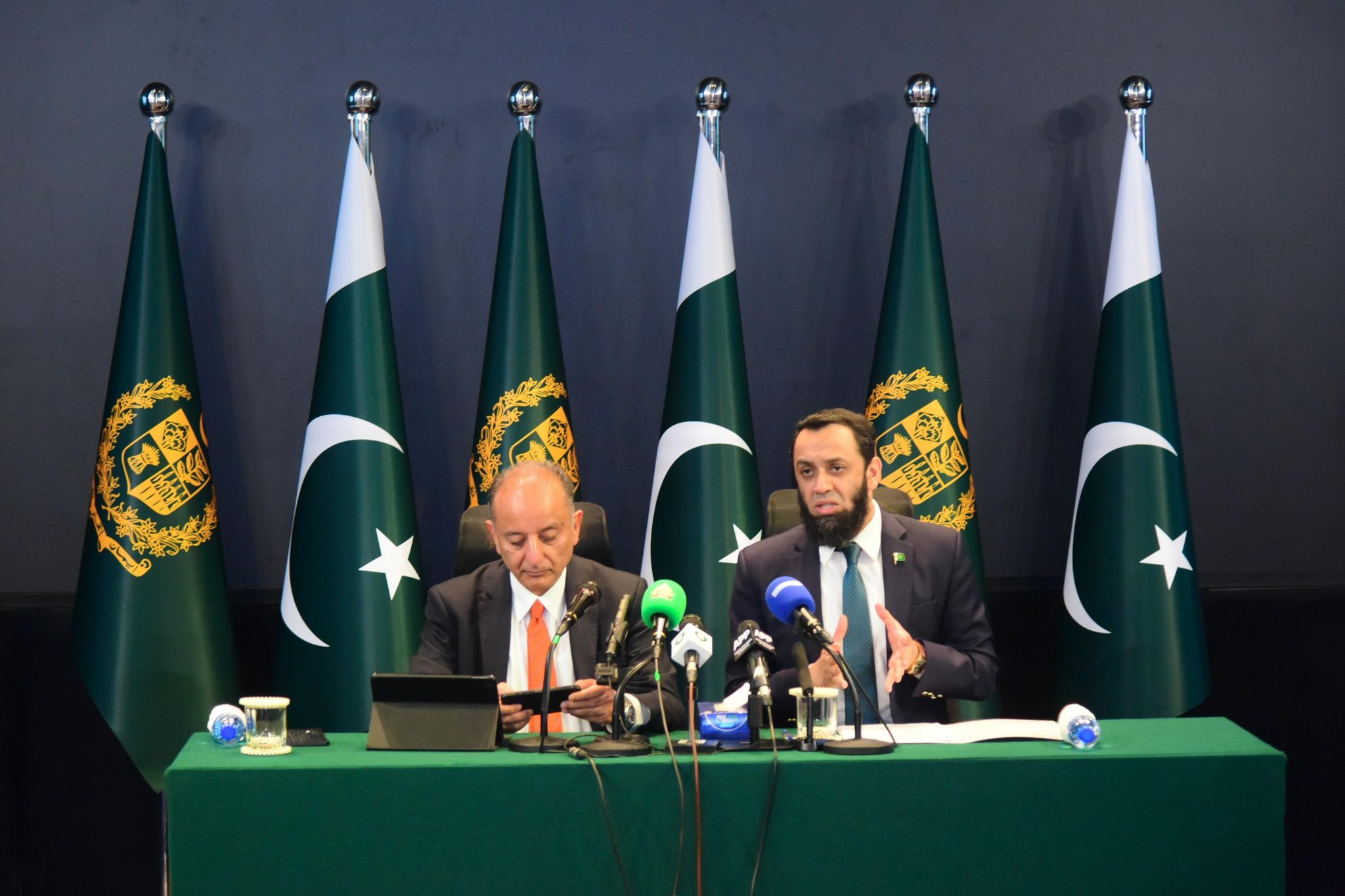
Water treaties survive because facts are kept straight, obligations are not blurred, and unilateral narratives are not allowed to harden into public assumptions through repetition alone. Today, Pakistan reasserted exactly that principle, not through rhetoric, but through the deliberate, evidence-based diplomacy of convening the world’s water and legal experts in Islamabad to host the first international seminar on the Indus Waters Treaty (IWT) to examine, in detail, the legal architecture of the Indus Waters Treaty and Pakistan’s rights under it.
Federal Information Minister Attaullah Tarar’s announcement of the seminar is significant not because Pakistan needed to discover new arguments. It is significant because it represents Pakistan choosing to fight a legal and narrative battle on the terrain where it has always held the stronger position: international law, treaty text, and the documented history of why this agreement exists in the first place.
A Treaty That Cannot Be Unilaterally Suspended — By Design
More than a year ago, India announced it was placing its IWT obligations in abeyance, a unilateral move that followed the attack on tourists in occupied Kashmir’s Pahalgam, which killed 26 people. New Delhi blamed Islamabad for the attack without presenting evidence. Pakistan strongly denied the allegations and called for a neutral investigation. That investigation never materialised. What materialised instead was India’s attempt to weaponise a humanitarian and agricultural treaty as a tool of political retaliation.
Tarar’s central legal point deserves to be stated with complete clarity, because it is not a matter of interpretation: the Indus Waters Treaty came into being through mutual consensus between Pakistan and India, and it can only be amended or revised through that same mutual consensus. It cannot be revoked unilaterally. It cannot be terminated unilaterally. It cannot be amended by one party acting alone. The treaty’s own framework remains in force regardless of one signatory’s unilateral declaration otherwise, because that is precisely what makes it a treaty rather than a discretionary policy that either side can withdraw at will.
This is not Pakistan’s interpretation alone. It is the documented, internationally recognised legal character of the agreement, and it is why Pakistan’s position has received significant legal support internationally, and why, as Tarar noted, India’s stance has not been accepted at any international forum where the issue has been discussed objectively.
Why the Treaty Exists: The History India’s Narrative Erases
To understand why unilateral suspension is not merely illegal but a betrayal of the treaty’s founding purpose, the history must be remembered in full, because that history is precisely what gets erased when grievance narratives replace documented fact.
The Indus Waters Treaty was not born of Indian generosity, nor was it a concession extracted through international pressure. It was born of acute vulnerability, a vulnerability created by Partition itself and crystallised in the April 1948 canal-water crisis, when East Punjab stopped water supplies to West Punjab following the expiry of a temporary arrangement. That episode deprived areas of Pakistan of water at a critical agricultural moment and left a lasting, justified fear that upstream control could be used to determine downstream survival.
The Inter-Dominion arrangement of May 4, 1948, documented this live dispute. The Indus Waters Treaty, negotiated over years and signed in 1960, superseded that temporary and precarious arrangement with something durable: not sentiment, but legal certainty. India is the upper riparian on the western rivers before they enter Pakistan, and Pakistan’s agricultural heartland, the lifeline of its food security and rural economy, depends critically on reliable flows from those rivers. This asymmetry of geography is exactly why the treaty exists. It replaced the discretion of an upstream power with the obligation of international law.
This is the history that any honest accounting of the treaty’s 1954 World Bank-proposed framework must reflect. The specific provisions often cited as evidence that India was “punished” for cooperation, restrictions on Chenab waters at Marala, limits on diversion from the Chenab, and constraints on upper-reach development, were not punitive measures. They were the structural safeguards that made downstream certainty possible for a newly partitioned country whose agricultural survival had already been demonstrated, in 1948, to be vulnerable to exactly the kind of unilateral upstream action India now claims the right to take again.
When safeguards are recast as unfairness, when dispute settlement mechanisms are recast as weaponisation, and when unilateral suspension is recast as a justified response to unproven allegations, silence in the face of that recasting risks normalising a position that is both legally unsound and strategically dangerous for the entire framework of treaty-based water sharing that protects downstream nations worldwide, not just Pakistan.
A Narrative Victory Built on Legal Substance
Pakistan’s seminar this week, bringing together water and legal experts from around the world to examine the treaty’s legal nature and its various dimensions, represents the kind of sustained, evidence-based public diplomacy that PAYF has consistently argued Pakistan must invest in more deliberately.
Tarar’s framing of this as a victory in the narrative domain is accurate, and it is worth understanding why. International experts, examining the treaty’s text and history objectively, have consistently acknowledged Pakistan’s rights. India’s unilateral suspension has not found acceptance at any international forum where the matter has been discussed on its legal merits rather than through the political framing India has attempted to attach to it.
Prime Minister Shehbaz Sharif has consistently described water as both Pakistan’s lifeline and its red line. Field Marshal Syed Asim Munir has conveyed the same message at every available forum. This consistency of messaging, from civilian and military leadership alike, reflects an understanding that the Indus Waters Treaty is not a peripheral diplomatic issue. It is foundational to Pakistan’s agricultural survival, and therefore foundational to the food security of a nation whose agricultural heartland feeds it.
Climate Vulnerability and the Pattern of Pakistani Self-Reliance
The same press conference that addressed the Indus Waters Treaty also revealed a pattern worth highlighting independently: Pakistan’s growing posture of self-reliance in the face of climate vulnerability it did little to cause.
Pakistan ranks among the world’s ten countries most vulnerable to climate change despite contributing less than one per cent of global carbon emissions and greenhouse gases, an imbalance between climate responsibility and climate consequence that Pakistan has rightly raised at every available international forum, including successive UN General Assembly addresses.
What deserves particular attention is Tarar’s disclosure that during the most recent floods, Pakistan did not appeal for international aid, for the first time. This was a joint decision of federal and provincial governments to rehabilitate affected populations through domestic resources, resettle them in affected areas, and manage relief and disaster response independently. Tarar described this as a responsible and conscious step, reflecting an improved economic position that now allows Pakistan to manage disaster response without external dependency, while still extending humanitarian assistance to other nations affected by disasters of their own.
This self-reliance matters for the broader narrative Pakistan is constructing internationally. A country capable of managing its own climate disaster response, while simultaneously building a rigorous legal case for its water rights under an international treaty, is a country asserting both capability and principle simultaneously, not a country positioning itself as a perpetual claimant of international sympathy, but one demonstrating it can stand on its own resources while still holding firmly to the legal rights it is owed.
What This Means for the Region
The Indus Waters Treaty’s integrity matters far beyond the Pakistan-India bilateral relationship. It is one of the most durable water-sharing agreements in modern international law, surviving wars, military confrontations, and decades of broader political hostility between the two countries precisely because both sides, until India’s unilateral suspension, treated it as legally inviolable regardless of the state of the broader relationship.
If India’s unilateral suspension is allowed to stand unchallenged in the international narrative, the precedent it sets extends far beyond South Asia. Every upper riparian nation watching this dispute will conclude whether international water treaties can be suspended unilaterally whenever political convenience demands it, a precedent with implications for downstream nations across Asia, Africa, and the Middle East, wherever water-sharing agreements between upstream and downstream nations exist.
This is why Pakistan’s legal and diplomatic defence of the treaty’s integrity is not merely a bilateral matter. It is a defence of the principle that treaties mean what they say, that obligations cannot be unilaterally abandoned through grievance narrative, and that international law continues to bind even when one party finds compliance politically inconvenient.
Facts Kept Straight
The Indus Waters Treaty exists because of a documented history of vulnerability, was negotiated through years of careful multilateral effort, and has survived six decades specifically because both signatories treated unilateral suspension as outside the realm of legitimate options.
Pakistan’s position is not a grievance. It is the law. The seminar convened this week in Islamabad, bringing the world’s legal and water experts to examine the treaty’s text, history, and legal force, is precisely the sustained, evidence-based diplomacy that defends a legal position rather than merely asserting one.
India’s unilateral suspension, prompted by an attack it blamed on Pakistan without evidence and without the neutral investigation Pakistan has consistently requested, does not change the treaty’s binding legal character. It does not survive scrutiny when examined objectively by international experts. And it will not be allowed to harden into an accepted international narrative while Pakistan continues to do the work, diplomatically, legally, and publicly, of keeping the facts straight.
Water is Pakistan’s lifeline. It is also its red line. And on this matter, the law remains firmly on Pakistan’s side.