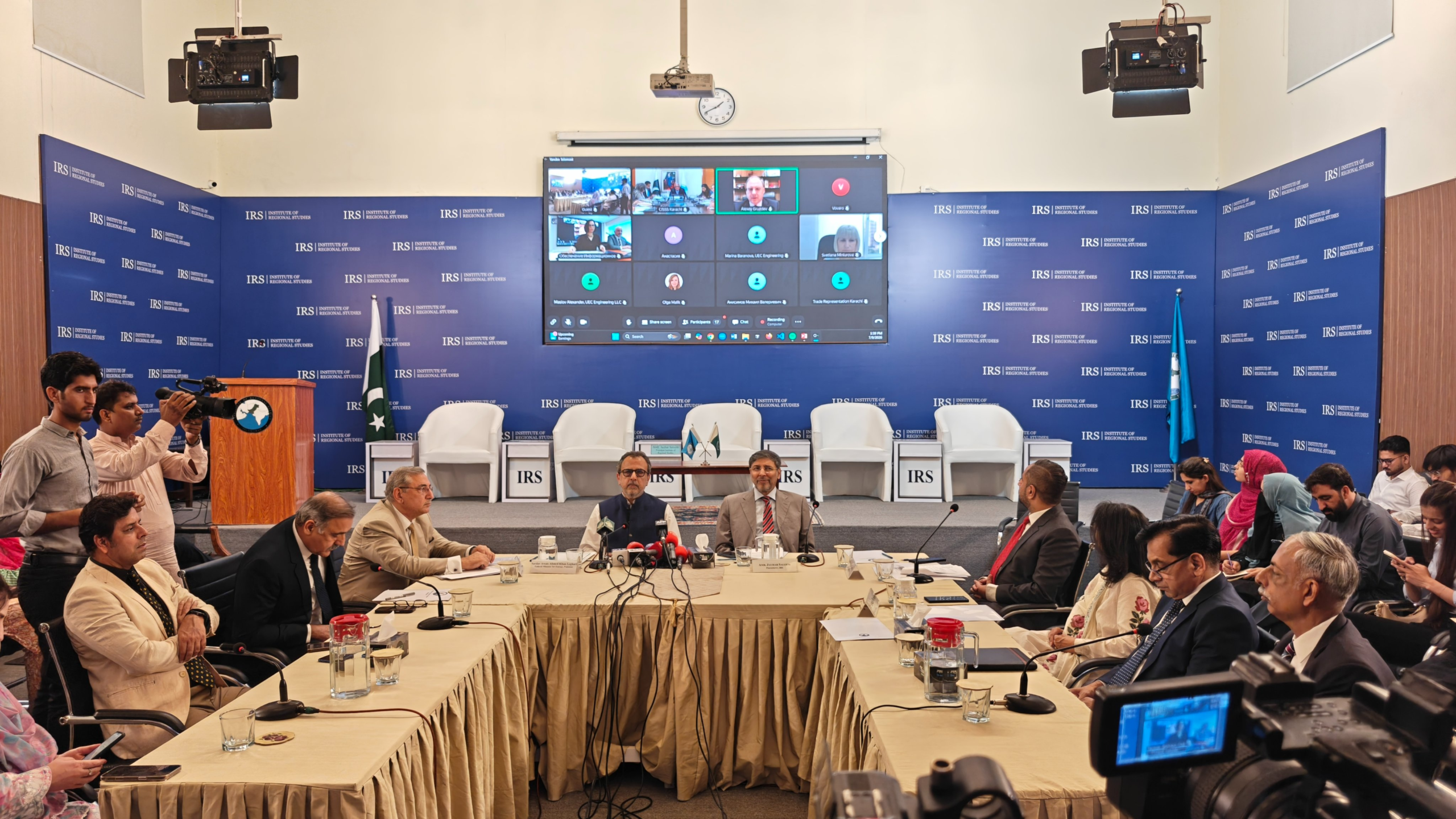
The Institute of Regional Studies (IRS), Islamabad, in collaboration with the University of World Civilizations, Moscow, convened a high-level webinar on 9 July 2026 to explore the future trajectory of Pakistan–Russia relations. The event brought together ministers, diplomats, academics, business leaders, and policy experts from both countries to discuss opportunities for expanding bilateral cooperation amid evolving regional and global dynamics.
The webinar "Pakistan–Russia: Strengthening Trade, Education & Energy Collaboration" commenced with keynote remarks by Federal Minister for Energy of Pakistan, Sardar Awais Ahmed Khan Leghari; Deputy Minister of Industry and Trade of the Russian Federation, Alexey V. Gruzdev pic.twitter.com/yxqVduntgu
— Pakistan Embassy Russia (@PakinRussia) July 9, 2026
Overview
Participants emphasised that the strengthening political relationship between Pakistan and Russia should now be translated into tangible economic and strategic cooperation. Against the backdrop of shifting geopolitical realities, changing supply chains, Eurasian connectivity initiatives, and Russia’s eastward economic orientation, speakers argued that both countries are well positioned to build a more comprehensive and sustainable partnership.
A recurring theme throughout the discussions was the need to move beyond symbolic engagement and establish institutional mechanisms capable of delivering measurable outcomes in trade, investment, infrastructure, education, technology, and regional connectivity.
Key Areas of Discussion
The webinar focused on several priority areas for future cooperation, including:
- Institutionalising implementation through strengthened intergovernmental coordination and sector-specific working groups.
- Developing a long-term Pakistan–Russia Comprehensive Economic Roadmap to guide cooperation in trade, investment, technology, and industrial development.
- Advancing Pakistan’s economic engagement with the Eurasian Economic Union (EAEU) and exploring preferential trade opportunities.
- Expanding bilateral trade through alternative payment mechanisms, barter arrangements, and improved financial settlement systems.
- Enhancing regional connectivity by developing multimodal transport corridors, railway links, logistics infrastructure, and trade routes connecting Pakistan with Central Asia and Russia.
- Strengthening collaboration in the energy sector, including hydrocarbons, renewable energy, electricity infrastructure, and engineering cooperation.
- Promoting cooperation in agriculture, food security, industrial manufacturing, mining, railway engineering, and heavy industries.
- Expanding partnerships in digital technologies, artificial intelligence, cybersecurity, and digital public infrastructure.
- Increasing educational exchanges, scholarships, joint research initiatives, Russian language training, and institutional collaboration between universities.
- Encouraging sustained people-to-people engagement through think tanks, academic networks, cultural exchanges, and provincial-level partnerships.
- Improving the investment climate by addressing regulatory, customs, financial, and business facilitation challenges.
- Recognising the importance of regional stability, particularly in Afghanistan, for enhancing long-term connectivity, energy security, and Eurasian trade.
Why It Matters
The discussions reflected a growing consensus that Pakistan and Russia have an opportunity to deepen their strategic partnership through practical economic cooperation. As regional connectivity and Eurasian integration continue to gain importance, sustained institutional engagement and commercially viable projects could play a significant role in strengthening bilateral relations and supporting broader regional development.