A rising Global South institution is reshaping how conflicts are managed challenging the UN’s dominance while offering an alternative model of diplomacy.
A Fractured Global Order Searching for New Mediators
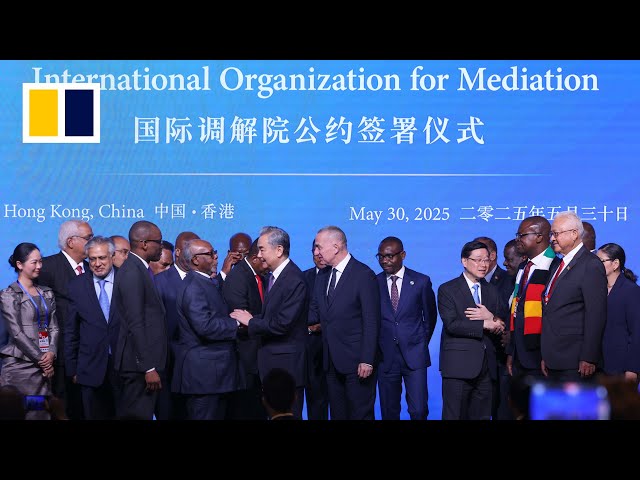
For eight decades, the United Nations has attempted to anchor the world’s peace architecture, but its ability to mediate conflicts is increasingly constrained by geopolitical rivalries. The paralysis resulting from U.S.–China competition, the resurgence of strategic blocs, and expanding regional conflicts has created a vacuum in global diplomacy. This vacuum has opened the door for the International Organization of Mediation (IOMed), established in 2023 with strong backing from China and a consortium of Global South states. Its arrival signals a shift in global governance at a time when traditional institutions struggle to respond collectively. This moment reflects not the UN’s collapse, but the fragmentation of global authority.
IOMed presents itself as a dialogue-driven, culturally rooted mediator. Yet its emergence raises a fundamental question: is it a complementary partner to the UN or the beginning of a parallel diplomatic system that reflects the ambitions of a rising non-Western world?
Why the UN’s Mediation Landscape Needed a Shake-Up
The UN has historically played pivotal roles in settling conflicts from Cambodia to Mozambique, yet its structural limitations have become more visible in the 21st century. Security Council politics form the core of this limitation. Between 2011 and 2023, Russia vetoed 17 resolutions on Syria, China and Russia jointly blocked several resolutions on Myanmar and Ukraine, and the United States has repeatedly shielded Israel from censure. In practice, the veto often functions as a tool of political obstruction, allowing powerful states to halt collective action and leaving the world unable to act in accordance with its conscience on pressing humanitarian or security challenges. This deepening gridlock has eroded trust, especially among developing nations that increasingly feel the UN’s mediation system mirrors Western preferences more than global consensus.
Alongside the political paralysis, operational challenges plague the UN. Peacekeeping missions face the largest funding shortfall in two decades, leading to the withdrawal or downsizing of missions in Mali, Sudan, and the Democratic Republic of Congo. With resource-starved departments and contested mandates, the UN’s capability to initiate timely mediation has significantly weakened. Many in the Global South perceive UN mediators as disconnected from local political realities, revealing a persistent gap between international diplomacy and the communities it seeks to support.
IOMed’s Rise as a South-South Mediation Model
Against this backdrop, IOMed introduces a model that emphasizes diplomatic flexibility, cultural sensitivity, and the principles of non-interference. Its founding charter highlights “harmony without uniformity,” echoing a long-standing tenet of Chinese diplomacy. Unlike Western-led mediation that often combines conflict resolution with political reforms and human rights benchmarks, IOMed frames itself as a forum that respects state sovereignty and prioritizes quiet dialogue over public pressure.
This approach resonates across Africa, Asia, and the Middle East, where many governments prefer discreet negotiation to avoid international scrutiny. The organization’s early plans include creating a Mediation Academy, sponsoring regional peace dialogues, and training emerging diplomats from developing states. With China pledging financial support and political backing, IOMed positions itself not merely as a mediator but as a new intellectual hub for the Global South. As Kenyan peace scholar Dr. Mercy Aoko notes, “Peace talks succeed when mediators understand not only the conflict, but also the culture. IOMed offers that familiarity.”
A Potential Partner or Rival to the United Nations
While IOMed frames its mission as complementary to the UN, geopolitical realities complicate this narrative. Many Western analysts argue that China’s sponsorship of new institutions from the Asian Infrastructure Investment Bank (AIIB) to the expanded BRICS grouping and now IOMed reflects a broader strategy of “parallel multilateralism.” The logic is clear: build alternative institutions that gradually dilute Western dominance without directly confronting the UN system. Mediation is emerging as China’s next frontier for influence, according to a report in the Financial Times.
There are concerns that IOMed’s neutrality may be tested by China’s strategic partnerships. States like Pakistan, Iran, and Ethiopia enjoy deep political ties with Beijing, raising questions about whether outcomes will tilt toward status-quo governments rather than inclusive or transformative peace processes. Critics draw parallels to past experiences in Libya, where multiple competing mediation tracks UN, Russia, Turkey, France, and Gulf states created fragmented and conflicting negotiation spaces. If the same pattern emerges with IOMed, global diplomacy risks further disintegration.
However, IOMed can also fill gaps the UN simply cannot. When Security Council divisions prevent UN involvement, IOMed’s flexible format can serve as a pre-negotiation platform or a Track 1.5 diplomatic space that builds confidence among rival parties. With more representation from Asia and Africa, it may also correct the long-standing imbalance in the composition of global mediation teams, which remain dominated by European experts.
Where IOMed May Step In: Early Conflict Zones to Watch
Current geopolitical trends suggest that IOMed’s early influence may appear in regions where China already has substantial diplomatic or economic leverage. The Middle East is the most visible example, following Beijing’s surprise-driven 2023 facilitation of the Saudi–Iran rapprochement. Building on that momentum, IOMed could quietly engage in Yemen’s fragmented peace process or explore reconstruction-related dialogues in Syria. South Asia represents another potential arena. Although India and Pakistan reject UN mediation, both engage diplomatically with Beijing, making IOMed a potential forum for crisis communication or limited de-escalation mechanisms, especially on border or water-sharing disputes.
In the Horn of Africa, China’s deep economic footprint and long-term presence position IOMed as a possible actor in Ethiopia-Sudan tensions or South Sudan’s stalled political dialogue. Myanmar remains another likely focus area, given China’s longstanding ties with both the military junta and several ethnic armed groups relationships that the UN cannot navigate with similar flexibility.
Conclusion: A New Architecture of Peace or a New Arena of Rivalry?
The arrival of IOMed reflects a world searching for new diplomatic pathways as old structures falter under geopolitical strain. It does not replace the United Nations, nor does it openly challenge its legitimacy. Instead, it embodies a new phase in the evolution of global governance, where the Global South asserts greater agency through institutions shaped by its own political logic. Whether IOMed becomes a constructive supplement to the UN or a competitor that deepens fragmentation will depend on three variables: transparency in its operations, its ability to remain neutral despite China’s influence, and its willingness to broaden membership beyond a narrow circle.
Peace theorist Johan Galtung once wrote that “a system survives when it rises above the power politics that created it.” If IOMed and the UN manage to coordinate rather than collide, they may jointly strengthen a fragile global order. If they do not, mediation itself may become another battleground in an already divided world at a time when the demand for peace has never been more urgent.