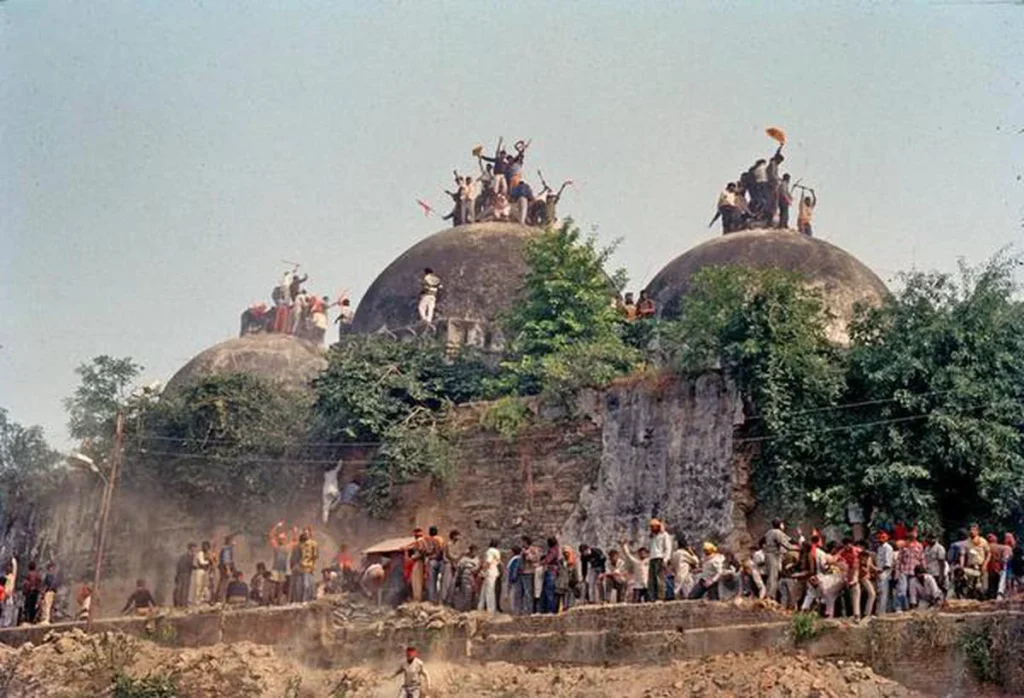
December 6, 1992, marks a defining rupture in India’s constitutional history. The demolition of the Babri Masjid in Ayodhya by kar sevaks showed how religious nationalism could shape political identity. The event reshaped the promise of secularism and highlighted how citizenship could be influenced by majoritarian belief rather than constitutional equality.
To understand modern India, the conflict of Babri Masjid vs Hindutva Ideology needs to be viewed as an ideological transformation that expanded beyond a land dispute and entered the realm of identity, nationalism, and citizenship.
1949: When the Dispute Turned into a Political Project
The mosque, built in 1528 by Mir Baqi under Mughal rule, remained a place of worship for centuries. The conflict took on political significance on the night of December 22, 1949, when someone secretly installed idols of Ram inside the mosque. Prime Minister Jawaharlal Nehru ordered their removal, arguing that the state could not endorse an act carried out in secrecy. The local administration ignored the order, sealed the gates, and labeled the site a “disputed property.” The authorities barred Muslims from entry, while Hindu worship continued in different forms.
This administrative decision created the foundation for future political mobilization. The structure was demolished in 1992. In 2019, the Supreme Court acknowledged that the demolition violated the rule of law and still granted the land to Hindu litigants. The verdict closed the legal battle while revealing how organized mobilization had shaped state outcomes.
The Theoretical Foundations of Exclusion
The conflict of Babri Masjid vs Hindutva Ideology is rooted in the writings of thinkers who shaped Hindu nationalism. Vinayak Damodar Savarkar, in Essentials of Hindutva (1923), defined a true Indian as one who regards India as both Pitrubhumi (Fatherland) and Punyabhumi (Holy Land). By this definition, Muslims and Christians became communities whose loyalty to the country was questioned due to their holy lands being located outside India. The definition created a category of suspect citizenship.
M.S. Golwalkar, the second chief of the RSS, reinforced this framework. In Bunch of Thoughts, he labeled Muslims as “Internal Threat Number One,” along with Christians and Communists. Golwalkar wrote that non-Hindu communities could live in India only if they adopted Hindu culture, language, and political subordination. The elimination of minority identity symbols was framed as a requirement for national strength.
From Ideology to Violence
After the Bharatiya Janata Party assumed power in 2014, the ideological foundation of Hindutva began shaping everyday social behavior. Between 2015 and 2018, cow protection violence led to 44 deaths, 36 of them Muslims. The lynching of Mohammad Akhlaq in Dadri over rumors of beef consumption and the killing of dairy farmer Pehlu Khan demonstrated how religious symbolism was turned into a tool of public violence. In 2024, hate speech incidents targeting religious minorities increased by 74.4 percent, with 1,165 recorded cases. The majority of these incidents occurred in BJP-ruled states. Public intimidation became part of mainstream political culture.
Bulldozer Justice: How State Power Targets Religious Minorities
The logic of Babri Masjid vs Hindutva Ideology has also entered administrative practice through “Bulldozer Justice.” After communal unrest in Nuh, Haryana, authorities demolished more than 300 properties in 2023. Most belonged to Muslims. The Punjab and Haryana High Court questioned whether the state was conducting an exercise in ethnic targeting. Amnesty International reported that in three months of 2022, 128 demolitions rendered 617 people homeless, with Muslims forming a disproportionate majority.
Legislating Citizenship: Religion and the Politics of Inclusion in India
The Citizenship Amendment Act (CAA) of 2019, along with the proposed National Register of Citizens (NRC), reintroduces religion into citizenship criteria. The law offers fast-track citizenship to migrants from neighboring states while excluding Muslims. Additionally, “Love Jihad” laws passed in several states criminalize interfaith marriages and place the burden of proof on the accused, enabling the monitoring of personal life on religious grounds. Together, these laws construct a hierarchy of belonging influenced by identity rather than equal citizenship.
Conclusion
The inauguration of the Ram Temple in 2024 represents the outcome of a political movement shaped over decades. Babri Masjid vs Hindutva Ideology is no longer a story of a demolished structure. It has become a defining element of public policy, legal interpretation and social relations. India’s 200 million Muslims now navigate a political environment shaped by ideas once confined to ideological writing. What began with a locked gate in 1949 continues to shape everyday citizenship, state authority and national identity. The future of India’s secular character now depends on whether equality before the law can withstand a political movement driven by cultural dominance.