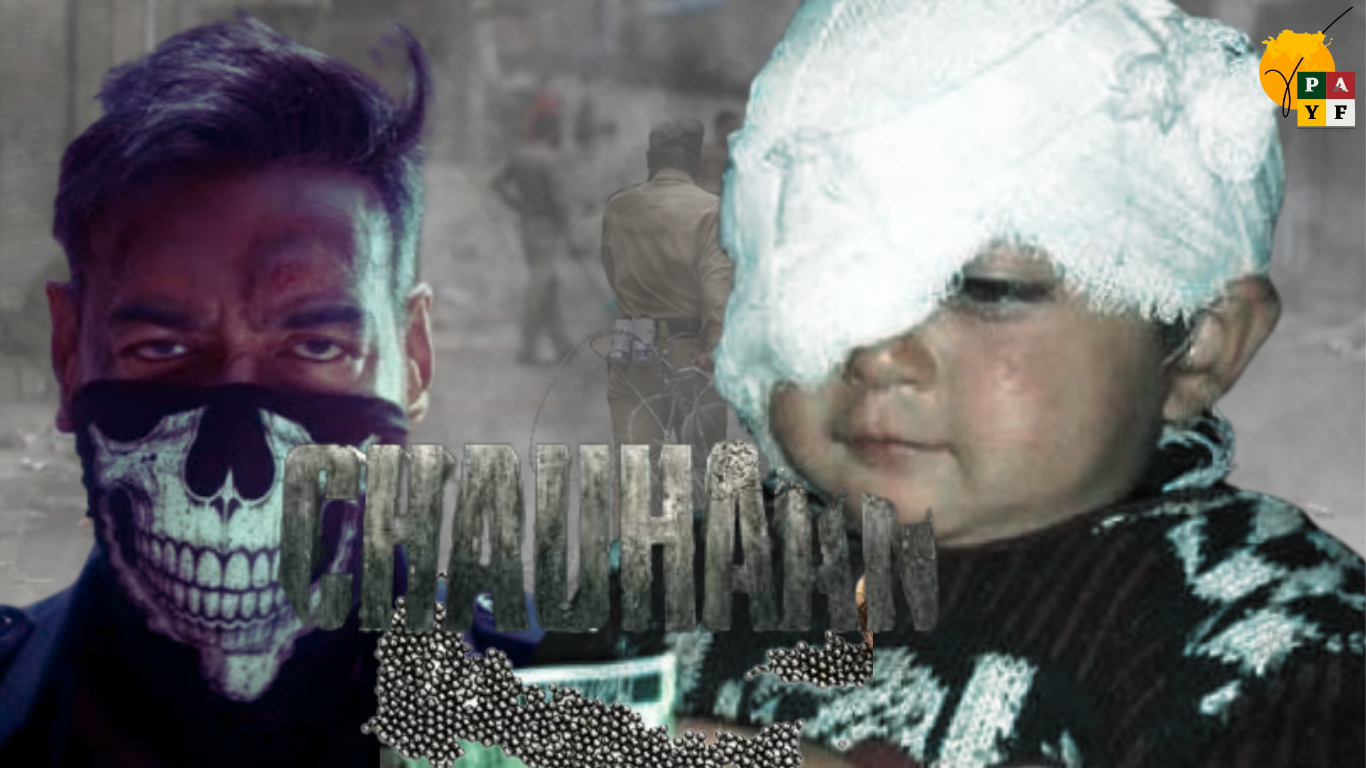
On June 25, 2026, a film teaser dropped on the internet. Two minutes and twenty-four seconds. A Bollywood star. A politically charged backdrop of Kashmir, stone-pelting, smoke, security operations, and a conflict-scarred landscape rendered cinematic. And then, in the measured voiceover of Ajay Devgn, a sentence that should have stopped everyone who heard it cold.
Tear gas, he explained, is ineffective; masks are available online. Water cannons have only a temporary effect. And pellet guns?
“Limited damage.”
He said it with the casual authority of a man describing a mildly inconvenient tool. Not with hesitation. Not with qualification. With the confidence of someone who has decided, before the sentence leaves his mouth, that the matter is settled.
Abhishek Bachchan endorsed it.
The internet moved on.
But somewhere in the archives of SKIMS Medical College Srinagar, in the ophthalmology ward of SMHS Hospital, in the pages of the Indian Journal of Ophthalmology, in the parliamentary records of the Indian Lok Sabha, in the testimony of an Italian photographer who spent four months looking into the faces of people who can no longer look back, the answer to “limited damage” already existed. Had existed for fifteen years. Had been written in the medical notes of a six-year-old child, the youngest pellet gun victim admitted to SKIMS in 2010. Had been counted in the 777 ocular injury patients admitted to a single Srinagar hospital in four months of 2016. Had been recorded in the confession of a Central Reserve Police Force (CRPF) force that told the High Court it had fired approximately 1.3 million pellets in just 32 days.
No one making Chauhaan appears to have read any of it.
This editorial has.
The Medical Record That “Limited Damage” Cannot Survive
The numbers exist. They are not contested. They come from Indian hospitals, Indian parliamentary proceedings, Indian state human rights commissions, and peer-reviewed medical journals. They do not require Pakistani sources or international advocacy organisations to establish. They establish themselves.
Between March 2010 and October 2013, 91 patients with pellet gun injuries were admitted to hospitals in Kashmir. Of those, 36 were admitted to the department of ophthalmology. Many were assessed as having “no prospect of restoring their sight.”
A 2014 study published in the Journal of Evolution of Medical and Dental Sciences, conducted by doctors at SKIMS Medical College, Srinagar, reviewed 20 pellet gun victims with ocular injuries admitted between January 2010 and September 2013. Of them, 17 patients had injuries in one eye and three in both eyes. Thirty-three per cent did not regain any vision. The mean patient age was 21.45 years.
In the seven months following Burhan Wani’s martyrdom in July 2016, over 6,000 people were injured by pellet guns, including 782 who suffered eye injuries, according to Amnesty International. According to official figures presented in the Indian Parliament, 17 people were killed by pellet injuries between July 2016 and August 2017. According to data from the State Human Rights Commission of Indian-Occupied Jammu and Kashmir, 1,726 people were injured by metal pellets in 2016 alone. In January 2018, then-Chief Minister Mehbooba Mufti told the state assembly that 6,221 people had been injured by pellet guns between July 8, 2016 and February 27, 2017; among them, 728 suffered eye injuries, and 54 suffered some form of permanent visual impairment.
A study published in the Indian Journal of Ophthalmology in 2022, led by Dr S. Natarajan and colleagues, reviewed all 777 patients admitted to a tertiary hospital in Srinagar with ocular pellet gun injuries between July 18 and November 18, 2016, a four-month window that produced 777 cases of eye injury serious enough to require hospital admission at a single facility.
A study of 198 pellet injury patients led by Majid Mushtaque of SKIMS, published in the Turkish Journal of Trauma and Emergency Surgery, found that 72.7 per cent of patients were aged between 16 and 25 years. In 2010, the youngest victim at SKIMS was six years old.
This is the medical record. Chauhaan calls this “limited damage.” The Indian state’s own parliament, hospitals, and human rights commission produced the numbers that describe what it actually is.
The Weapon That Was Never Designed for This
The pellet gun’s introduction into Kashmir requires its own historical accounting because it was introduced in 2010 as a humanitarian measure.
Following months of unrest in which over 100 civilians were killed in police firing, the then-Jammu and Kashmir government under Chief Minister Omar Abdullah requested the Centre to provide a non-lethal alternative for crowd control. The Centre subsequently supplied the J&K Police with 12-gauge pump-action pellet shotguns, first used in Sopore on August 14, 2010. The stated intention was to reduce fatalities by replacing live ammunition with a less lethal alternative.
The terminology matters, and the Omega Research Foundation, a UK-based charity that monitors military technologies, has been precise about it: “The Indian forces call it a pellet gun, but it is a pump action shotgun. The ammunition is not designed for crowd control.” Each cartridge contains up to 500 tiny lead pellets that disperse in all directions when fired, commonly used in hunting, structurally incapable of the discrimination that crowd control requires.
Amnesty International has described the pellet shotgun as “cruel,” “dangerous,” “inaccurate and indiscriminate,” stating that there is no way to use it for crowd control in compliance with international human rights standards. The UN Commission on Human Rights called it “one of the most dangerous weapons used against protesters.”
Fourteen people have been killed by pellet guns in Kashmir since 2010, according to Amnesty International. Thousands have been blinded. The year 2016 became known, locally and internationally, as the year of the dead eye epidemic. This is what a non-lethal alternative produced.
The Faces Behind the Statistics
Statistics, however precisely documented, risk abstracting the human reality they represent. The faces of this epidemic exist, and they must be named.
Insha Mushtaq Lone was fourteen years old on July 11, 2016, three days after Burhan Wani’s killing. She looked out of a ground-floor window in Sedow village in Shopian district to watch a protest that had broken out in her neighbourhood. Within moments, a searing pain ripped through her face. Three of her front teeth broke. There was blood everywhere. She did not know what hit her.
Hiba Jan was nineteen months old on November 25, 2018. She was in the arms of her mother, Marsala, in the Kapran area of Shopian when security forces fired tear gas outside their home. Feeling suffocated, Marsala opened the door to get some air. Immediately, pellets ripped through the mesh door. Some struck Marsala’s hand. One struck Hiba’s right eye. Hiba’s face and injury became a global symbol.
Farzan Sheikh was sixteen years old on the afternoon of March 28, 2017, doing his mathematics homework at home in Srinagar when he heard a commotion outside. He stepped out and saw a funeral procession. He heard pro-Kashmir slogans and heard security personnel fire tear gas and pellets to scatter the crowd. He started running toward home. “I saw a policeman with a gun aiming at me, and he shot directly at me,” he said. “That was the last thing I saw.” Then one day in August, his father forgot to turn off a streetlight that shone into Farzan’s bedroom. Farzan stepped out at 11 pm to turn it off himself. Pellets struck him again, this time in his right eye. They came from a CRPF vehicle parked across the street. There were no warnings. After three surgeries on his right eye and four on his left, doctors told Farzan he had lost all vision in his right eye. They said he might regain 40 to 50 per cent vision in his left eye with further surgeries.
Visiting eye surgeon Dr S. Natarajan, who performed surgeries on 40 patients at SMHS Hospital in Srinagar, said: “We have to do our best. These are youngsters, teenagers and children. We can’t let them go blind.”
Ajay Devgn’s film calls what happened to Insha, to Hiba, to Farzan, “limited damage.”
What Bollywood Has Done — And Why It Matters
Chauhaan is directed by Neeraj Yadav and produced by Aanand L. Rai under Colour Yellow Productions, in association with Jio Studios. Its teaser features stone-pelting, pellet gun injuries, security operations, and a conflict-scarred region, indicating a politically charged action narrative set in Kashmir. It is scheduled for theatrical release on October 1, 2027.
The film’s creative team made choices. They chose to frame pellet guns as an insufficient tool requiring defence rather than a weapon requiring accountability. They chose to put the “limited damage” characterisation in the mouth of a Bollywood star whose cultural reach extends across the Indian subcontinent and its global diaspora. They chose to set this narrative against the backdrop of the very conflict that produced the dead eye epidemic, without, apparently, the medical literature, the parliamentary admissions, or the faces of the blinded children informing the script.
This is how normalisation works. Not through a government announcement that blinding protesters is acceptable policy. Through a film in which a sympathetic protagonist calmly explains that the weapon that blinded Insha Mushtaq Lone, Hiba Jan and Farzan Sheikh and many others causes only limited damage, audiences leave the theatre having absorbed that framing as the natural background of the story they just watched.
Italian photographer Camillo Pasquarelli, who spent four months in Kashmir documenting pellet gun victims, described what he found: men, women, and children with eyes that appear to be gazing at a distant view, but are not looking at anything. The darkness that surrounds them in his photographs surrounds them in life. They are fully or partially blind.
“The pain and suffering surround you,” Pasquarelli said. “It’s everywhere when you go to Kashmir. You know that, somehow, everyone you speak to is related to the conflict. Maybe his neighbour has been injured, maybe his daughter has been killed.”
According to Doctors Without Borders, 41 per cent of adults in Kashmir have significant symptoms of depression. An entire population living with the accumulated weight of conflict, occupation, and the specific documented terror of a weapon that could blind you while you looked out of your own window or stepped outside to turn off a streetlight.
The International Standards That Were Never Met
The legal and human rights framework around pellet gun use in Kashmir is not ambiguous. It has been assessed by the relevant international bodies, and the verdict is consistent.
Amnesty International has stated explicitly that there is no way to use the pellet shotgun for crowd control in compliance with international human rights standards, not that it is difficult to use compliantly, but that compliance is structurally impossible with this weapon in this context. The UN Commission on Human Rights has called it one of the most dangerous weapons used against protesters. The weapon’s own technical characteristics, up to 500 lead pellets dispersing in all directions per discharge, make discriminating use between protesters and bystanders physically impossible.
The Record That Cannot Be Rewritten
The medical record demands that the characterisation of pellet gun injuries as “limited damage” be publicly and consistently challenged, not only in Pakistani and international media, but in the Indian public discourse that will watch Chauhaan and absorb its framing as background fact.
The human rights record demands that the 777 ocular injury patients admitted to a single Srinagar hospital in four months of 2016, the 6,221 people injured between July 2016 and February 2017, the 14 people killed, the children as young as six years old admitted to SKIMS, the 33 percent who never regained any vision, that these numbers remain attached to any public discussion of pellet gun use in Kashmir, and that they appear alongside any cultural product that seeks to reframe that use as measured and justified.
The accountability demand is clear: the Indian state used a weapon that its own parliament, its own state human rights commission, its own hospital records, and its own RTI responses have documented as producing mass ocular injuries predominantly among young people, and it fired approximately 1.3 million pellets in 32 days. That record is not a creative interpretation. It is the Indian government’s own data.
Bollywood does not get to call this limited damage. The children who can no longer see their mathematics homework have already answered that characterisation. Their testimony, their medical records, and their faces are the response that no film marketing budget can overwrite.
The darkness that surrounds Pasquarelli’s subjects in his photographs is not limited. For nineteen-month-old Hiba Jan, whose right eye absorbed a pellet through a mesh door, it is not limited. For Farzan Sheikh, who lost all vision in his right eye and may recover 40 to 50 per cent in his left after seven surgeries, it is not limited. For the 33 per cent of ocular pellet injury patients who never regained any vision, it is not limited.
It is total.