Skip to content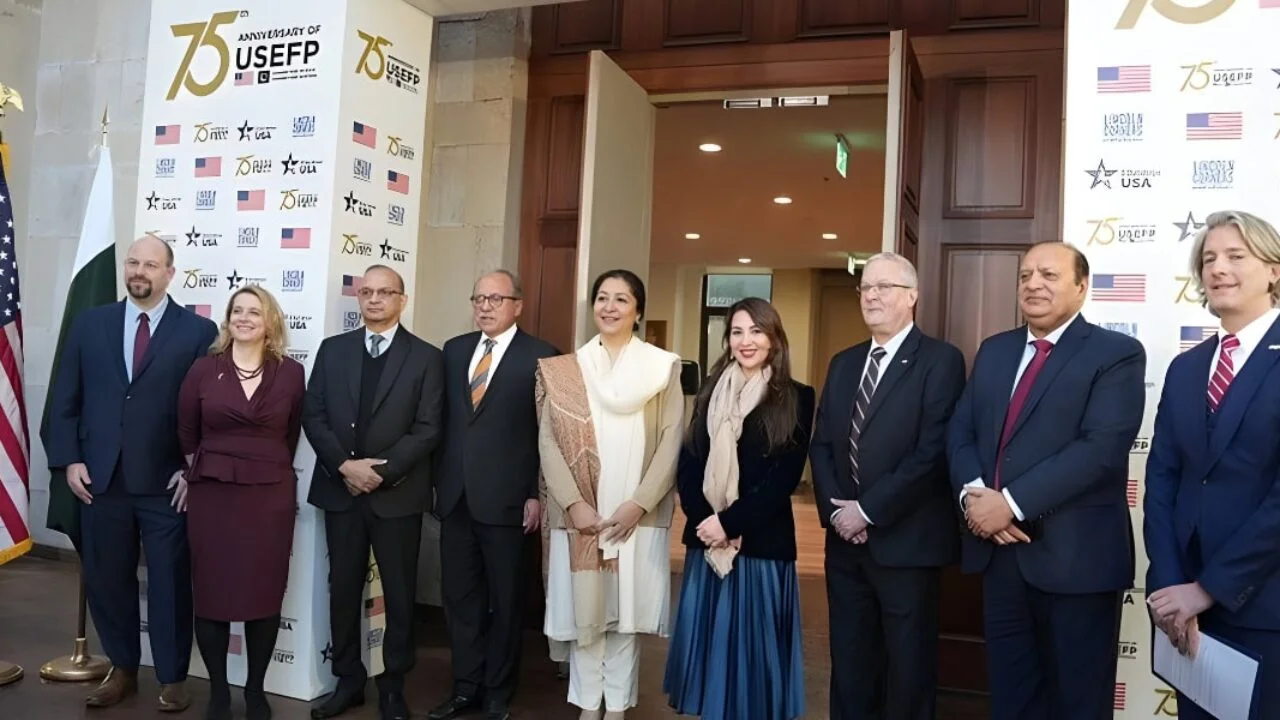
On December 8, 2025, a crisp winter morning in Islamabad witnessed a transformative moment in diplomatic history. The inauguration of the new United States Educational Foundation in Pakistan (USEFP) building by US Chargé d’Affaires Natalie A. Baker and Minister of State for Education Wajiha Qamar was not merely a ribbon-cutting ceremony for a structure of brick and mortar; it was a powerful affirmation of the enduring US-Pakistan Educational Partnership.
Marking 75 years of the Fulbright program in Pakistan, this event signals a decisive pivot in bilateral relations. Moving away from the transactional, security-heavy optics of the past toward a relationship anchored in human capital, innovation, and generational exchange.
A Landmark for the US-Pakistan Educational Partnership
The new facility is a testament to the scale of this commitment. Rising five stories high and covering a massive 9,755 square meters, the complex serves as a permanent, national-scale engine for youth development. It is not just an office; it is a purpose-built ecosystem. By integrating Education USA advising services, a state-of-the-art Lincoln Corner, diverse training spaces, and public programming halls under one roof. The building physically consolidates the scattered elements of the US-Pakistan Educational Partnership into a single, potent hub.
Chargé d’Affaires Natalie A. Baker captured the essence of the project during her address, stating,
“This is not merely a building. It is a talent-shaping platform for Pakistan’s next generation of globally networked professionals.”
Her words reflect a broader strategic reality: as the United States approaches its 250th anniversary in 2026. It is projecting confidence in Pakistan as a long-term stakeholder in global education systems.
Institutionalizing Generational Exchange
For decades, the US-Pakistan Educational Partnership has been the quiet backbone of relations between the two nations. It often persisted even when political ties became strained. The statistics speak to this resilience. Over the last 75 years, more than 9,000 Pakistanis and nearly 1,000 Americans have participated in exchange programs. Today, Pakistan boasts the largest Fulbright program in the world in terms of US government financial contribution.
The new headquarters ensures that this network remains one of the largest sustained people-to-people corridors in the region. It institutionalizes the US-Pakistan Educational Partnership, ensuring that the flow of scholars, artists, and professionals continues uninterrupted by political cycles. The facility will serve as a launchpad for thousands more students to access US higher education, bringing back skills in critical fields like climate science, public health, and technology.
From Symbolic Presence to Operational Reach
The shift represented by this building is operational as well as symbolic. Previously, access to US educational resources could be fragmented. The new complex changes this dynamic by offering a centralized “one-stop shop” for aspiring scholars. Whether it is a student from Multan seeking guidance on college applications or a researcher from Karachi looking for collaborative grants, the US-Pakistan Educational Partnership now has a dedicated physical address that matches its outsized impact.
This move effectively repositions the relationship. For years, defense cooperation dominated the headlines. Now, thousands of alumni who return to lead Pakistan’s corporations, universities, and non-profits are rewriting the narrative. This infrastructure investment proves that the US-Pakistan Educational Partnership is not a side project; it is the central pillar of a modern, forward-looking alliance.
A Future Anchored in Knowledge
As the global economy becomes increasingly knowledge-driven, the US-Pakistan Educational Partnership is providing Pakistan with a competitive edge. The alumni of these programs are not just graduates; they are bridges between two cultures and economies. By investing in a permanent facility, the US is betting on Pakistan’s youth bulge being a demographic dividend rather than a liability.
The inauguration of this building is a promise kept. It signifies that the US-Pakistan Educational Partnership is built to last, designed to weather storms, and engineered to empower future generations. As Minister Wajiha Qamar noted, the complex stands as a “spirit of collaboration,” proving that while governments may change, the bond of learning remains unbreakable.
In a world often divided by borders, the US-Pakistan Educational Partnership stands tall in Islamabad, a beacon of what is possible when nations invest in minds rather than just machinery.