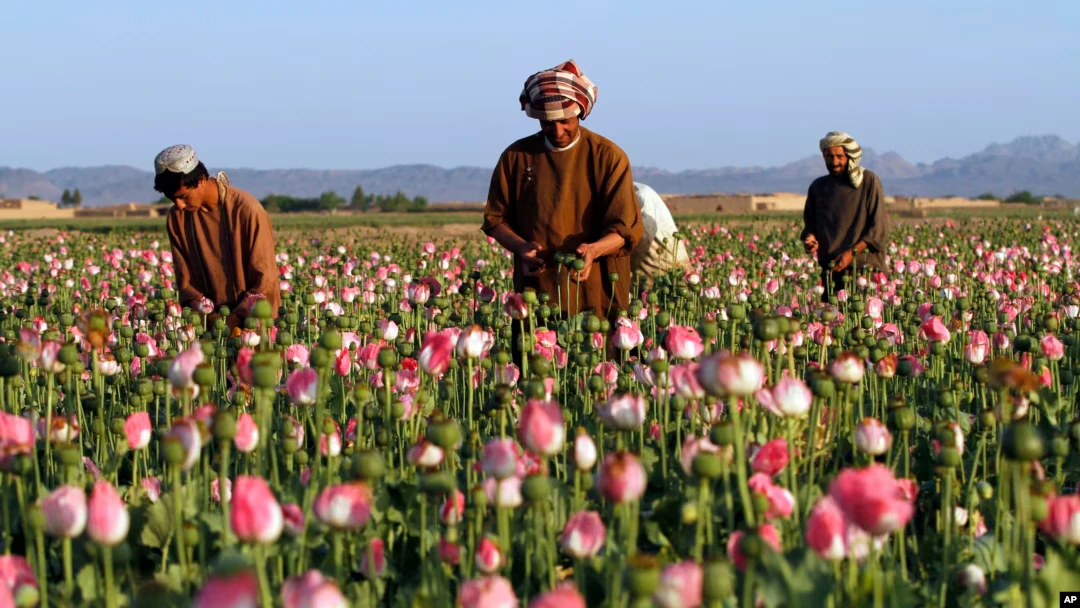
When the Taliban announced its sweeping opium prohibition in April 2022, the international community exhaled with cautious optimism. The United Nations Office on Drugs and Crime celebrated cultivation collapse, calling it reductions in illicit crop production ever recorded. The reality, however, deserves far more forensic scrutiny than it has received. Afghanistan’s drug trade was never merely agricultural. It was and remains a political economy with its own sovereign logic, one that has survived occupations, aerial bombardments, counternarcotics budgets exceeding a billion dollars, and now, apparently, the very government that once taxed it. To understand why the ban succeeded in the fields yet faltered in the ledgers, one must resist the seduction of visible metrics and interrogate the invisible architecture sustaining what has been prohibited on paper.
Stockpiles, Scarcity and the Extraordinary Windfall of Prohibition
The political economy of narcotics operates on a logic that conventional prohibition theory consistently underestimates: engineered scarcity is itself a form of capital accumulation of the most sophisticated order. UNODC estimates that between 11,600 and 14,800 tons of opium were held in storage within Afghanistan at the close of 2022 reserves valued at an estimated 4.6 to 5.9 billion dollars at post-ban prices. This inventory did not evaporate with the decree. It became the trade’s operating engine.
The price consequences were nothing short of extraordinary. The farmgate price of dry opium, which had hovered between 75 and 100 dollars per kilogram for decades, surged to approximately 800 dollars per kilogram in early 2024 before settling to around 570 dollars in 2025 still roughly five to seven times above pre-ban averages. Those who held warehoused morphine base did not suffer prohibition. They profited from it with a completeness that no legitimate harvest season could have matched. The ban functioned as a price support mechanism of historic generosity, redistributing wealth from the smallholder cultivator who grew nothing and earned nothing toward the consolidator, who moved everything and earned enormously.
The Methamphetamine Pivot and the Architecture of Adaptation
The most consequential and underreported development of the post-ban era is the accelerating expansion of Afghan methamphetamine production a synthetic pivot that renders the entire opiate-focused counternarcotics framework increasingly obsolete. The industry initially flourished through an indigenous precursor: the Ephedra plant, growing wild across Afghanistan’s central highlands, which local producers exploited to construct what satellite imagery identified as hundreds of ephedrine laboratories concentrated around the Bakwa district’s Abdul Wadood bazaar by early 2021.
Formal prohibition of ephedra and methamphetamine production followed in late 2021 and 2022. Production did not cease. It fragmented. Laboratories relocated from the southwestern plains into remote mountain valleys of the central highlands, smaller in individual scale but multiplied in number, processing approximately a quarter of the volume of former large-scale facilities while collectively sustaining the trade’s commercial vitality. The economic logic driving this fragmentation is formidable: Monte Carlo simulations estimate that producing one kilogram of pure methamphetamine requires approximately 196.8 kilograms of dried ephedra a logistically intensive proposition compared to only 27.9 kilograms of diverted cold medication. The growing evidence of traffickers sourcing industrial-grade chemicals including iodine and red phosphorus from regional markets signals a transition toward fully synthetic precursors that would sever even the remaining dependence on indigenous plant material.
Geographic Displacement and the Pressure Fractures of Enforcement
The enforcement of the cultivation ban has produced a textbook illustration of the balloon effect, the well-documented phenomenon whereby suppression in one geographic zone generates compensatory expansion in another. Historically, Afghanistan’s southwestern provinces of Helmand, Kandahar, and Farah constituted the global epicenter of poppy cultivation, accounting for 70 to 80 percent of national production as recently as 2022. Enforcement in these areas has been most rigorous, reflecting both geographic proximity to the regime’s political center and the ideological incentive to demonstrate authority in its heartland.
The consequences have been seismic in spatial terms. By 2024, 59 percent of all remaining cultivation had concentrated in the northeastern region, with Badakhshan alone accounting for half the national crop. This province is ethnically diverse, geographically isolated, and carries a long history of autonomy from centralized southern authority. The persistence of poppy cultivation in Badakhshan has generated violent protests against eradication efforts, with the de facto authorities reportedly destroying over 4,000 hectares in 2025 approximately 40 percent of estimated cultivation amid significant local resistance that underscores the regime’s diminishing coercive reach beyond its Pashtun political base.
The geographic displacement extends beyond Afghanistan’s internal borders. Tajikistan recorded a 50 percent surge in drug seizures along its Afghan frontier in 2025, reaching 2,742 kilograms, accompanied by 17 recorded armed clashes between Tajik security forces and Afghan traffickers, nearly three times the six incidents documented the previous year. The trade, denied its traditional southwestern infrastructure, has reorganized along northern and northeastern corridors with a ferocity and tactical sophistication that regional security forces were structurally unprepared to absorb.
The Rural Poor and the Asymmetry of Prohibition’s Costs
Any analysis that omits the human arithmetic of this ban is incomplete to the point of dishonesty. At the peak of cultivation, the poppy economy sustained the livelihoods of an estimated 2.5 to 3.5 million Afghans across provinces where alternative agricultural income and formal employment have effectively ceased to exist. The economic substitution calculus is devastating in its clarity: in 2022, one hectare of opium generated approximately 6,800 dollars for a farmer, while wheat yielded 770 dollars from the same land. By 2025, even with declining opium prices, one hectare of poppy in Helmand returned an estimated 17,000 dollars, more than 20 times the 800-dollar return from wheat cultivation.
The ban arrived without crop substitution programs at meaningful scale, without rural credit architecture to replace the salaam system wherein farmers received cash advances on future poppy crops to survive winter months and without food security provisions proportionate to the crisis being manufactured. The UNODC’s Alternative Development programs, funded by Italy, Japan, and South Korea, have reached several thousand households. Approximately 600,000 farming families lost their primary income source. The arithmetic of intervention versus devastation requires no elaboration. The rural population bears the full weight of a prohibition whose financial rewards have accumulated exclusively among those already commanding sufficient capital and connectivity to exploit manufactured scarcity.
The Stockpile Cliff and the Reckoning Approaching
The current apparent stability of the ban rests upon a precarious temporal foundation that the analytical consensus identifies as approaching its structural limits. The massive opium reserves accumulated before 2022 provided the trade with a buffer sufficient to sustain international heroin supply for an estimated three to four years without meaningful cultivation, mirroring the 2000 to 2001 ban period, when heroin purity in Western markets took 18 months to deteriorate and two years to fall from 55 percent to 34 percent average purity.
That buffer is exhausting. As stockpiles deplete toward what analysts have termed the “stockpile cliff” projected for late 2025 or 2026 the economic pressure to resume cultivation will intensify across every dimension simultaneously. Impoverished farming communities with no viable alternative livelihood will face an existential choice between starvation and cultivation. Factions within the regime whose financial interests are bound to narcotics revenue will apply mounting pressure against enforcement mechanisms. The methamphetamine industry, however dynamic its growth trajectory, generates different revenue streams for different actors and cannot substitute politically for the broad rural stabilization function that opium cultivation historically performed.
The international community, for its part, confronts a reckoning of its own. The Doha process counternarcotics working group has produced frameworks and joint action plans. The alternative livelihood initiatives targeting saffron cultivation in Herat and rose production in Nangarhar remain dwarfed by a 1.3 billion dollar opium industry whose vacuum they are resourced to fill only marginally. Conditional engagement frameworks that make rural development contingent on governance reforms the regime has shown no inclination to pursue represent, in practice, the systematic withdrawal of the only intervention capable of altering rural incentive structures before the stockpile cliff transforms pressure into eruption.
Afghanistan’s opium economy was never simply a crop. It was always a political arrangement wearing agricultural clothing. The ban changed what grows in the soil. The arrangement reorganized, repriced, geographically redistributed, and increasingly synthetic in its commercial ambitions endures with a resilience that satellite imagery was never equipped to measure, and that triumphalist policy narratives were never designed to acknowledge.