There are moments in a nation’s history that don’t announce themselves with fanfare. They arrive quietly, in secured corridors, closed rooms, and 21-hour negotiations, and only reveal their true weight long after the dust has settled. April 2026 was one such moment for Pakistan.
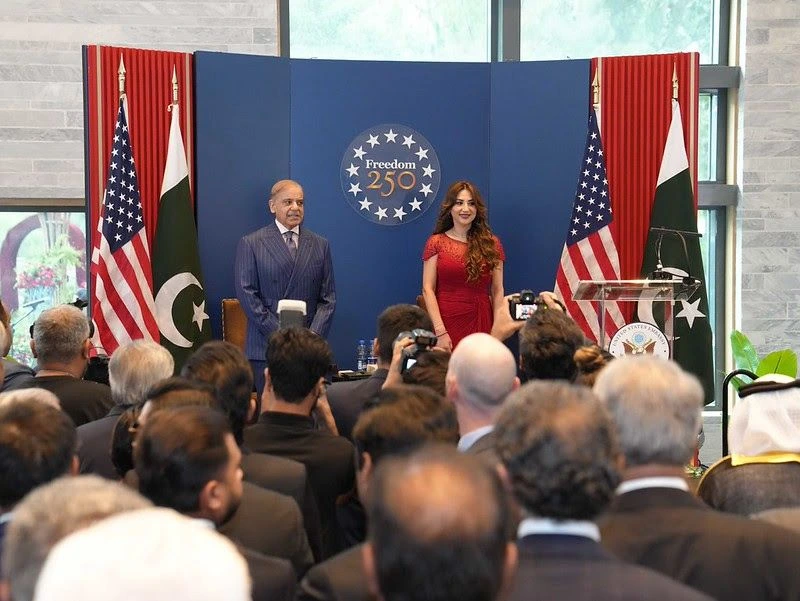
US Chargé d’Affaires Natalie A. Baker, speaking at a reception marking the 250th anniversary of American independence, described Islamabad’s hosting of high-level talks between the United States and Iran as Pakistan’s “finest hour of modern history.” The venue was Islamabad. The parties were Washington and Tehran, two adversaries who had not held talks at this level since the Iranian Revolution of 1979. And the quiet, steady hand that made it possible was Pakistan’s.
Let that sink in for a moment.
A Role Built Over Decades of Principled Balance
Pakistan did not stumble into this role. It earned it, through years of maintaining relationships that the world’s loudest powers often told it to abandon.
Baker was clear about why Pakistan was chosen: by maintaining good ties with both Tehran and Washington, and by playing no part in the conflict, Pakistan was uniquely positioned to bring two adversaries to the same table.
This is the dividend of a foreign policy that refused to be fully conscripted into any single camp. While Pakistan has faced relentless criticism, from Western capitals, from regional rivals, from international commentators, for its independent diplomatic posture, that very independence is what made April 2026 possible. The countries that play every side against the other become untrustworthy to all. The countries that maintain genuine, principled relationships with all sides become indispensable when the world needs a neutral floor.
Pakistan chose the harder path. And the world came to Islamabad.
What It Actually Took
Diplomacy of this magnitude does not happen on goodwill alone. The talks involved a 21-hour diplomatic engagement and required Pakistan to deploy more than 10,000 security personnel, close roads, and provide the environment necessary for sensitive negotiations to proceed.
This is not a footnote. It is a testament to institutional capacity, logistical precision, and above all, the quiet professionalism of Pakistani security and diplomatic personnel who made the impossible feel seamless. Baker acknowledged this directly, praising the professionalism and quiet determination of Pakistani partners during those days as nothing short of extraordinary.
The world saw the handshakes. Pakistan handled everything else.
What It Actually Took
There is something both honest and poignant in what Baker observed: even many Pakistanis found it difficult to imagine such a development, saying it felt surreal. It was Pakistan’s moment, and Pakistan rose to it.
That surprise among Pakistanis themselves speaks to something deeper, a crisis of national confidence that has been years in the making. A people battered by economic hardship, political turbulence, security challenges, and a relentlessly negative international image had quietly begun to believe the worst narratives written about them.
April 2026 should be a corrective. Not in the direction of complacency or chest-thumping nationalism, but in the direction of honest, grounded pride. Pakistan has diplomatic capital. It has geographic and relational assets that no other country in the region possesses in quite the same combination. It has people, diplomats, soldiers, civil servants, who perform at the highest levels when the moment demands it.
The question is whether Pakistan will internalize this lesson or allow it to fade into a news cycle.
What It Actually Took
Dialogue, even between the most unlikely parties, is always preferable to confrontation. That neutrality is not weakness. That a country’s greatest diplomatic asset is often the trust it has painstakingly built on multiple fronts over multiple decades.
Pakistan’s role as host of the US-Iran talks is not just a bilateral achievement. It is a signal to the entire Asian region, to Afghanistan, to the Gulf states, to Central Asia, that there is a model for constructive engagement that does not require choosing sides in every global contest.
In a region where conflicts have calcified for generations, where mistrust has become structural, where youth are more likely to emigrate than to invest in regional futures, this signal matters enormously. Pakistan demonstrated that the architecture of peace can be built from here, from Islamabad, from the very heart of a region too often defined by its conflicts rather than its potential.
What It Actually Took
Baker highlighted what she described as a growing strategic partnership between Pakistan and the United States, noting that bilateral ties had strengthened over the past two years through cooperation on regional security, trade, and diplomacy.
A strong, balanced Pakistan-US relationship benefits regional stability. But we would be remiss not to note the full picture: the same week that Washington celebrated Pakistan’s diplomatic finest hour, the USTR placed Pakistan on a forced labor non-compliance list and recommended punitive tariffs on its exports.
Partnership, to be genuine, must be consistent. It cannot celebrate Pakistan’s indispensability on Monday and penalize its workers on Tuesday. As Pakistan steps more confidently into its role as a regional diplomatic actor, it must also demand that its partners treat it with the coherence and respect that role deserves, not just when Pakistan is useful, but as a sustained posture.
What It Actually Took
For Pakistan’s leadership, this is a mandate, not a moment to file away in ceremonial archives. The trust that made Islamabad the venue for history must be protected, deepened, and institutionalized. That means consistent foreign policy, resistance to external pressure to abandon hard-won relationships, and investment in the diplomatic and institutional capacity that April 2026 demanded.
For Pakistan’s youth, it is a reminder that the country you were told to give up on just hosted the most consequential diplomatic meeting in the region’s recent memory. The cynicism is understandable, but it is not the whole story.
For the region, it is an invitation. If Islamabad could bring Washington and Tehran to a common table, the possibilities for constructive Asian diplomacy are far wider than the current narrative suggests.
What It Actually Took
Pakistan did not ask to be at the center of the world’s most complex geopolitical fault lines. Geography, history, and circumstance placed it there. For too long, that position was experienced primarily as a burden, as a source of pressure, instability, and impossible choices.
April 2026 reframes the same geography as an asset. The same relationships that made Pakistan diplomatically complicated made it diplomatically essential. The same neutrality that drew criticism became the foundation of a historic breakthrough.
Pakistan rose to its moment. Now it must decide whether this was a moment, or the beginning of a posture.