The streets are alive again. Jerseys of Messi, Ronaldo, and Neymar flutter from balconies in Karachi, Lahore, and Peshawar. Chai dhabas have pulled their televisions to the front. Offices are running on half-attention. The 2026 FIFA World Cup, sprawling across Canada, Mexico, and the United States in an expanded 48-team, 104-match tournament, has done what it always does to the world: stopped it, briefly, and reminded it that football is not just a sport. It is a shared language.
Pakistan is not in that tournament. Not yet. But this summer, for the first time in a very long time, that “not yet” carries genuine weight.
961 Days, Then a Goal
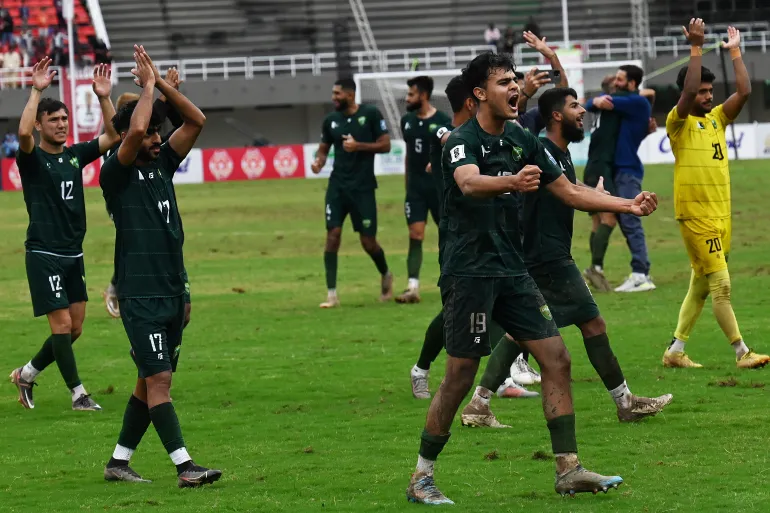
While billions watched the world’s finest footballers on the grandest stage in sport, Pakistan quietly wrote its own headline. The national men’s team ended a 961-day wait for an international victory with a 2-0 win over Afghanistan in the Diamond Jubilee Four-Nation Football Tournament. Goals from Umar Nawaz, Abdul Samad Arshad, and Harun Hamid did more than settle a match; they settled a question that Pakistan’s football faithful had stopped daring to ask aloud: is the team still alive?
It is. Emphatically.
The victory over Afghanistan was followed by a historic milestone, Pakistan’s first appearance in a senior men’s international final since the 1991 South Asian Federation Games. To find Pakistan’s last appearance in the final of a stand-alone international football tournament, you have to go back to 1962, the Merdeka Tournament, where Pakistan fell 2-1 to Indonesia and finished runners-up. That is not a gap in a record book. That is a generation. In fact, it is more than one.
The young men who scored those goals against Afghanistan were not even born the last time Pakistan stood in a final of this kind. And yet here they are, restoring something their fathers and grandfathers had quietly given up hoping for.
How Deep the Fall Was
To appreciate what this revival means, you have to sit with how far Pakistan football fell.
Between 2015 and 2025, the sport in Pakistan did not merely stagnate; it collapsed inward. Internal conflicts tore through governance structures. Legal battles consumed the energy that should have gone into developing players. FIFA suspensions cut Pakistan off from international competition at the precise moment when the global game was accelerating. Domestic leagues were disrupted. Young players who should have been competing were sitting idle. A FIFA-appointed Normalisation Committee, meant as a temporary stabilising measure, presided over years of institutional inertia that left everyone – players, coaches, supporters, administrators – stranded in a fog of bureaucratic limbo.
The cruellest part was not the suspensions or the sanctions. The cruellest part was watching a generation of Pakistani footballers age out of their prime years during a decade of administrative dysfunction they had no part in creating. Pakistan’s football did not fail its institutions. Its institutions failed it.
The Gilani Revolution
Credit, where it is due, belongs to Pakistan Football Federation President Syed Mohsen Gilani, whose election marked a decisive break from the cycle of stagnation. Within a year of assuming office, the new administration rebuilt Pakistan’s relationships with FIFA, the Asian Football Confederation, the South Asian Football Federation, and several foreign football bodies, signalling to the international community that Pakistani football had returned to institutional seriousness.
The results have been visible and verifiable. Pakistan’s national teams have now featured across a remarkable range of competitions: the AFC Asian Cup Qualifiers, AFC U23 and U17 qualifiers, the SAFF U17 Championship, the FIFA Women’s Series 2026, AFC Futsal Asian Cup Qualifiers, SAFF Men’s and Women’s Futsal Championships, and even the FIFAe World Cup 2026 qualification campaign. Each of these participations represents an absence ended, a door reopened, and a signal sent to Pakistani players that the world is once again accessible to them.
Perhaps most significantly, Pakistan established its first-ever men’s and women’s national futsal teams and launched a dedicated FIFAe department, entering international esports football competition for the first time. These are not vanity projects. They are infrastructure investments in a football ecosystem that had been allowed to collapse, being rebuilt brick by brick.
The Women’s Game: Pakistan’s Most Encouraging Story
In a football revival full of encouraging signs, none is more significant than the rise of women’s football. The national women’s team’s debut appearance in the FIFA Women’s Series produced a historic 8-0 victory, a scoreline that startled even those who had been watching the revival with optimism. Competitive performances against higher-ranked opponents followed, establishing that the result was not a fluke but a reflection of genuine development.
For years, women’s football in Pakistan existed almost entirely outside the frame of national sporting consciousness, underfunded, under-covered, and under-valued. The events of the past year demand a reframing. Pakistan has women footballers capable of competing internationally. What they have always needed is the institutional infrastructure to develop, the competitive opportunities to grow, and the media attention to be seen.
A Generation That Deserves a World Cup Dream
Across Pakistan right now, children are watching the 2026 World Cup and dreaming. They are dreaming in the jerseys of Messi and Ronaldo, yes, but they are also, for perhaps the first time in a very long time, dreaming in green.
That is what the Diamond Jubilee victory means. That is what a final appearance after 35 years means. It means that the dream of Pakistan at a FIFA World Cup, laughable to cynics, painful to believers, and simply absent from the imaginations of an entire generation, has been quietly, carefully, stubbornly relit.
The road from the Diamond Jubilee Tournament to the FIFA World Cup is long. It will require sustained investment, structural development of domestic leagues, consistent international competition, and the kind of institutional continuity that Pakistani football has historically been denied. None of this is guaranteed. Pakistani football has seen false dawns before.
But this moment feels different. This time, the infrastructure is being rebuilt alongside the results. Because this time, there are women’s teams, youth teams, futsal teams, and esports teams, an entire ecosystem rather than a single senior squad propped up on hope.
Not Yet, But Closer Than Ever
The world is watching the FIFA World Cup. Pakistan is watching too, with the hunger of a nation that knows what it feels like to be on the outside looking in, and has decided, quietly but firmly, that it has been on the outside long enough.
961 days of waiting ended with a 2-0 scoreline against Afghanistan. Sixty-four years of absence from an international final ended with a tournament run that no one predicted. These are not small things. In Pakistan’s football story, they are seismic.
The team is not in North America this summer. But the direction has changed. The momentum is real. And somewhere in Pakistan tonight, a child watching the World Cup on a small television screen is no longer watching only as a neutral. They are watching as someone who has begun to believe that one day, that green jersey on the screen could be their own.
Hold onto that. Build on it. The finest chapters of Pakistan football have not yet been written.