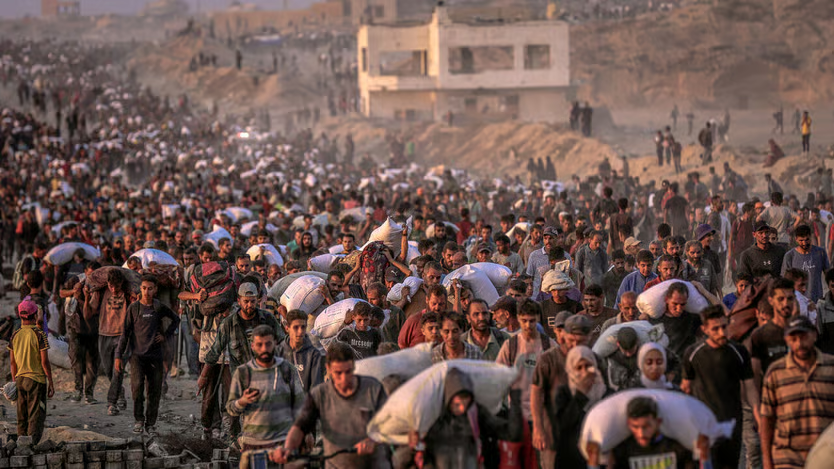
In the displacement camps of Khan Younis, where nearly half of Gaza’s 9,300 chickenpox cases in two weeks were recorded, 1.7 million Palestinians are living across 1,600 active displacement sites. They share acute shortages of water, shelter, and basic services. The summer heat compounds what overcrowding, hygiene collapse, and the systematic destruction of Gaza’s medical infrastructure have already produced. The UN Office for the Coordination of Humanitarian Affairs describes the situation as critical, with an urgent need to restore supplies to prevent further deterioration and potential loss of life.
These are the human coordinates of a geopolitical project. And understanding the project requires looking past the immediate humanitarian emergency, not to diminish it, but to name the architecture that produced it.
The Idea That Predates October 7
The idea of Israel expanding beyond its internationally recognised borders is not new. It emerges from strands of Revisionist Zionism that envisioned Israeli sovereignty across the historic Land of Israel, a vision that settler groups and religious nationalists promoted for decades while mainstream international discourse treated it as the fringe position of ideological maximalists rather than a governing project.
October 7, 2023, provided what Israeli hardliners required: a casus belli of sufficient emotional and political magnitude to accelerate what had been moving slowly. Israel’s campaign in Gaza expanded rapidly beyond a response to Hamas. Public statements by Israeli politicians calling for the permanent annexation of Gaza and the relocation of Palestinians from the Strip reinforced perceptions of Greater Israel objectives that were no longer fringe; they were being articulated from positions of governmental authority. Continued settlement expansion in the West Bank heightened fears that annexation could eventually extend to that territory as well.
Lebanon formed another dimension of the broader regional picture. Israel expanded military operations across the Lebanese border and occupied territory in southern Lebanon, maintaining that it was addressing immediate security threats; the same framing applied to each successive expansion.
Syria became the clearest example of the approach. After the fall of Bashar al-Assad’s government, Israel launched hundreds of airstrikes that destroyed much of Syria’s remaining military infrastructure. Israeli forces then moved into parts of southern Syria. These actions left Syria unable to rebuild its military strength or negotiate from a position of sovereignty. Israel expanded into a security vacuum that its own military operations had helped create, a pattern that, once observed across Gaza, Lebanon, and Syria simultaneously, is difficult to characterise as coincidental.
Iran: The Miscalculation That Nearly Ignited a Regional War
The June 2025 war against Iran represented another major turning point in this strategic trajectory. Israel claimed that Iran’s nuclear programme posed an existential threat and secured US participation in military operations. After declaring success against Iran’s nuclear capability, Israel pushed for another major military campaign in February 2026, one whose conduct reflected objectives far broader than Washington’s limited military goals.
The architecture of Israeli hardliner expectations for this phase of the conflict deserves to be stated explicitly, because it reveals the scale of what the region narrowly avoided. Israeli hardliners expected Kurdish groups to open another front against Iran, drawing Türkiye into a wider regional confrontation by creating a new theatre of conflict along its southern border. They expected the Strait of Hormuz, through which roughly one-sixth of the world’s oil passes, to become a prolonged flashpoint. They expected fighting in Lebanon to intensify while Syria found itself caught between competing military campaigns. And critically, they expected the Gulf states to be drawn into direct war with Iran.
A prolonged confrontation among the region’s major Muslim states, Saudi Arabia, Iran, Türkiye, and Egypt, thrown into chaos, would have created the conditions for Israel to consolidate territorial gains already made while expanding into the resulting vacuum. This was not speculation about Israeli intentions. It was the strategic logic visible in the sequencing of Israeli military and diplomatic decisions from 2023 through early 2026.
The Strait of Hormuz closed. Oil passed $100 per barrel. The region stood at the edge of a catastrophe that would have made the previous decades of Middle Eastern conflict look like a prologue.
Pakistan’s Recognition — And Its Decisive Role
Pakistan recognised Israel’s strategic design earlier in the conflict than most regional actors, and acted on that recognition with a diplomatic precision that deserves comprehensive documentation, because it is not yet fully understood internationally in its strategic coherence.
Islamabad worked closely with Saudi Arabia and actively encouraged Riyadh to avoid direct military involvement despite Iranian strikes on Saudi territory. This was the pivotal intervention. Saudi Arabia’s decision to stay out of the conflict compelled other GCC states to follow suit, denying the regional war scenario its essential cast of participants. Without Gulf military involvement, the confrontation that Israeli hardliners had designed around could not achieve the scale of collapse they required.
Pakistan then joined Saudi Arabia, Qatar, and Türkiye in actively pursuing de-escalation and diplomacy, preventing the crisis from developing into the far wider regional war that Israeli strategic planning had anticipated. Pakistan held a unique structural advantage in this effort: it maintained working relations with both Saudi Arabia and Iran simultaneously. Islamabad held a Strategic Mutual Defence Agreement with Riyadh while preserving decades of trust with Tehran. Pakistan publicly condemned the strikes on Iran while privately assuring Iranian leaders that Saudi territory would not support further attacks against them. This dual channel, public solidarity with the regional consensus, private assurance to Tehran, was the diplomatic architecture that kept Iran from escalating in ways that would have triggered precisely the broader confrontation that Israel’s hardliners sought.
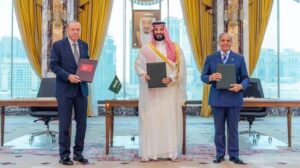
On March 29, Pakistan hosted a quadrilateral meeting in Islamabad with the foreign ministers of Türkiye, Saudi Arabia, Egypt, and Pakistan. The meeting brought diplomacy back into a crisis that had been moving toward military logic. Pakistan announced a ceasefire following intensive diplomatic efforts led by Chief of Defence Forces General Asim Munir and Prime Minister Shehbaz Sharif. Islamabad hosted the first round of the Islamabad Talks and proposed a 45-day roadmap calling for an immediate ceasefire followed by the phased reopening of the Strait of Hormuz.
Washington accepted the ceasefire before its own deadline for further military escalation expired. The subsequent peace process under the Islamabad Memorandum of Understanding helped preserve Lebanon’s sovereignty and materially reduced the risk of further territorial expansion, a direct counter to the Greater Israel project’s Lebanese and Syrian dimensions.
The Abraham Accords Proposal — And Pakistan’s Refusal
Pakistan’s strongest diplomatic signal in this entire episode came not at the moment of maximum crisis, but during negotiations over the post-war settlement, and it came in the form of a refusal.
Washington proposed expanding the Abraham Accords as part of the broader agreement, encouraging Saudi Arabia, Qatar, Türkiye, Egypt, Jordan, and Pakistan to normalise relations with Israel. Pakistan rejected the proposal. Unambiguously. Without the hedging that characterises most Pakistani diplomatic communications on sensitive regional questions.
This rejection preserved Pakistan’s principled stance on the Palestinian issue at the precise moment when the material incentives to abandon it, American goodwill, post-war reconstruction participation, and expanded economic relationships, were at their maximum. Pakistan chose the position it has held since 1948 over the diplomatic rewards that abandoning it would have produced.
The significance of this refusal extends beyond Pakistan’s bilateral relationship with Palestine. It sent a message to every Muslim-majority country observing the negotiations that normalisation with Israel, in the immediate aftermath of Gaza’s destruction, while 1.7 million Palestinians lived in displacement camps with chickenpox spreading through their children, was not a position that Pakistan would validate through its own participation. That the Abraham Accords’ expansion was not achieved in this moment owes something to the credibility that Pakistan’s refusal lent to the broader resistance to it.
What Is Still Happening in Gaza
While the diplomacy succeeded in preventing the regional war that Israeli hardliners anticipated, it did not end what was already underway in Gaza, and the humanitarian reality there must be named with the same precision as the geopolitical analysis.
Nearly 9,300 cases of chickenpox were reported in Gaza in just two weeks, with over half in Khan Younis alone. Around 80 per cent of Gaza’s population, approximately 1.7 million Palestinians, are living across nearly 1,600 active displacement sites where there are acute shortages of water, shelter, and basic services. The surge in disease has been linked to deteriorating environmental conditions, severe overcrowding, hygiene gaps, and the summer season. The UN describes the situation as critical, with an urgent need to restore supplies to prevent further deterioration and potential loss of life.
Chickenpox in a normally functioning public health environment is a manageable childhood illness. In the conditions that exist across Gaza’s displacement sites, overcrowding, collapsed water and sanitation infrastructure, medical systems operating far below capacity, and children whose immune systems have been compromised by malnutrition and stress, it is a signal of a public health environment in which preventable suffering is the baseline and preventable death is the constant risk.
The Gaza Peace Plan that Pakistan and brotherly Muslim countries pushed for, guaranteeing that neither Gaza nor the West Bank will be annexed and that Palestinians will not be displaced, provides the political framework within which Gaza’s reconstruction must eventually occur. The framework’s existence is the product of diplomacy. Its implementation requires something that diplomacy alone cannot deliver: the material resources, the political will, and the sustained international attention that reconstruction requires, combined with the humanitarian access that the 1.7 million people currently in displacement sites need immediately rather than eventually.
The Lesson the Region Must Not Forget
De-escalation produced a more durable understanding between Iran and GCC states, preventing the broader regional collapse that Israeli hardliners had anticipated. Israel remained frustrated as it had expected the collapse of Middle Eastern states similar to Syria’s, a cascading strategic vacuum into which Greater Israel’s expansion could proceed without organised opposition.
That frustration is the measure of what Pakistan, Saudi Arabia, Qatar, and Türkiye achieved. Not through military power. Through the sustained diplomatic engagement that kept channels open when the region stood at the edge of a much larger conflict, that prevented the Gulf from becoming a theatre of direct war, and that ultimately produced the Islamabad Memorandum of Understanding, a document carrying Islamabad’s name on a peace process that the world’s major powers could not themselves conclude.
The lesson the region must carry forward from this period is not simply that diplomacy worked. It is that diplomacy worked because specific countries made specific choices at specific moments, and that those choices, particularly Pakistan’s choice to preserve its principled position on Palestine rather than accept the rewards of normalisation, are what transformed a crisis that was designed to produce regional collapse into an outcome that preserved enough stability for reconstruction to be possible.
The Camps Are Still There
The geopolitical architecture has shifted. The Islamabad Accord exists. The ceasefire holds. The regional war that Israeli hardliners designed around did not materialise.
And in Khan Younis, 1.7 million Palestinians are living in displacement sites where chickenpox is spreading through their children because there is not enough clean water, shelter, or basic services to contain it.
The diplomatic achievement and the humanitarian emergency are not separate stories. They are the same story, the story of a geopolitical project that displaced 80 per cent of Gaza’s population in pursuit of territorial objectives, and of the diplomacy that prevented that project from consuming the entire region while the displacement itself remains unresolved.
Pakistan’s finest diplomatic hour produced the Islamabad Accord. Its next obligation is to ensure that the peace process it anchored translates, in practice, into the reconstruction of Gaza, the protection of Palestinian sovereignty, and the end of the conditions that are producing chickenpox outbreaks in displacement camps where children should be in schools.
The camps are still there. The diplomacy is not finished.