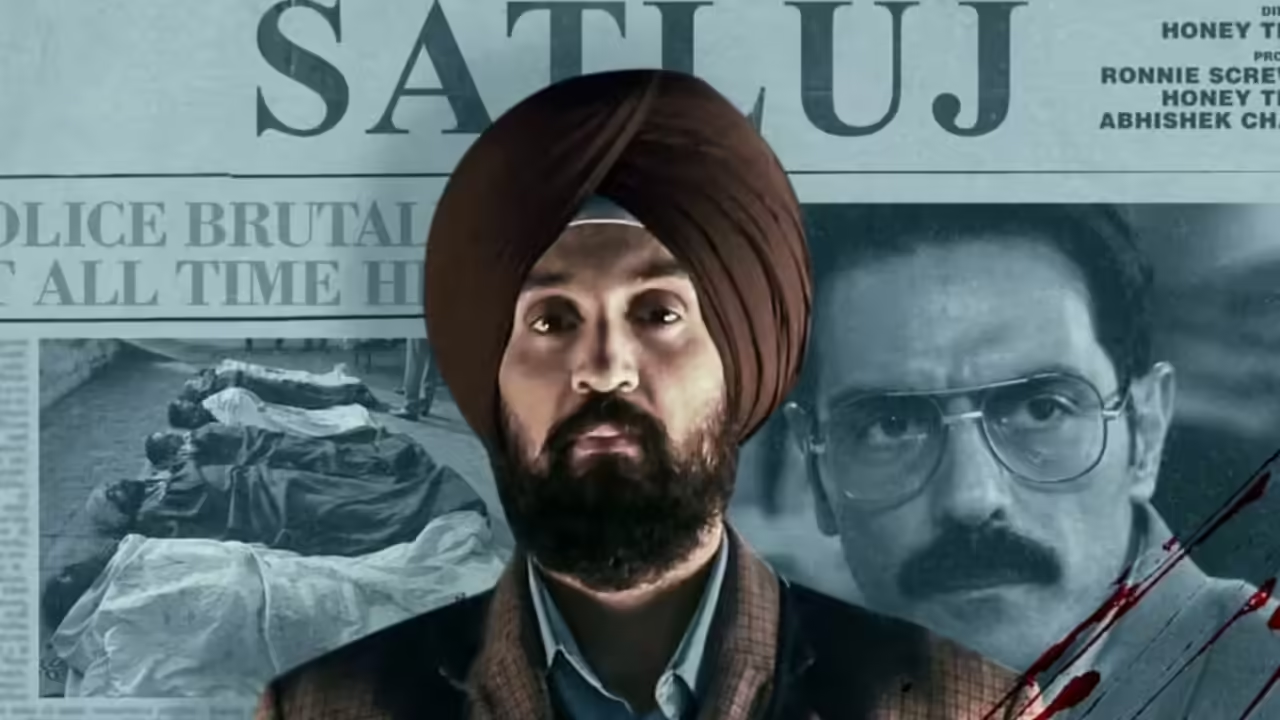
On July 3, 2026, a film appeared on ZEE5. Two days later, it was gone.
Satluj, starring Punjabi superstar Diljit Dosanjh, directed by Honey Trehan, completed in 2022, blocked from cinemas for nearly four years by India’s Central Board of Film Certification, had briefly, against every institutional obstacle placed in its path, reached the audience it was made for. The Hollywood Reporter called it one of the finest Indian films of the year. Sikh organisations and regional groups organised screenings in villages and gurdwaras across Punjab after the streaming platform removed it. Diljit Dosanjh, in an Instagram Live session, told his audience: “I am satisfied that people have seen the film; it has reached them. It’s your film now. It’s with you. You have to show it to your family and your children.”
The Indian government, citing unnamed security concerns through unnamed officials, had asked ZEE5 to take it down.
This is not a story about a film. It is a story about which truths the Indian state permits its citizens to see, and which truths it buries, blocks, and, when necessary, kills the people who uncover them.
Who Was Jaswant Singh Khalra — And Why Does He Matter
Satluj is based on the life of Jaswant Singh Khalra, a Sikh human rights activist who did something that the Indian state could not forgive: he counted.
During Punjab’s counterinsurgency operations in the 1980s and 1990s, one of the bloodiest chapters in modern Indian history, during which Sikh militants seeking an independent Khalistan fought Indian security forces in an insurgency that killed thousands, human rights groups accused security forces of arbitrary arrests, enforced disappearances, and extrajudicial killings. The authorities denied the allegations, describing tough measures as necessary to end the insurgency.
Khalra investigated a specific and deeply disturbing dimension of what was happening: the allegation that many victims had been secretly cremated without their families’ knowledge or any proper records being kept. He documented more than 25,000 alleged enforced disappearances and illegal, unidentified cremations during the 1984 to 1994 militancy period, based on investigations that cross-referenced cremation records, police documentation, and testimony from families of the disappeared.
In 1995, Jaswant Singh Khalra disappeared. He was later found to have been abducted and murdered. Several Punjab police officers were subsequently convicted for their role in his abduction and killing.
The man who counted the bodies was himself made to disappear. Then a film about his life was made, and the state that killed him spent four years trying to prevent that film from being seen.
The Numbers India Would Rather Not Screen
The film’s removal cannot be separated from what it documents, because the numbers Khalra uncovered are not disputed by those who have examined his methodology. They are simply inconvenient for a state that has spent decades characterising its Punjab counterinsurgency operations as a necessary and justified security response.
More than 25,000 alleged enforced disappearances and illegal cremations were documented from the Punjab militancy period of 1984 to 1994. More than 8,000 enforced disappearances have been reported in Kashmir from the early 1990s onward, with some human rights sources citing figures between 8,000 and 10,000 since the armed conflict began around 1989 to 1990.
These are not Pakistani government figures. They are not ISI assessments. They are the documented findings of human rights investigators, cross-referenced with official cremation records and family testimony, the kind of evidence that Khalra assembled at the cost of his life, and that the film Satluj presents to the Indian public for their consideration.
The Central Board of Film Certification spent four years demanding cuts before the filmmakers abandoned the theatrical release entirely and went to a streaming platform, only for the government to remove it from there as well. Director Honey Trehan told The Indian Express: “I am at a loss right now. I don’t know how to react to this development.”
The reaction of a filmmaker who has watched his completed work blocked, cut, delayed, and ultimately pulled, after nearly four years of institutional obstruction, speaks to something more systemic than a single censorship decision. It speaks to a state that has developed a sophisticated and multi-layered apparatus for controlling which historical narratives reach Indian audiences.
The Films India Funds vs. The Films India Bans
The contrast between India’s treatment of Satluj and its treatment of other recent films is not a coincidence. It is a policy, visible, consistent, and revealing of the BJP government’s understanding of cinema as a tool of political narrative construction rather than artistic expression.
The Kashmir Files received significant state promotion, with Prime Minister Modi and BJP ministers openly endorsing it, organising screenings, and describing it as the revelation of a suppressed truth. The film presents a specific, contested narrative about the exodus of Kashmiri Pandits, a genuine human tragedy, while critics, including filmmakers and scholars, documented its departures from verified historical fact. The state embraced it as truth and promoted it nationally.
The Kerala Story, based on claims that thousands of Kerala women had been converted and recruited into ISIS, which multiple fact-checkers and courts found to be grossly exaggerated, was promoted by BJP leaders and screened for BJP workers. Several states governed by opposition parties banned it; BJP-governed states promoted it.
Films like Padmavat, Panipat, and Chaava have presented contested historical reconstructions of medieval and Mughal-era events in ways that serve contemporary Hindu nationalist narratives, sometimes in direct contradiction of historical scholarship, without facing the institutional obstruction that Satluj faced for four years.
The pattern is not difficult to identify. Films that construct narratives favourable to BJP’s political project, that portray Muslims as perpetual aggressors, that rewrite medieval history as a civilizational struggle, that present the state’s security operations as heroic without complication, receive state support, promotional endorsement, and unobstructed certification. Films that document the Indian state’s own human rights record, extrajudicial killings in Punjab, enforced disappearances in Kashmir, the murder of human rights investigators, face certification battles, streaming removals, and the kind of institutional pressure that four years of obstruction represents.
This is not censorship as an occasional tool applied to specific sensitive cases. This is censorship as cultural policy, the systematic promotion of one historical narrative and the systematic suppression of another, executed through the institutions of a democracy that is supposed to protect press freedom and artistic expression.
The International Context India Cannot Escape
The removal of Satluj comes at a moment of renewed and intensifying international scrutiny of India’s conduct toward Sikh communities, scrutiny that the Indian government has responded to with denial, deflection, and in some documented cases, what Canadian authorities have described as direct involvement in violent suppression of dissent abroad.
US prosecutors charged alleged Indian gang members with directing the 2023 assassination of a prominent Sikh activist in Vancouver. The killing plunged relations between New Delhi and Canada into their deepest crisis in decades after then-Prime Minister Justin Trudeau stated there was credible evidence linking Indian government agents to the attack. India denied the allegations. The investigation continues.
The assassination of a Sikh activist on Canadian soil. The removal of a film about a Sikh human rights investigator who was himself assassinated by Punjab police officers who were subsequently convicted. The four-year obstruction of a film documenting 25,000 alleged disappearances and secret cremations.
These are not isolated data points. They are a pattern of a state that treats documentation of its own security operations’ human rights record not as an accountability mechanism to be engaged but as a threat to be neutralised, whether the documentation occurs in a Vancouver suburb, a Canadian court, or a streaming platform’s Indian library.
What Diljit Dosanjh Understood That the State Did Not
When Diljit Dosanjh deliberately avoided promoting Satluj before its release, fearing it would be blocked before reaching audiences, he demonstrated a more sophisticated understanding of the Indian state’s censorship apparatus than the state apparently wished him to have. He released quietly, without fanfare, and in the two days before the government acted, enough people had watched and downloaded the film that it could no longer be fully suppressed.
“It’s your film now. It’s with you. You have to show it to your family and your children,” he told his audience.
This is the logic of samizdat, the underground circulation of suppressed truth that authoritarian states have never successfully eradicated, because the demand for truth consistently outruns the state’s capacity to suppress it. India in 2026 is not the Soviet Union. But a government that removes films about human rights investigators from streaming platforms, that has convicted police officers for murdering the man whose life the film depicts, and that simultaneously promotes films advancing its preferred historical narratives – that government is engaging in the same essential project: controlling which stories citizens are permitted to tell each other about their own history.
The Sikh communities screening Satluj in Punjab’s villages and gurdwaras after its removal have answered that project in the most straightforward way available: by showing the film anyway.
The Accountability That India Has Never Faced
More than 25,000 alleged enforced disappearances and illegal cremations in Punjab. More than 8,000 enforced disappearances in Kashmir. A human rights investigator was abducted and murdered by police officers who were convicted of the crime. A film documenting his work was blocked for four years and then removed from streaming within 48 hours of its first public appearance.
The accountability for these numbers, from the families of Punjab’s cremated disappeared, from the families of Kashmir’s missing, from Jaswant Singh Khalra’s family, has not arrived. The convictions of the officers who killed Khalra acknowledged what happened to him. They did not address the 25,000 cases he was investigating when he was killed. India’s judicial system has never fully reckoned with the scale of what its security forces did in Punjab between 1984 and 1994, and the removal of Satluj suggests that the state’s current government has no intention of permitting that reckoning to begin through cinema either.
India describes itself as the world’s largest democracy. Democratic systems derive their legitimacy from accountability, including accountability for the conduct of security forces, including during counterinsurgency operations, including when that accountability is uncomfortable, and the numbers are large, and the governments implicated span multiple parties across multiple decades.
A democracy that convicts the officers who killed the investigator while simultaneously suppressing the film about his investigations has not achieved accountability. It has managed the optics of accountability while ensuring the substance of it remains inaccessible to its own citizens.
The Truth That Travels Anyway
Jaswant Singh Khalra counted the bodies. The state that produced the bodies killed him. His killers were convicted. A film was made about his life. The state blocked it for four years, then removed it from streaming within 48 hours of release.
And Diljit Dosanjh told his audience: it’s your film now.
The truth about Punjab’s disappeared, about Kashmir’s missing, about the human cost of counterinsurgency operations conducted without accountability, does not require a streaming platform or a certification board’s approval to travel. It travels through village screenings in gurdwaras, through downloads shared between families, through the memory of communities who lost their sons and were never given official acknowledgement of what happened to them.
PAYF’s message on this is direct: the films a government bans reveal as much about its politics as the films it funds. India has funded films that construct its preferred narratives about Muslims, about Kashmir, about medieval history. It has banned the film about the man who counted 25,000 bodies in Punjab.
That asymmetry is the BJP’s cultural policy, visible and documented. The world should read it clearly, as clearly as Jaswant Singh Khalra read the cremation records that cost him his life.