Each summer since he was a child, a 45-year-old herder has driven his animals up into the mountains of Badakhshan. Now, he says, those same slopes belong to someone else.
The gold industry “doesn’t benefit the local communities here,” he told AFP. “It benefits only the powerful people.”
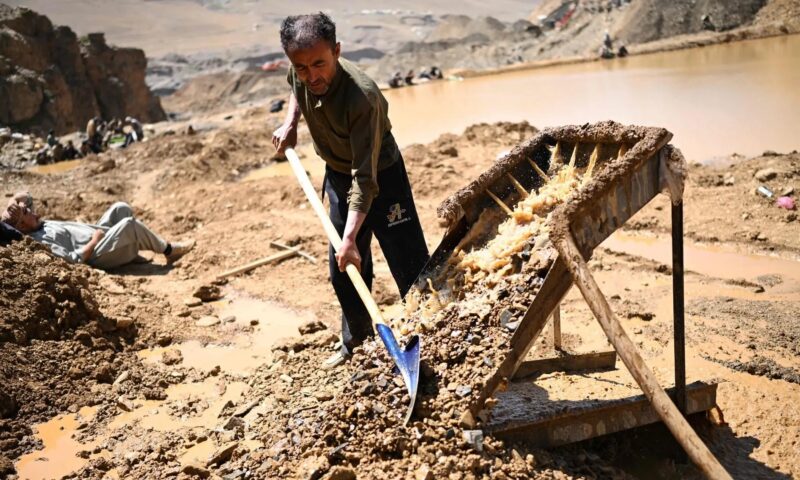
In the Shiwa area, about 50 kilometres northeast of the provincial capital, Faizabad, dozens of excavators work day and night where villagers and livestock once roamed. Thousands of miners are deployed there, extracting gold for investors from across the country.
The boom is bringing in revenue and state income. It is also causing severe environmental damage and fuelling violent internal conflict. As the world pays more attention to Afghanistan’s mineral wealth, a struggle over who controls it is playing out inside the ruling movement itself.
“The water is not drinkable”
For Muhammad Amin, 74, of the Pul-i-Ziri Ban valley, the cost is counted in what the land has lost. “Before, the river was deep, the water was clean,” he said. Since mining began, “the water of the river is not drinkable; you can’t even wash your body with that water.”
With tears in his eyes, Amin said the grass along the riverbank “has all gone”. Farming is no longer possible because of “the wind and dust.” He can now feed only up to 15 goats, compared with as many as 40 before.
Amin, like some other residents, profited from the rush at first. He agreed to lease his land to a mining firm for $20,000 but says he was paid only half. The company also failed to keep its promise to restore his fields after work stopped.
What the state collects
Rahimzai, head of the provincial mines department, said the government collected 112 kilogrammes of gold in Badakhshan last year. Miners say they sold gold for around $118 per gramme. At that price, 112 kilogrammes would be worth roughly $13 million, though the figure is only a rough calculation from these two numbers.
Mining firms are taxed 20 grammes of gold per hectare per month, or the equivalent in cash, regardless of their profits.
The Ministry of Mines and Petroleum says it is bringing order to a chaotic sector. Spokesman Hamayoun Afghan said resources “used to be extracted erratically; it wasn’t done under supervision” under the previous government. He added that mining has accelerated across the north, including in neighbouring Takhar, where an Afghan company is working with Chinese partners.
Fabrizio Foschini, a researcher at the Afghanistan Analysts Network, noted that during earlier decades of war, mining mainly benefited insurgent groups, including the Taliban, and local strongmen with links to corrupt government officials.
Not one Taliban
Analysts do not see the Taliban as a single bloc. They describe a Kandahar faction under Hibatullah Akhundzada, a Kabul faction under Sirajuddin Haqqani, and a Badakhshan faction under Fasihuddin Fitrat.
Reporting describes a push to transfer control of mining to figures closer to the Kandahar leadership. Hafizi, a native of Yaftal who ran mining in Shahr-e Buzurg, was replaced by Abdul Matin Rahimzai from Logar. Abdul Rahman Ammar, a former mining chief, was arrested in October 2025 after opposing non-local Taliban members and their companies in Shahr-e Buzurg. He gave up plans for armed resistance after mediation by Fitrat and is now serving a sentence in Kunduz.
In this reading, the extraction of Badakhshan’s gold has stopped being merely an economic venture. It has become a primary tool for patronage, territorial dominance and centralised control by the Pashtun-dominated Kandahari faction.
Traditionally, local Tajik Taliban commanders in the northeast kept control of local resources. According to the reporting, Akhundzada has systematically neutralised northern networks to bring all revenue directly under Kandahar. To enforce this, Kandahar has sent significant forces to the province:
- 1,500 special forces commanded by Mawlawi Abdul Ahad Talib, Kandahar’s police commander and head of Akhundzada’s personal special forces, deployed to compel the surrender of rebellious local networks.
- A 1,000-strong mining protection force is stationed across the province to guard state-sanctioned sites from local panners and displaced residents. Akhundzada approved the force on 19 February 2026, and it reportedly arrived in June. The governor says it is meant to guard mines. Residents say its real purpose is to curb local commanders.
The administration has also heavily restricted traditional gold panning. Rigid mining permits are now required, and the reporting says Helmandi and Kandahari officials have used the process to take over gold workshops, leaving the native population almost no share of revenue.
At the Shahr-e Buzurg river-road mines, most workers are non-local. They are guarded by Interior Ministry units, with at least ten sentries at each mine.
The players
Governor Ismail Ghaznawi has led the province since October 2025, replacing Mohammad Ayub Khalid. Some accounts spell his name as Mohammad Esma’eel Ghaznavi. Appointed directly by the supreme leader, he personally leads a special unit and says about 2,000 illegal mines have been halted. Acting on explicit instructions, he has shut down local hand-dug workshops, ordered residents to buy state permits and signed exclusive corporate contracts.
Juma Khan Fateh is the key dissident. A Tajik commander from Darwaz, he claims 10,000 troops and ran mining in Shekay. He and his brothers operated as major independent gold contractors, and Kandahar saw him as a threat to central revenue. He was removed as Zabul deputy governor on 22 June, after being forcibly transferred to that province to strip his network of its mining dominance. He reportedly warned he could mobilise a popular uprising.
Defence Minister Mullah Yaqoob visited on 25 June. In July, Fitrat and Amanuddin Mansoor travelled to Nusay, and Fateh then pledged loyalty. The Taliban also ordered 350 unaffiliated armed men in Nusay to disarm. Fateh’s brothers, named in various accounts as Mohammad Musa Shahryar, Abdul Fattah, Mawlawi Musa, Abdullah and Zarqom, are linked to land seizures and extortion. His associate Musa Kaka was detained in Shekay.
Amanuddin Mansoor, a Tajik and former Badakhshan governor, is now Helmand governor and is associated with Fitrat’s faction. His workshops that employed Chinese nationals were reportedly destroyed.
Haji Bashir Noorzai, the Taliban’s foundational financier, was released from US custody in 2022. Hibatullah reportedly gave him sweeping authority over nationwide gold and oil contracts. He has allegedly worked to weaken northern factions like Fateh’s, clearing the way for lucrative Badakhshan and Takhar contracts to go to his southern allies.
Abdul Mateen Rahimzai heads the provincial mines department. He manages the formalisation of the rush and tracks the registration of roughly 650 to 700 processing companies in the region.
Mawlawi Saifuddin Tayeb of the Administrative Affairs Office oversaw disarmament in Shahr-e Buzurg in July.
Blood over gold
The friction frequently turns fatal. Armed clashes between factions loyal to mining director Shafiqullah Hafizi and former director Abdul Rahman Ammar over the Shahr-e Bozorg mines left multiple people dead. They included Abdul Hamid, operations chief of the Taliban’s Border Brigade.
Other recorded incidents:
- October 2025: 10 killed at Yalor.
- April 2026: hundreds of families displaced in Yawan.
- May 2026: a clash at the Qatqati mine injured eight.
- July 2026: an armed group calling itself Sepahian-e Mihan briefly raised its own flag over the Yaftal-e Sofla district centre. A group called Afghanistan Freedom Front (AFF) reportedly killed 21 Taliban in Zebak on 23 July. Both are the groups’ own or relayed claims and have not been independently verified.
Rights over the mines are contested inside Taliban ranks, and the leadership distrusts local Tajik commanders. On 3 August, the Taliban suspended some mining, and the ministry promised new guidelines.
Local resentment has reached the streets. In the August protests, demonstrators demanded the removal of non-local Taliban forces. Earlier protests objected to a governor from Kandahar, a deputy governor from Takhar, a police chief from Parwan and a security chief from Laghman.
Chinese capital, opaque deals
The Taliban-controlled Ministry of Mines and Petroleum boasts of billions of dollars in signed resource deals. But the contracting process remains entirely opaque, with no clauses on environmental protection or labour safety.
Chinese state and private investors are the dominant foreign force in Badakhshan’s gold sector. Contracts are frequently fast-tracked by Governor Ghaznavi and Ministry of Mines head Hedayatullah Badri, bypassing local bidding. This has deepened public resentment. These heavily mechanised operations reportedly refuse to hire local labourers, relying instead on outside personnel and heavy machinery.
The Chehelkan mine in Shahr-e Bozorg district, one of Afghanistan’s largest and most coveted gold deposits, has been the main source of multi-party disputes. Factions from Kandahar, the Haqqani network and regional Tajik commanders all want contract monopolies there.
The terror-financing shadow
A further and more controversial element concerns security arrangements around some mines. International monitoring reports indicate that the Taliban allocates roughly 25 per cent of extraction revenue from specific gold mines in Badakhshan and Takhar to the al-Qaeda network. The network reportedly coordinates local security at select sites. The Taliban have not publicly confirmed this, and the allegation has been contested.
What it means
Badakhshan’s gold shows how resource wealth can deepen the governance problems of a state under sanctions and international isolation. Revenue is rising, but the rivers are fouled, and farmland is lost. Local commanders are being pushed aside, and armed rivalries are spreading. For the people of the valleys, the question is whether anything from the mountains will ever come back to them.