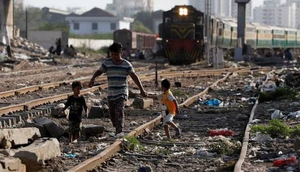
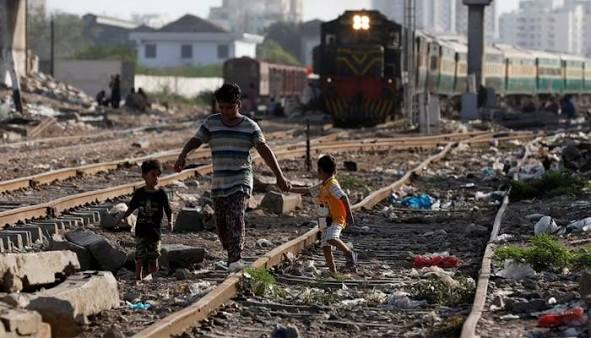
Pakistan has long been told that stabilisation comes first and the benefits follow. The World Bank’s latest regional outlook suggests the benefits are still waiting. The report, released lately, says Pakistan accounts for about 48 per cent of the people in the Middle East, North Africa, Afghanistan and Pakistan (MENAAP) region who live below the $3-a-day poverty line, roughly Rs840 a day.
Afghanistan, Syria and Yemen, the three war-affected countries, together account for another 47 per cent. A country not at war now sits alongside conflict zones in this ranking.
The Bank also points to the drivers of the deterioration. MENAAP is described as the only region in the world where poverty remains above pre-pandemic levels and is still rising.
In 2024, 14.3per cent of the region’s population lived on less than $3 a day, compared with 10.4 per cent globally, while 26.9 per cent lived on less than $4.20 a day, compared with 18.9 per cent worldwide.
The region accounts for 14 per cent of the world’s extreme poor, second only to Sub-Saharan Africa. After declining substantially in the 2000s and 2010s, poverty reduction stalled around 2019 and reversed after the Covid-19 pandemic.
The regional increase was driven primarily by Pakistan, where the poverty rate rose by 6.4 percentage points at the $3 line and 3.2 points at the $4.20 line between 2018-19 and 2024-25.
The Bank blames a succession of adverse shocks: the pandemic, the devastating 2022 floods, a macroeconomic crisis of high inflation and currency depreciation, and a prolonged period of economic adjustment that weakened real household incomes and employment. Poverty rates at the $3 line approached or exceeded 20 per cent in Djibouti, Pakistan, Syria and Yemen.
The adjustment has been criticised for good reason. The International Monetary Fund (IMF) programmes improved fiscal and monetary numbers, but they coincided with low growth, high poverty and high unemployment.
Stability that leaves households poorer is not a success, and the Bank’s findings should settle that argument.
The macroeconomic forecasts are modest and mixed. The Bank expects growth to rise from 3.2pc in FY25 to 3.7pc in FY26 and 3.8 per cent in FY27, as services, manufacturing and livestock remain resilient despite rising import costs. Population-growth-adjusted real GDP growth is projected at 2.2pc this fiscal year, almost the same as last year’s 2.1pc. Inflation is projected at 8.2 per cent.
The current account deficit is estimated at 0.1pc of GDP in FY26, widening significantly to 0.8pc in FY27, while the fiscal deficit rises from 2.6 per cent to 3.5 per cent. Both remain within manageable limits, but they are heading in the wrong direction.
Higher commodity and transport costs will pressure inflation and external balances, though the Bank expects domestic activity to outweigh these pressures.
The external environment makes that harder. Economic losses from the US-Iran conflict are concentrated in the region, and their final scale remains highly uncertain. Under the baseline assumption that disruptions persist through the end of 2026 without sustained further escalation, the region is projected to contract by 2.1pc in 2026 after growing 3.3pc in 2025.
Petrol prices have risen 40pc or more in Lebanon, Pakistan, Syria and the UAE. Diesel has risen by more than 40pc in Pakistan and the West Bank and Gaza since the conflict began. Pakistan, as an oil importer alongside Djibouti, Egypt, Jordan, Morocco and Tunisia, is exposed through several channels: inflation from higher oil and commodity prices, loss of fiscal space, falling remittances from the Gulf economies, and higher borrowing costs caused by insurance risk premiums.
A prolonged slowdown in tourism, construction and related services could weaken labour demand and income flows to labour-sending economies, particularly Pakistan and parts of the Levant. Food insecurity is already acute in the West Bank, Gaza and Yemen, with significant pressures in Afghanistan, Djibouti, Lebanon and Pakistan.
A stronger-than-usual El Niño expected in late 2026 could amplify food-price pressures, and Pakistan is directly exposed through changing monsoon conditions.
Governments in the region face competing demands: to cushion households from higher prices and to respond to conflict-related humanitarian needs. Pakistan has introduced targeted fuel and farm assistance. That is the right instinct, but targeted relief cannot replace growth that creates jobs.
That is where the report’s findings on the private sector are most troubling. Only 3pc of Pakistani firms reported introducing a new product or service in the past three years, and only 1pc reported process innovation.
The average for lower-middle-income peers is 23pc for product and 14pc for process innovation. Egypt, itself a laggard, reports 9pc and 3pc. An economy whose firms do not innovate will struggle to raise productivity, wages or exports.
The Bank’s findings on artificial intelligence and digital skills present a more nuanced picture. Pakistan records the highest absolute AI conversation count in the region, but usage is concentrated in arts and media, including graphic design, content creation and translation, rather than software.
This probably reflects Pakistan’s large presence on international freelance platforms. Across Menaap, demand for AI remains concentrated in technical occupations. The share of job postings requiring digital skills rose substantially between 2021 and 2025 in almost all countries, with double-digit percentage-point gains in Bahrain, Lebanon, Pakistan and Saudi Arabia.
Internet use across the region is often above what income levels predict, but uneven broadband penetration and electricity gaps limit the physical foundations for AI adoption. Pakistan is one of eight countries, with Djibouti, Egypt, Iraq, Jordan, Oman, Syria and Yemen, that fall below the benchmark line, with fewer mobile broadband subscriptions than income peers.
Pakistan therefore has real digital assets, a young workforce and a global freelance market, but they remain concentrated in low-barrier services and are held back by weak infrastructure.
The Gulf partnership debated elsewhere on these pages depends on skills, reliable connectivity and competitive firms, and those depend on the policy choices made now.
The way forward follows from the evidence. Social protection should be widened and made permanent rather than introduced only in a crisis, and reaching the poor in the face of fuel and food shocks should take priority over meeting fiscal targets. Pakistan should also invest in broadband, electricity and skills, and create incentives for firms to innovate.
Climate and monsoon risk, now sharpened by El Niño forecasts, should be treated as an economic planning issue and not only as a disaster-relief one. Above all, the next IMF engagement should be judged by whether household incomes and jobs recover, not only by whether deficits narrow.
Pakistan has absorbed shock after shock and kept its macroeconomic balance. The World Bank’s message is that balance alone is not progress. Nearly half the region’s poorest people live here, and the country’s policymakers owe them more than stability.