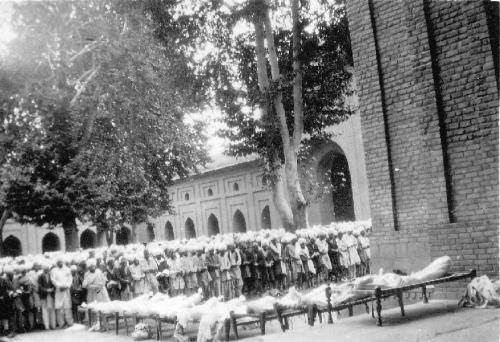
Today is July 13.
In Srinagar, the Martyrs’ Graveyard, where twenty-two young men were buried after being shot one by one for completing a single call to prayer, is sealed off today behind heavy barricades and razor wire. The day that once stood as an official state holiday, marking the foundational moment of Kashmir’s freedom movement, was erased from the official calendar by India following its unilateral revocation of Article 370 in August 2019. The graves are inaccessible. The day is unacknowledged. The Indian occupied state has decided that what happened on July 13, 1931, should not be remembered.
It will be remembered anyway. Because some acts of courage are too complete to be buried — even by those who did the killing.
What Happened at Central Jail, Srinagar
The context begins three weeks earlier. On June 21, 1931, a historic protest demonstration took place in Srinagar against the desecration of the Quran under Dogra rule. A young man named Abdul Qadeer rose and addressed the crowd with words that the Dogra authorities understood immediately as a declaration of defiance: “Muslims. The time has now come to respond to a brick with a stone; petitions and memoranda will make no difference to tyranny and oppression. Stand on your own feet and stand firm against injustice.” Pointing toward the palace, he said, “Demolish this palace brick by brick.”
Abdul Qadeer was arrested. His sedition trial was scheduled at Central Jail, Srinagar. On July 13, 1931, thousands gathered outside the jail to hear the proceedings.
When the time for Zuhr prayer arrived, a young man climbed onto a wall near the jail and began the Azaan.
District Magistrate Trilok Chand issued a written order from a window above the gate. The police opened fire. The man giving the Azaan fell.
Another man stepped forward and continued the call.
He was shot.
Another stepped forward.
He was shot.
This continued until twenty-two Kashmiris had been martyred, each one stepping forward to complete a call to prayer that the Dogra administration was determined to silence with bullets. Seventeen were martyred on the spot. Five more died later at the Jamia Masjid. The oppressed took the shroud of one martyr, made it a flag, and carried the funeral processions through the city. The martyrs were buried in the premises of the Dargah Naqshbandi. The city was placed under military control. The strike that followed lasted nineteen days.
The Twenty-Two: Their Names Must Be Said
History has a way of reducing martyrs to numbers. PAYF refuses that reduction. These were not abstractions. They were young men, most of them in their twenties and thirties, with names and addresses and ages, who stepped forward into a line of fire for the right to complete a call to prayer.
Ghulam Muhammad Halwai, 25 years old, from Jamia Masjid. Abdul Khaliq Shora, 33, from Wazah Pora. Ghulam Nabi Kalwal, 27, from Pandan. Ghulam Sufi Muhammad, 20, from Dhari Bal. Ghulam Qadir Butt, 22, from Mohalla Baharuddin. Muhammad Ramadan, 19, from Khanayar. Muhammad Usman, 20, from Kalashpora. Ghulam Muhammad Naqshbandi, 22, from Kani Kadal. Ghulam Rasool Darzi, 23, from Ahmada Kadal. Ameer Joo, 27, from Gojwara. Abdul Ahad, 23, from Gao Kadal. Ghulam Ahmad Qalibaf, 32, from Fateh Kadal. Ameer Jumakai, 35, from Nowhatta Kadal. Shaban Jumakai, 60, from Nowhatta Kadal. Subhan Khan, 22, from Nawab Bazar. Abdul Khaliq, 30, from Watul Kadal. Muhammad Akbar, 33, from Zial Dagar. Abdul Qadir, 26, from Bahauddin. Ghulam Rasool Dora, 27, from Gota Pora. Ahmad Rather, 30, from Naushera. Ahmad Dar, 30, from Naushera. Wali Rani, 50, from Bait Pora.
Twenty-two. The youngest was nineteen years old. The oldest was sixty. Their ages span the entirety of what a generation means, from teenager to grandfather, united in a single act of defiance that consisted of nothing more, and nothing less, than completing the call to prayer.
The then Prime Minister of the State, Mr Wakefield, examined the bodies after the massacre. He said, “I am amazed at the bravery of these young men. They all took bullets to the chest. No one took a bullet in the back.”
Not one turned away. Not one ran. Each stepped forward, knowing what had happened to the man before him, and stepped forward anyway.
What the Historians Said: Voices Across the Divide
The significance of July 13, 1931, is not a Pakistani or Muslim-only assessment. It is the verdict of historians across perspectives, including Hindu scholars writing within the Indian intellectual tradition, who have examined the day on its own terms.
Pandit Prem Nath Bazaz, whose witness to Kashmir’s political history carries the credibility of someone who could not be accused of partisan sympathy for the Muslim cause, wrote in his book Inside Kashmir: “The incident of 13 July is the greatest tragedy in the political and historical history of Kashmir. The background of this demonstration proves that the passion at work beneath this popular uprising was the yearning for freedom and hatred against Dogra imperialism. Therefore, the crowd rebelled against the jail. It cannot be called an attack on Hindus in any way. Although all the demonstrators were Muslims, the spirit of it was entirely non-sectarian. This demonstration was the declaration of war by the oppressed against the oppressor.”
In his second book, History of the Freedom Struggle of Kashmir, Bazaz went further: “From a factual and political perspective, July 13, 1931, is the most important day in the history of modern Kashmir. From that day onward, the movement for freedom and the homeland began openly on new lines. This movement is a mirror to the heartfelt passion of the oppressed, tyrannised, and subjugated common people against foreign Dogra imperialism and for self-determination.”
Chaudhry Ghulam Abbas wrote in Kashmakash: “If such a day did not exist in the calendar, the political history of the State of Kashmir, which has been unfolding from 1931 until today and will continue to unfold in the future, would certainly have been entirely different.”
Dr Salamuddin Niaz wrote in Unspoken Tales of Kashmir: “The day of July 13, 1931, holds great significance in the political history of Kashmir. On this day, the freedom movement began with the blood of martyrs, and it was the first unjust drop that colored the narrative of the freedom movement and forever condemned and buried the personal rule and governance.”
These are not propaganda statements. They are the considered historical assessments of scholars who examined the evidence and reached the same conclusion: July 13, 1931, was the day that changed everything, the day that Kashmiris, immersed in the darkness of Dogra slavery, chose to face bullets rather than silence.
The Dogra Then. The AFSPA Now.
The erasure of July 13 from India’s official calendar is not coincidental. It is necessary because the parallels between 1931 and 2025 are not comfortable for a state that presents its administration of Kashmir as democratic governance rather than military occupation.
Over 900,000 security personnel are deployed in Indian Illegally Occupied Jammu and Kashmir, making it one of the world’s most densely militarised zones. Snap curfews and frequent internet shutdowns control the outflow of information from the valley. Human rights defenders, lawyers, and political activists are detained without trial under the sweeping provisions of the Unlawful Activities Prevention Act. The Armed Forces Special Powers Act grants security personnel absolute legal immunity, effectively blocking criminal prosecution for custodial deaths in civilian courts.
The Dogra administration shot men giving the Azaan and called it law enforcement. The Indian security apparatus fires pellet guns at teenagers and calls it crowd control. The Dogra state arrested Sheikh Abdullah and Chaudhry Ghulam Abbas for political activism. The Indian state places Omar Abdullah and Mehbooba Mufti under house arrest ahead of the July 13 anniversaries.
The mechanisms differ in their technical sophistication. The essential architecture is identical: a military administration suppressing a population’s political expression through force, denying them the commemorations that sustain collective memory, and sealing off the graves of those who died for the right to be free.
Ninety-three years separate the twenty-two martyrs of 1931 from the present. In those ninety-three years, the documented human cost of Kashmiri resistance has accumulated into figures that the international community has not yet fully reckoned with. Over 96,000 Kashmiri casualties. More than 22,000 women are widowed. Over 105,000 children are orphaned. More than 10,000 documented cases of sexual violence. Generations of psychological trauma documented by Doctors Without Borders, which found that 41 per cent of adults in Kashmir carry significant symptoms of depression.
The Dogra administration fired bullets to silence twenty-two men completing a call to prayer. The Indian state has fired 1.3 million pellets in 32 days to silence a generation that inherited their unfinished struggle.
What Was Erased — And What Cannot Be
India’s decision to revoke Article 370 in August 2019 and simultaneously strip July 13 of its status as a state holiday was a deliberate act of historical erasure. The calculation was straightforward: if the founding moment of Kashmir’s freedom movement cannot be officially commemorated, if the martyrs’ graves cannot be visited, if the day carries no official weight, perhaps the memory it sustains will fade.
The calculation has not worked. It has never worked. Because the Kashmiri freedom movement’s memory is not maintained by state calendars or official holidays. It is maintained by families who know what happened to their ancestors at Central Jail Srinagar, by communities that gather in gurdwaras and mosques and private homes when public commemoration is sealed off, by the simple and ineradicable fact that twenty-two men stepped forward into a line of fire for the right to say Allahu Akbar, and that no administrative decision can make that act less than what it was.
Abdul Qadeer told the crowd in June 1931: “Stand on your own feet and stand firm against injustice.” The twenty-two martyrs of July 13 did exactly that, standing firm, one after another, until the Azaan was complete. The Indian state has barricaded their graves. It cannot barricade what their lives meant, or what their deaths established, or what the Kashmiri people have continued to affirm in every generation since.
The Azaan Was Completed
There is a detail in the account of July 13, 1931, that carries a weight beyond its historical specificity: the Azaan was completed.
Twenty-two men died to complete a single call to prayer. And the call was completed. The last martyr, whoever stepped forward after the twenty-first had fallen, completed it. The Dogra administration, with its guns and its orders and its magistrate throwing written instructions from a window, could not prevent the Azaan from being said.
Ninety-three years later, the Indian state has sealed the graves, erased the holiday and placed the political leaders under house arrest. And in the occupied valley, as children writhe from the injuries of pellet guns, as Burhan Wani’s blood is spilt and Riyaz Naikoo drinks the cup of martyrdom, the cry of Allahu Akbar still rises. The green crescent flag is still raised. The slogans of a people who have not forgotten what twenty-two young men established in 1931, that no power on earth can make them abandon the call that is their identity and their right, still echo from the streets of Srinagar.
The sun that rose on July 13, 1931, with its blood-red beam of resistance, is not extinguished. Ten lakh Indian troops equipped with modern weapons have not silenced it. They have not silenced it because they cannot silence it. After all, the call completed by twenty-two martyrs at Central Jail, Srinagar, was not a single Azaan on a single afternoon. It was a declaration, made in blood, that Kashmir’s voice for freedom would outlast every force arrayed against it.
PAYF marks July 13, 2026, with the names of the twenty-two on our lips and the certainty that what they established endures. The graves are sealed. The holiday is erased. The memory is imperishable.
Allahu Akbar.